



Intercropping boosts income, environment in island province









On Hainan Island, finding ways to adjust to loss of forest from rubber-production process
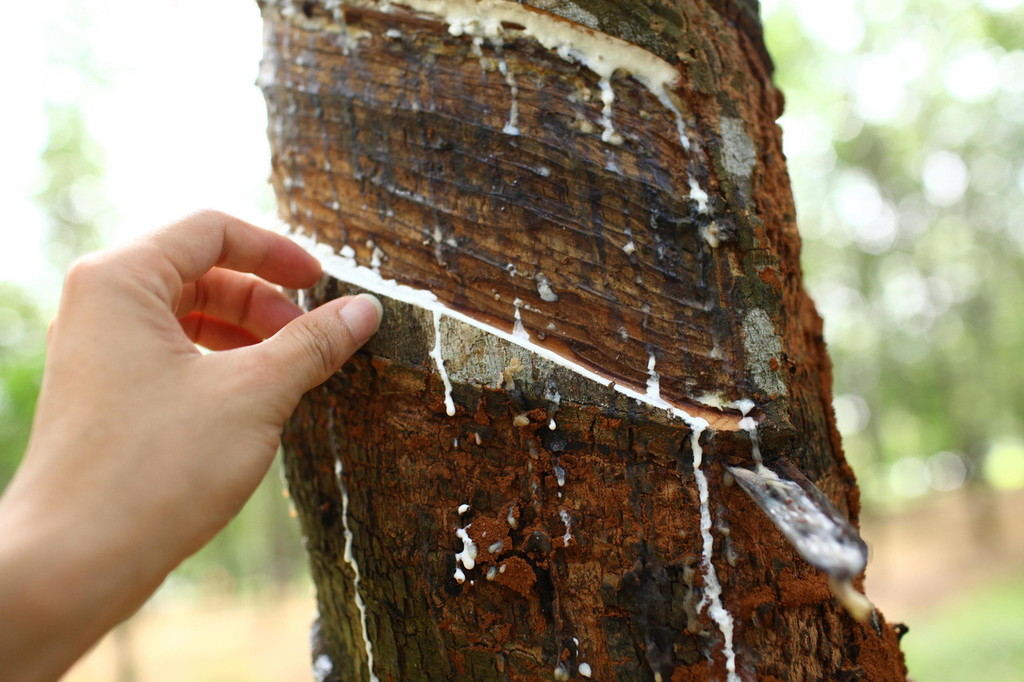
Rubber has always been the primary product on China's Hainan Island, a province that is the nation's southernmost point known for its tropical climate, beach resorts and forested, mountainous interior.
Hainan's rubber plantations have been expanding to supply tires for China's booming auto market, now the largest in the world. While providing jobs and income, the rubber production surge also led to an extensive loss of the island's natural forest, which benefits soil retention and flood mitigation. Rubber's ancillary effects also posed a danger to the island's coral reefs — a key tourist attraction.
A recent case study involving Hainan's rubber plantations and researchers from Stanford University, Canada's McGill University and the Chinese Academy of Sciences revealed that farmers and operators who took environmental concerns into account doubled their income while reducing their reliance on a single harvest.
It's an approach that also produced environmental benefits for the land, and the results suggest this could help farmers worldwide protect not only the environment, but their livelihoods as well.
In 2010, Gretchen Daily, director of the Stanford Natural Capital Project and a professor at Stanford University, arrived on Hainan Island.
"At that time (Hainan), had experienced its worst flooding in 50 years," Daily recalled. "There were also problems with infrastructure like roads and the island's fishing industry. With that vulnerability in mind, we set out to see what could reverse the rapid deforestation that was happening on the island."
Rubber production on Hainan was an example of monoculture farming (the agricultural practice of producing or growing a single crop) which maximizes crop yield. "Twentieth-century monoculture farms greatly increased agricultural production, but at a huge price," noted Daily.
Researchers looked at land use and land-cover changes in Hainan Island over a 19-year period of rubber plantation growth. Pairing that information with survey data from island households, they used software to understand how changes in land use management could have garnered different results.
In particular, the researchers looked at one key land management change: a technique called intercropping that involves cultivating other valuable plants in the understory of a main crop.
Daily and the researchers came up with the idea of planting crops like areca nuts and other high-value products in the space between the rubber tree trunks on Hainan. "Adding in other crops besides rubber helped to diversify and improve farm income (many of the crops had a higher margin than rubber) and also reduced the environmental risks from converting the island's forests to produce rubber," Daily said.
Zheng Hua of the Research Center for Eco-Environmental Sciences at the Chinese Academy of Sciences in Beijing was the lead author on the study. He said that initially many of the rubber farmers were reluctant to plant the new crops.
"The main reason why they were skeptical of implementing them is the market price changes. The market price of agricultural products (like rubber) is one of the main factors influencing rural household livelihoods. For example, the price of rubber in 2006 was 20 yuan per kilogram. However, in 2017, the price of rubber was about 8 yuan per kilogram," Zheng said.
Daily also said rubber farmers were concerned that the additional crops would take away nutrients from the soil and "diminish the productivity of the rubber trees".
Those fears proved to be unfounded, said Daily, as rubber production was equal to the yield before the additional crops were added. "Farmer income doubled because these were high-margin crops."
The environmental benefits include less sediment runoff, better flood control and a reduction in pollution runoff that was going into drinking water supplies, said Daily. All of this also reduced the stress on the coastal areas and the coral reefs to help the tourism industry on the island.
Zheng said China's government has encouraged others to apply this agricultural practice called the "Ecological Development Strategy".


- Fudan University reveals top 10 scientific and technological advances of 2025
- Shenzhou XXI astronauts complete handover, ready for returning to Earth soon
- Weak safety may have led to mine blast
- 7 scientists win Shaw Prize in 2026
- Skills seen as key to future job openings
- Hong Kong opens expanded terminal 2 after airport upgrade





