



Relocation of herders helps restore ecosystem around Xinjiang lake









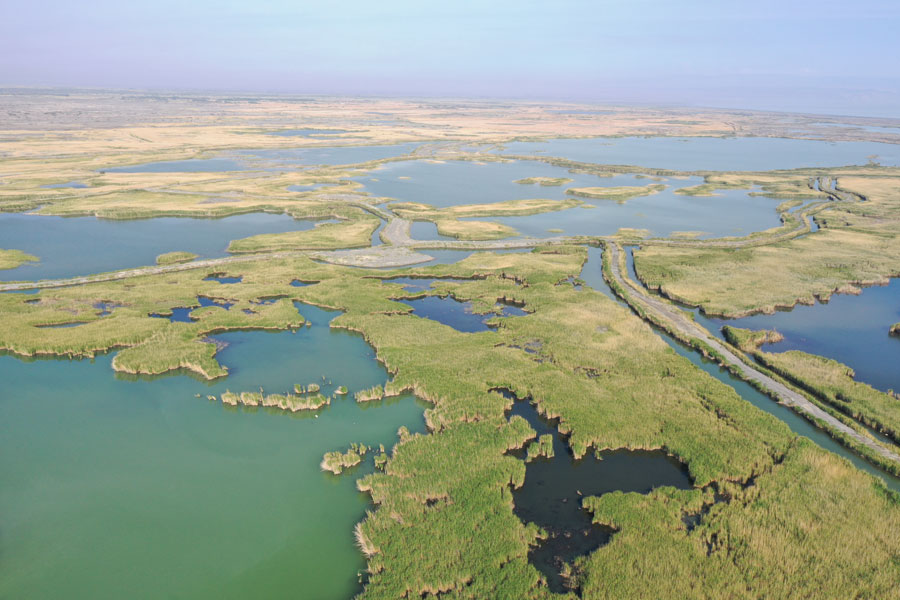
URUMQI - Sitting in his spacious new house, Sarhtibek Haoslikhan is quite content with his life.
"I have spent half my life herding, and I never imagined living in a big house like this," said 48-year-old Sarhtibek.
Decades ago, many Kazakh people chose to settle near the Ebinur Lake in Xinjiang Uygur autonomous region.
The lake area was known for its abundant sources of water and grass, and the people thrived there.
But many years of herding coupled with the over-exploitation of underground water damaged the ecosystem.
The area later became one of the sandiest places in China and featured frequent sandstorms.
However, a government relocation program helped restore the environment there in recent years.
The program was launched in 2015, and 54 Kazakh families that were living within the Ebinur Lake Wetland National Nature Reserve were asked to move to Alataw Pass, a city about 40 kilometers away.
Despite the lack of electricity and tap water in the lake area, Sarhtibek and his neighbors were reluctant to move.
"We would love to live in a city, but we were simply worried," Sarhtibek said. "Herding was the only thing we could do. How could we survive after moving to a new place?"
To help ease their concerns, authorities arranged a series of support measures.
"We worked with authorities of Alataw Pass and provided the herdsmen with basic living allowances, houses and favorable policies in medical and educational areas," said Yao Shuyin, a nature reserve official.
The herdsmen were also invited to attend a series of training sessions organized by the local government to help prepare them for a new urban life.
In 2017, Sarhtibek sold all his cows and sheep and joined the first group of families to relocate from the nature reserve. Sarhtibek and his wife managed to find jobs, which guarantee a monthly income of more than 6,000 yuan ($873). More than 180 of Sarhtibek's neighbors followed suit.
The relocation program, which included the relocation of companies and artificial precipitation, helped restore the ecosystem in the nature reserve. These days, wild animals such as red deer and goitered gazelles can be seen in the area again. The lake's area has been expanding, too.
"I am just happy that the environment near the lake is getting better," Sarhtibek said.
Xinhua


- China's second homegrown large cruise ship completes maiden sea trial
- Breathtaking views and smooth brews draw foreign fans to Yunnan coffee week
- Rain conjures ink-wash cloudscape over Hebei's Langya Mountain
- Robots transform Pudong airport expansion project
- Mainland welcomes Taiwan compatriots in joint space exploration: spokesman
- Chinese scientists develop novel method to differentiate neurodegenerative diseases





