


Subsidies help soybean farmers grow their business










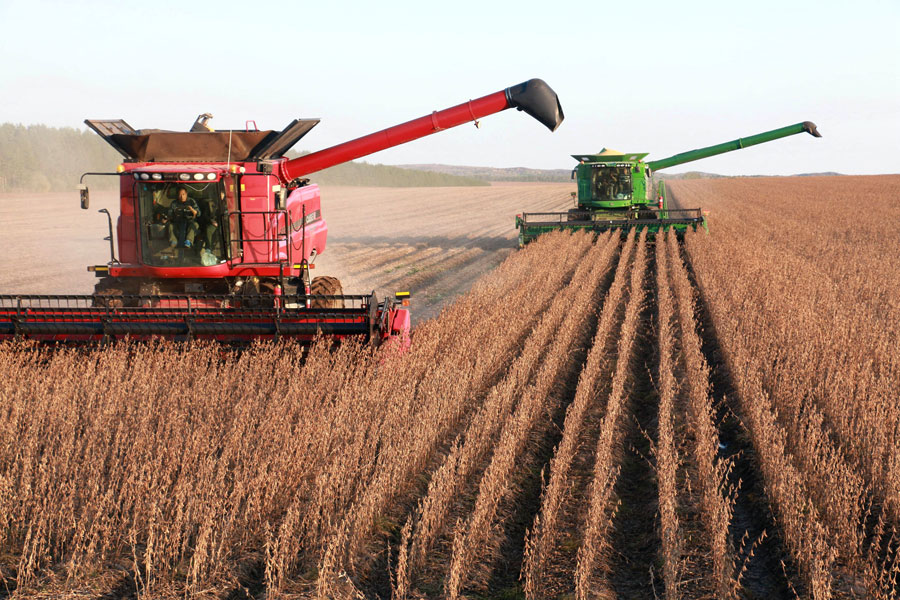
Of the city's 400,000 hectares of farmland, nearly 70 percent is devoted to soybean crops, all of them nongenetically modified products, he said.
Yin said soybean imports have risen quickly over many years because of rapidly increasing demand for edible oil and pig feed.
"Decades ago, pork was precious for many Chinese, but now they eat a lot of it. We could only produce more feed by increasing imports," she said.
Compared with domestically produced soybeans, which have a higher protein content but lower yield, most imports are genetically modified products with a much higher yield and are more suitable for extracting oil, Yin said.
"All domestically produced soybeans are non-GM products, as GM soybeans have not yet been approved in China, which means their production is more costly than imported GM soybeans, which are resistant to disease," she said.
"Compared with other crops, the soybean yield is low and more land is needed, which is relatively scarce in China. If the country wants to be self-sufficient in soybean production, the output of major crops such as rice and wheat must fall."
Yin said relying on soybean imports to meet most of the domestic demand is the best solution for China to ensure food security, adding that the gap between domestic production and total demand, which exceeds 80 percent, is unlikely to be bridged anytime soon.
Although government subsidies play an important role in encouraging farmers to grow soybeans, as seen in China and many other countries such as the US, other ways should be explored to increase domestic soybean production, such as developing new species, she said.
According to the ministry, while continuing to encourage international trade in soybeans, China is also making efforts to diversify its imports of the crop. It has increased imports from countries such as Argentina to minimize risks from turmoil in international relations.
Zhou Tianyong, an economics professor at the University of Science and Technology Beijing, said it is not practical to rejuvenate domestic soybean production solely through the provision of subsidies, which require heavy government investment.
He said more efforts should be made to improve productivity - so that fewer farmers can produce more soybeans - to reduce costs and increase domestic competitiveness.
Meanwhile, he suggested that authorities could consider using more uncultivated land, including desert and grassland, to enable it to be used for soybean production.





