


Enduring voyage of recovery










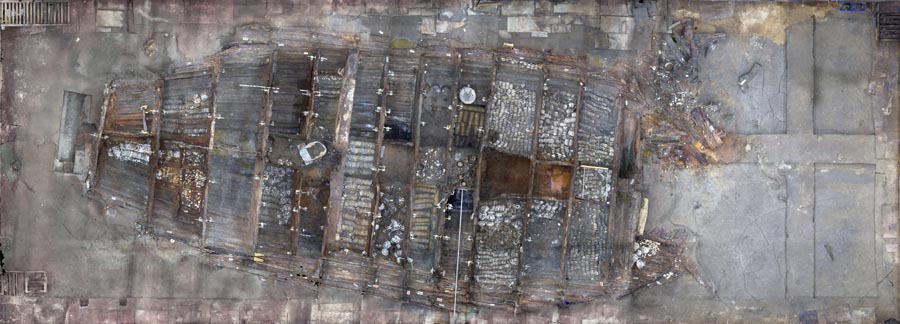
"It is so far the biggest underwater archaeological discovery in China," says Sun Jian, chief technical supervisor of the National Center of Underwater Cultural Heritage, the leader of the research program.
According to Sun, the cabin of the ship, which housed 15 separate rooms, has recently been cleaned up.
Because the wreck was typical of the Fujian style at the time, archaeologists believe that the ship and its fully-laden cargo set off from Quanzhou, a city in the province, which was then one of the world's busiest sea ports.
"Fujian-style ships were widely used in ocean trade during the Southern Song Dynasty," Sun explains. "They were safer than other ships at countering storms and high waves, and they were able to carry more goods. However, they were slower."
It is not known where the vessel was heading or whether it was a storm, high waves, or some other accident, that sealed the fate of Nanhai One, but the ship sank just a few hundred kilometers away from its starting point. We will probably never know the real reason for its demise.
Systematic research of Nanhai One began in 2000. There was much debate about how to move it from its resting place 20 meters below the surface of the water to dry land.
In 2007, archaeologists finally decided to salvage the shipwreck using a pool-type container called the Crystal Palace to move it to the Maritime Silk Road Museum of Guangdong in Yangjiang. Then, in 2014, archaeologists began to "unearth" the wreck, which was still buried in mud and sand.
The plan was awarded China's highest prize for progress in science and technology, a rare accolade for the archaeological community.
"If we lifted the wreck directly from the seabed, we would have overlooked some of the cultural relics, which had been scattered around the wreck," says Jiang Bo, director of the underwater archaeology department at the National Center of Underwater Cultural Heritage. "We were fortunate to see so much historical information remain so well preserved.
"It's just so perfect," he says. "For Chinese underwater archaeology, its significance is incomparable."





