


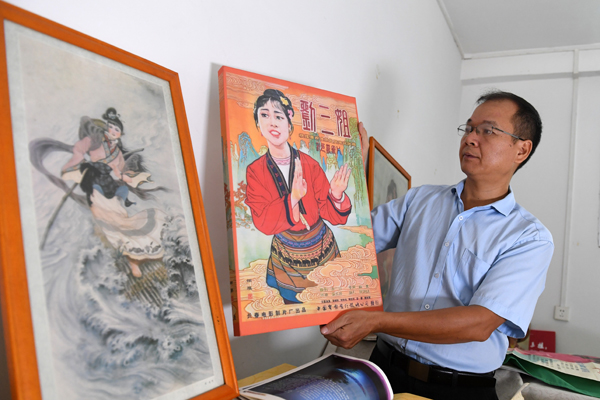
At about 8 pm every night, one hour after his dinner, 45-year-old Xie Zhongguo opens his computer and searches for new items to acquire for his Liu Sanjie cultural museum.
Living in the city of Nanning, the capital of southern China's Guangxi Zhuang autonomous region, Xie is a big fan of Liu Sanjie, the legendary folk singer from the Zhuang ethnic group. Since 1998, he has collected more than 3,000 items of memorabilia related to the singer.
Located in the region's scenic city of Guilin, the Liu Sanjie cultural museum, founded by Xie, is just one of the many private museums that have sprung up across the country over recent years.
The museum has seven exhibition halls, which occupy more than 600 square meters. The exhibits include CDs, newspapers, film scripts, calendars, postage stamps, dolls and cigarette cases-anything related to the singer, according to Xie.
"Liu Sanjie represents the rich ethnic culture in Guangxi, and setting up the museum offers a better way to expand her influence. In the past, few collected these things systematically, leaving many items to be lost to history," Xie says.
Currently, a total of 11 ethnic minorities live in Guangxi, making the local private museums that focus on the various ethnic cultures popular in the region, including the bronze drum museum in Donglan county in the city of Hechi.
The bronze drum is a traditional musical instrument used by some of the region's ethnic groups, with a history of more than 2,000 years. Donglan county is known as the "home of bronze drums "because of the instrument's prevalence in the area.
Built in 2011, the bronze drum museum exhibits 135 sets, which have been collected since the 1970s. The earliest bronze drum in the museum was cast during the Song Dynasty (960-1279), while the most recent dates back to the late Qing Dynasty (1644-1911).
The drums are now mainly used as decoration in the local residences and played mostly during festive events.
"The drums look similar in shape but different in decoration, especially some of the ones with frogs, cows and horses on them," says Chen Zhenyang, curator of the museum.
Private museums have become an increasingly important part of the country's heritage landscape. In Guangxi alone, there are 59 non-State-owned museums, nearly double the 31 such establishments recorded in 2013.
However, despite showing promise, some private museums in China face difficulties and challenges. Compared to the State-owned museums, the limited operating funds and small exhibition areas often hinder their development.
Wu Weifeng, chairman of Guangxi's museum association, believes that many of China's private museums are still in the initial stages of development.
"Undoubtedly, private museums play an important role in the whole museum system, as they have some exhibits which cannot be found in the State-owned institutions. The development of such museums is generally a trend born of economic and social development," says Wu.





