


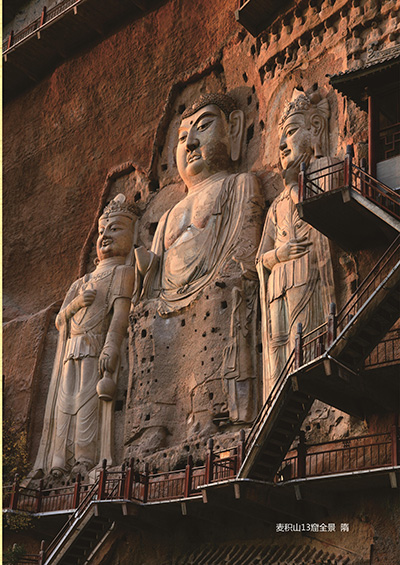
These grottoes are interconnected by 14-layer plank roads along the cliffs. Currently, there remain 12,182 statues preserved, including 7,886 clay statues, in addition to 1,065.2 sq m of murals and 18 stellai. Other relic buildings include the Ruiying Temple and the stupa. A total of 800 historic items and more than 1,500 volumes of Buddhist text and documents are housed.
The highest remaining Buddha statue in Maiji Mountain Grottoes is 15.33 meters high and the smallest one is less than 30 centimeters high, with those in Grottoes No. 4, 74, 78, 133 and 127 being the most representative. Most of the grottoes were carved during the Northern Dynasties, including 44% during the Northern Wei Dynasty, 6% during the Western Wei Dynasty, 21% during the Northern Zhou Dynasty, 5% during the Sui Dynasty, and the remaining 24% or so during other dynasties.
The current grottoes in Maiji Mountain were mostly made during a period from the Northern Dynasties to the Sui Dynasty. The earthquake and invasions of Tubo in the Tang Dynasty marked the end of the best days for the grottoes. Multiple large-scale renovations were launched from the Song Dynasty till the Qing Dynasty on the grottoes. The existing clay statues dating from the Northern Wei, the Western Wei, the Northern Zhou, and the Sui dynasties represent the best works of China's clay statue making in the 5th to the 7th centuries.
Clay statue making welcomed a comeback in the Song Dynasty, demonstrating the artistic achievements in the region in the 10th to the 13th centuries. The statues made in early years of the Northern Wei Dynasty embody the Pingcheng Model (also known as Yungang Model) of China's Buddhist grottoes and the implications from Indian art of Gandhara. The local features of Buddhist statue making art in the ancient Qinzhou region are also notable. Some unique statue-making and painting techniques used in Maiji Mountain Grottoes represent the features in the local Buddhist culture and arts. During the period from the late Northern Wei Dynasty to the Western Wei Dynasty, the statue-making style of Luoyang and the Southern Dynasties gains dominance in Maiji Mountain Grottoes.
Maiji Mountain, as a strategic western exit from Chang'an city to surpass the Longshan Mount on the Silk Road, acted as a transit station that sinicized the Buddhist arts and then transmitted the arts to the Western world.
The emergence of large sutra paintings and the content about China's traditional concept on "becoming immortal" had an impact on the art forms of Dunhuang Mogao Grottoes dating back to the middle of the 6th century and later. Maiji Mountain Grottoes feature a diversity of themes and styles in statue-making.
As Trikalea Buddhas, Seven-Buddha, Thousand-Buddha, Maitreya and Vimalakirti were popular from the Northern Dynasties through to the Sui Dynasty, a number of Trikalea Buddhas and Vimalakirti statues were made, evidencing the popularity of Mahayana, a translational work by Kumarajiva during his stay in Chang'an, in the region. Mahayana has become a key component of regional Buddhist belief in the region since then.
In 1961, Maiji Mountain Grottoes were listed among the first batch of key cultural relics units under national protection by the State Council. In June 2014, the World Heritage List made Maiji Mountain Grottoes a site in the listed heritage Silk Roads: the Routes Network of Chang'an-Tianshan Corridor.





