



Japan's security lies with peaceful region: China Daily editorial









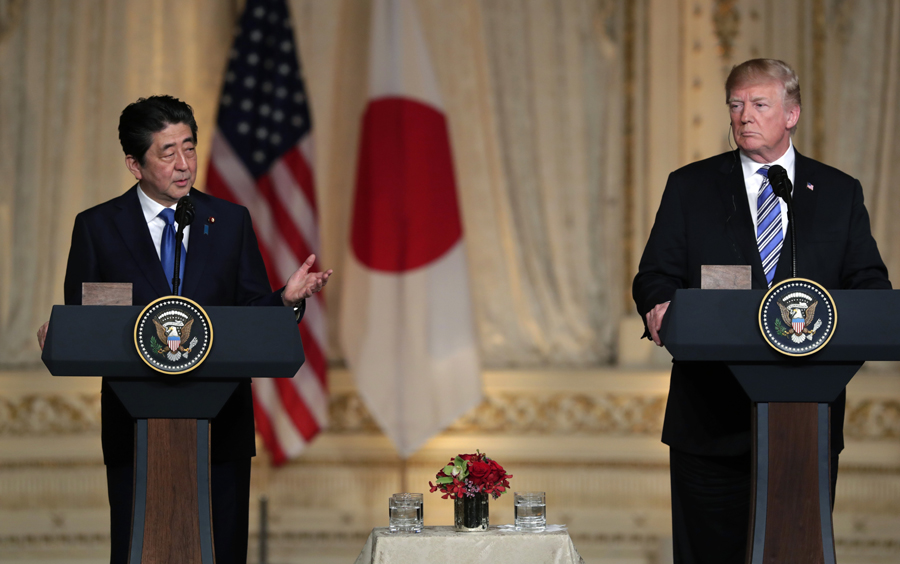
In spite of their yet-to-be-resolved differences over how such issues as cost sharing should be handled, both United States President Donald Trump and Japanese Prime Minister Shinzo Abe reiterated their respective government's commitment to the now 60-year-old Japan-US security treaty.
In contrast with his famous June statement that the treaty was "unfair" and needed changes, Trump now sees it as "essential" to further strengthen and deepen the security alliance with Japan.
Abe, on his part, pledged to make the alliance "even more robust".
With this in mind, his government intends to pursue a closer security alliance with the US in more than the traditional sense. The Japanese leader made no secret of his ambition to also dramatically expand its scope, to both outer space and cyberspace.
The Japanese Space Domain Mission Unit, which is expected to begin operation as part of the country's Air Self-Defense Force in April, for instance, marks a move toward the Abe administration's goal of drastically bolstering the capabilities and system of the Japan Self-Defense Forces in order to "secure superiority".
The unit is Tokyo's reply to Washington's recent inauguration of the US Space Command, with which Abe said it will cooperate.
Extending their traditional partnership to the new frontiers of outer space and cyberspace certainly will inject fresh energy into the security alliance, which both enables and entails closer coordination and collaboration. But it is quite another matter whether it can deliver the security benefits Tokyo seeks.
The idea of expanding the Japan-US security alliance derives at least partly from worries about what Tokyo and Washington deem as security challenges and threats — the improving defense capabilities of such non-allies as the Democratic People's Republic of Korea, Russia, even China.
But what would really give Japan a stronger sense of security at the end of the day: more powerful military capabilities and a stronger security alliance, or a less confrontational regional security environment?
Abe's recent show of willingness to engage the DPRK by talking with its top leader Kim Jong-un without the preconditions he once requested, and ongoing attempts at thawing ties with Beijing indicate he has the answer already. But his clinging to the security umbrella of the US shows he lacks confidence that best-case scenario can be realized.
The idea to upgrade and tighten what to neighboring countries is a legacy of the Cold War and a hallmark of confrontation, however, is in no way conducive to Abe's aspiration for a cost-effective approach to improving his country's security environment.





