



AI fever screening empowers virus control for upcoming travel peak









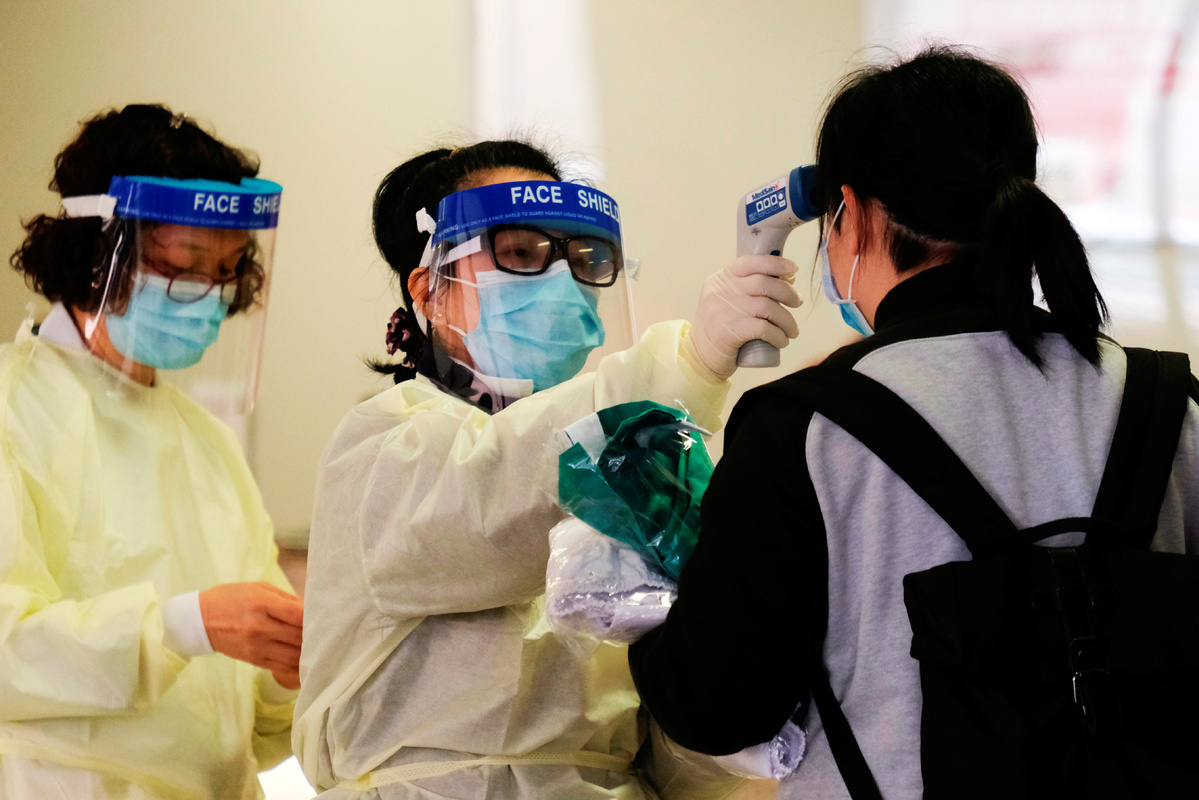
BEIJING -- Every second, 15 passengers suspected of fever can be detected even when they are more than 3 meters away, with the entire process carried out by a single staff member.
Artificial intelligence (AI) fever screening systems have been deployed in some busy pedestrian areas in Beijing to provide non-contact and efficient temperature inspection for the novel coronavirus control during the upcoming post-holiday travel peak.
The novel coronavirus epidemic prevention and control is in a critical period as passenger flows are expected to peak during the post-holiday travel rush.
Beijing's subway system, for instance, launched temperature detection measures in all of the city's subway stations last Friday. Passengers will be tested by thermal imagers and handheld thermometers. Those with abnormal body temperatures will be sent to hospital.
However, in busy pedestrian areas like subway and railway stations, traditional forehead thermometers are not efficient enough and may cause crowd congestion, increasing the risk of cross-infection due to close contact.
It is also difficult for staff members to quickly identify the high-temperature area of an infrared image with the naked eye and locate the target.
Meanwhile, although some temperature screening systems have been integrated with AI features, the masks and hats people wear mean the system has too few facial features to recognize and analyze.
How to achieve rapid fever detection in busy pedestrian areas with no body contact has become an urgent issue in the novel coronavirus epidemic prevention and control.
On Jan 25, Zhongguancun Science City in Beijing called on tech firms and research groups in Haidian District to develop AI solutions for infrared temperature screening systems to improve the accuracy and efficiency of temperature screening in busy pedestrian areas.
On Tuesday, AI fever screening systems were deployed in some subway stations in Haidian District, home to China's high-tech hub Zhongguancun, and Haidian District Service Hall.
AI company Megvii, developer of the system, said its engineers optimized the system for masks and hats with a margin of error within 0.3 degrees Celsius. The system also supports non-contact remote temperature screening of more than 3 meters.
Once a passenger is suspected of having a fever, the system will automatically alert staff members. Person re-identification (ReID), a technology to identify and track a person of interest from group images, enables staff members to quickly locate the passenger for further tests.
Megvii researchers said the system can send fever alerts for up to 15 people per second and one system can cover 16 lanes, basically covering one subway entrance. Meanwhile, only one staff member is needed to work onsite, reducing the risk of infection among frontline staff.
At Qinghe railway station, an AI fever screening system developed by tech giant Baidu went into operation last Saturday.
Qinghe station is of the departure stations of the Beijing-Zhangjiakou high-speed rail line and one of the largest stations on the line. It is also an interchange station for Beijing's subway line 13. During the Spring Festival, the average daily passenger flow can reach 30,000.
The system is also non-contact and automatically identifies and locates suspected cases. Passengers don't need to take off their masks while going through the inspection.
Baidu said the demand for temperature screening systems for densely populated areas is expanding in many Chinese cities. The company will provide free support for government agencies at all levels and local communities.











