



Pessimism over economy unwarranted









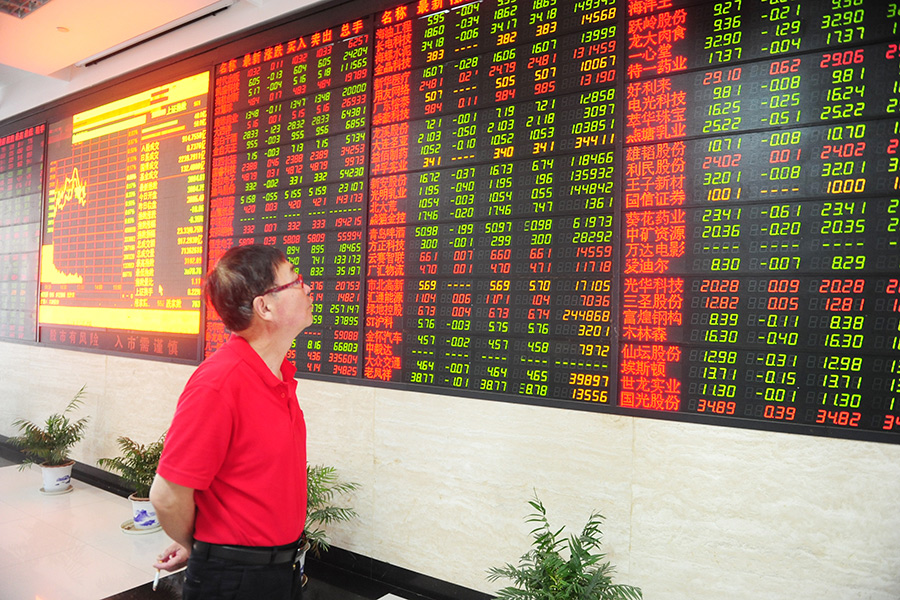
An investor looks at share prices at a brokerage in Fuyang, Anhui province. [Photo by Wang Biao/For China Daily]
The COVID-19 outbreak is likely to have a big impact on China's economy in the first quarter, especially because many people have postponed their return to work after the Spring Festival holidays.
Yet since the government has now rolled out measures across the country, except Hubei province, to gradually resume normal economic activities, people should have confidence in China's economic outlook for 2020. Given China's comprehensive prevention and control measures to control the COVID-19 outbreak-and judging by a study on Brazil's economic performance after the 2016 Zika virus outbreak-the coronavirus epidemic is unlikely to undermine the fundamentals of China's economy.
For those who are afraid that the epidemic will deal a deadly blow to the Chinese economy, it is important to remember what former US president Franklin D.Roosevelt said: "The only thing we have to fear is fear itself."
In Brazil, the first reports of locally transmitted Zika infection appeared in May 2015. In February 2016, as the Zika virus spread rapidly across the range where Aedes mosquitoes thrive in the Americas, the World Health Organization declared that Zika, which causes microcephaly and other neurological disorders, constituted a public health emergency of international concern.
Also, by early February 2016, local transmission of Zika had been reported from more than 20 countries and territories, and thousands of people had been infected in Cabo Verde, off the west coast of Africa. Which means the Zika virus was carried by international travelers to places thousands of kilometers beyond the range of Aides mosquitoes.
In 2016, Brazil faced an even bleaker situation than China is facing now, not least because the Brazilian economy had contracted by 3.5 percent in 2015.
Yet the WHO and the International Olympic Committee turned down a proposal to defer or shift the 2016 Summer Olympic Games from Rio de Janeiro even as one after another international organization lowered the growth forecast for Brazil. As a result, Brazil became the first South American country to host the Olympics-on schedule.
No confirmed Zika cases were reported during the Rio Olympics with Brazil attracting a record of 6.6 million visits by foreigners in 2016, up 4.8 percent year-on-year. In fact, Brazil attracted more foreign visitors in 2016 than in 2014, the year it hosted the Football World Cup.
As a result, WHO withdrew its directive calling Zika a public health emergency of international concern in November 2016, while economic contraction and inflation eased in Brazil. The Brazilian economy contracted 3.3 percent in 2016 compared with 3.5 percent in 2015.
In 2017 and 2018, the Brazilian economy grew by 1.1 percent, with the growth in the first, second and third quarters of 2019 being 0.6 percent, 1.1 percent and 1.2 percent respectively. And while its consumer price index grew by 6.3 percent in 2016, down from 10.7 percent in 2015, the following two years and the first 11 months of 2019 saw a lower CPI growth, of 3.0 percent, 3.8 percent and 2.7 percent respectively.
In contrast, China had a spectacular year-on-year growth in 2003, the year the severe acute respiratory syndrome (SARS) broke out in the country, followed by 10 years of high growth. In actual terms, China recorded a GDP growth of 10 percent in 2003, higher than the 9.1 percent in 2002, the first year after China enjoyed the dividend of joining the World Trade Organization. The double-digit growth continued until 2007.
Thanks to its experience of controlling SARS, China knows how to bounce back after an epidemic outbreak. Which has been acknowledged by WHO, which said that declaring the COVID-19 outbreak a public health emergency of international concern was not about doubting China's ability to contain the epidemic but about protecting countries with weaker health systems.
Therefore, market players better stay calm, without being overly pessimistic about China's growth prospects.
The author is a researcher at the Chinese Academy of International Trade and Economic Cooperation. The views don't necessarily represent those of China Daily.


Today's Top News
- Business leaders hail nation's intelligent manufacturing
- Young voyagers encouraged to continue quest
- UK companies seeking larger role in China
- Secessionists' 'word game' belies their anxiety
- Chinese military delegation attends Shangri-La Dialogue in Singapore
- Xi replies to letter from Chinese, US students





