



'Mother River' needs production and protection in balance, say advisers









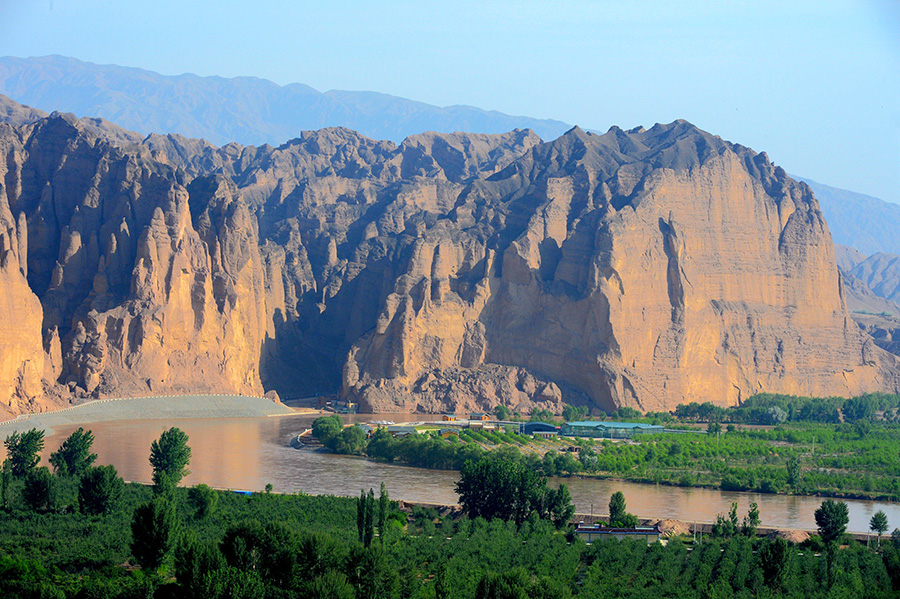
Finding a balance between production and the environment is imperative to promote ecological protection and high-quality development of the Yellow River, known as China's "Mother River", a political adviser said during the two sessions.
"The ecological protection and high-quality development of the Yellow River Basin is not only a major national strategy, but also is critical to the country's economic and social development and ecological security," said Ouyang Jian, a member of the 13th National Committee of the Chinese People's Political Consultative Conference, the top political advisory body.
Thanks to efforts to implement projects including water source conservation and water and soil loss control, the environment along the Yellow River in Gansu province, which covers 145,900 square kilometers or 32 percent of the province's area, has seen marked improvements, said Ouyang, also chairman of the CPPCC Gansu Committee.
However, regional economic development is still lagging, with a lack of infrastructure and residents faced with poor production and living conditions, he said.
As this year marks the deadline for China to eradicate absolute poverty, Ouyang said Gansu was encouraging efforts to push forward with green development while strengthening environmental protection.
To better connect poverty alleviation with environmental protection, the province will step up efforts to advance supply-side structural reform in agricultural production by reducing the planting area for high-water-consuming crops and optimizing the planting of grain, cash crops and forage, he said.
Circular agriculture will be further promoted, which will provide sufficient high-quality feed for husbandry by turning corn and corn-stalks into fodder, while at the same time better protecting grassland resources and reducing water loss and soil erosion, Ouyang added.
He said the local authorities will minimize the harmful effects of agricultural practices on the environment by upgrading irrigation facilities and promoting water-saving technology to boost farm output in an eco-friendly way.
A slew of favorable land and taxation policies should be rolled out to foster the development of ecological industries, which will attract more investment from enterprises and give impoverished people jobs and stable incomes, Ouyang said.
In the past few years, the provincial government invested a large sum of money in ecological protection, but the results were not very satisfactory because many of the projects generated few economic and social benefits and did not attract widespread, active participation, he said.
"The key to cope with the problem lies in active development of eco-friendly and sustainable industries, which will consolidate the foundation for high-quality development and provide a steady impetus for enhanced protection of the Yellow River," he said.
At the same time, Ouyang acknowledged that prominent problems remained in the Yellow River Basin, with the ecological environment still fragile and a grim situation in regard to the protection of water resources.
He said that an ecological compensation mechanism, along with a special national fund for the ecological protection and high-quality development of the Yellow River, should be put in place as long-term strategies to cope with ecological and environmental problems.
Zhang Ping, also a member of the CPPCC National Committee from Gansu, called on the government to establish a demonstration zone for soil and water conservation and ecological restoration in the middle and upper reaches of the Yellow River Basin in an effort to strengthen its ecological protection and high-quality development.
The zone, stretching from Lanzhou to Baiyin, would be located at the transition area between the Loess Plateau and Tengger Desert and promote the efficient use of water resources in the water-scarce region and the reduction of soil erosion, she said.
Citing a forecast by the Northwest Institute of Eco-Environment and Resources, Zhang said the project would prevent 2.6 million metric tons of soil being lost to wind erosion, and reduce the amount of sediment in the river, in the form of sand and mud, by 300,000 tons a year.
The project would reduce the frequency and intensity of sand and dust storms, while also facilitating the development of city clusters and enabling the coordinated development of cities along the middle reaches of the Yellow River, Zhang added.


- Increase in western Pacific military activities noted
- China, Pakistan pledge deeper military ties
- SPP to oversee handling of Shanxi mine explosion case
- Mine blast victims get mental health counseling
- China leads with ‘deep and real’ methane control efforts, expert says
- China calls for fair global ocean governance in Xiamen symposium





