


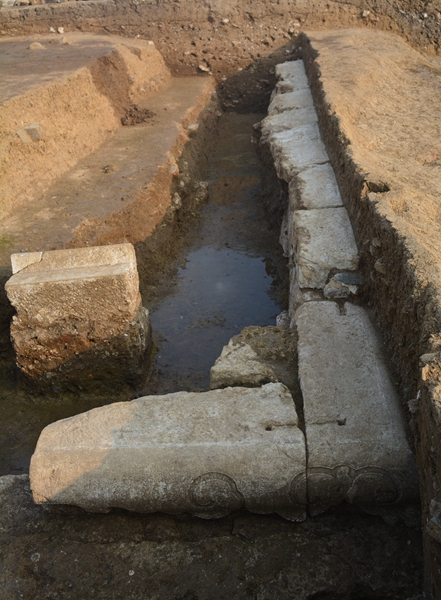
The core palatial section has been the focus of archaeological research.
The earliest archaeological investigation of Zhongdu was conducted from 1969 to 1981 by late archaeologist Wang Jianying, who helped people to recognize the site's significance.
Large-scale excavation began in 2014, as the Zhongdu site was designated as Anhui province's first archaeological park to promote public awareness of heritage protection and tourism's benefits to the local economy.
"Our investigations have covered most areas within the (Zhongdu) 'forbidden city', and we know the layouts of its major buildings, roads and waterways," Anhui Provincial Institute of Cultural Relics researcher Wang Zhi says.
"And our understanding of their construction methods are also improving. We've thus gathered precious experience doing research on other large-scale heritage sites.
"We can't protect Zhongdu as a cluster of individual spots. Only when its integrity is well preserved can its historical significance and connection with the environment be better revealed."
Indeed, more similarities among the palace compounds in Zhongdu and Beijing may become apparent as excavations of the greater area around Zhongdu proceed.
For instance, there's a hill to the north of the palatial city of Zhongdu. Likewise, Jingshan Hill is just across the road from the northern exit of the Palace Museum today. Jingshan Hill was created from earth piled up while digging the moats surrounding the Forbidden City.
The Zhongdu site hosts counterparts of Beijing's Forbidden City's major outer city gates-the Eastern Prosperity Gate, the Western Prosperity Gate, the Meridian Gate and others.
And an area by the southern entrance of Zhongdu's imperial city was cleaned up in 2018, unveiling Chengtianmen (the Gate of Accepting the Heavenly Mandate).
There's a similar structure in Beijing, which was renamed Tian'anmen (the Gate of Heavenly Peace) in 1651.
Some local legends say there were "five dragon bridges" underground in the area, but Wu's team found seven.
The bridges also have famous counterparts in front of Tian'anmen, known as Jinshuiqiao.
Though information about Zhongdu's city gates is clearly recorded in history, detailed information about its inner palaces are vague.
"We feel like we're filling in voids in history," Wu says.





