


What was life like for Chinese soldiers 1,200 years ago? How did they guard the border? What did they do after work and how did they escape the summer heat? A recent excavation project in Northwest China's Xinjiang Uygur autonomous region may partly answer these questions.
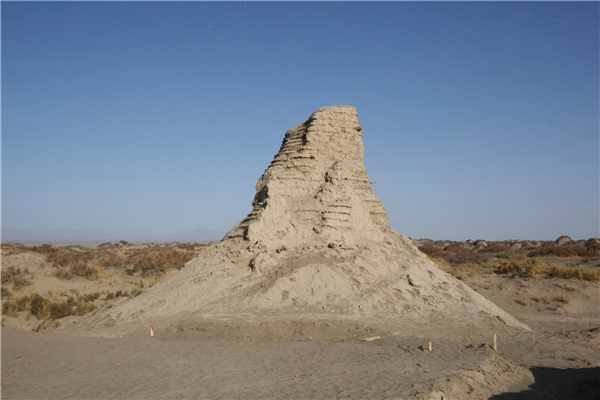
From Sept 2019 to June this year, archaeologists in Xinjiang excavated the ruins of a beacon tower located in the wilderness some 90 km away from Yuli County in the Mongolian autonomous prefecture of Bayingolin.
Dating back to the Tang Dynasty (618-907), the Kiyakkuduk beacon tower was used to transmit military signals by smoke and fire, said Hu Xingjun, team leader of the excavation project from the regional institute of cultural relics and archaeology.
Hu said the tower was part of the beacon tower cluster built on the northern side of the Konqi River to prevent sneak attacks by the Tubo people via the nearby Loulan path.
The path used to be an important section of the ancient Silk Road that led to Loulan, also called Kroraina, one of the pivotal stops along the Silk Road. It became less popular with merchants in the Tang Dynasty after the cit of Loulan was buried in sands.
At the beacon tower ruins, archaeologists unearthed more than 700 paper documents and wooden tablets, which showed that soldiers at that time took turns to patrol, observed the merchants passing by along the Loulan path, collected military information and guarded the tower.
Garrison regulations inscribed on wooden tablets stipulated rules like the use of "peace fires," a fire signal sent out regularly to indicate everything there was normal.
Three semi-basement rooms were also unearthed at the western side of the tower, which were believed to be a facility for soldiers to escape the summer heat.
"Waterways nearby had already dried up and sandstorms often hit the area where no tall trees were grown. The ground temperature may have exceeded 50 or 60 degrees Celcius," said Hu. "The semi-basement rooms may have served as the only site for soldiers to beat summer heatwaves."





