



Tech firms gear up to tap self-driving taxi services









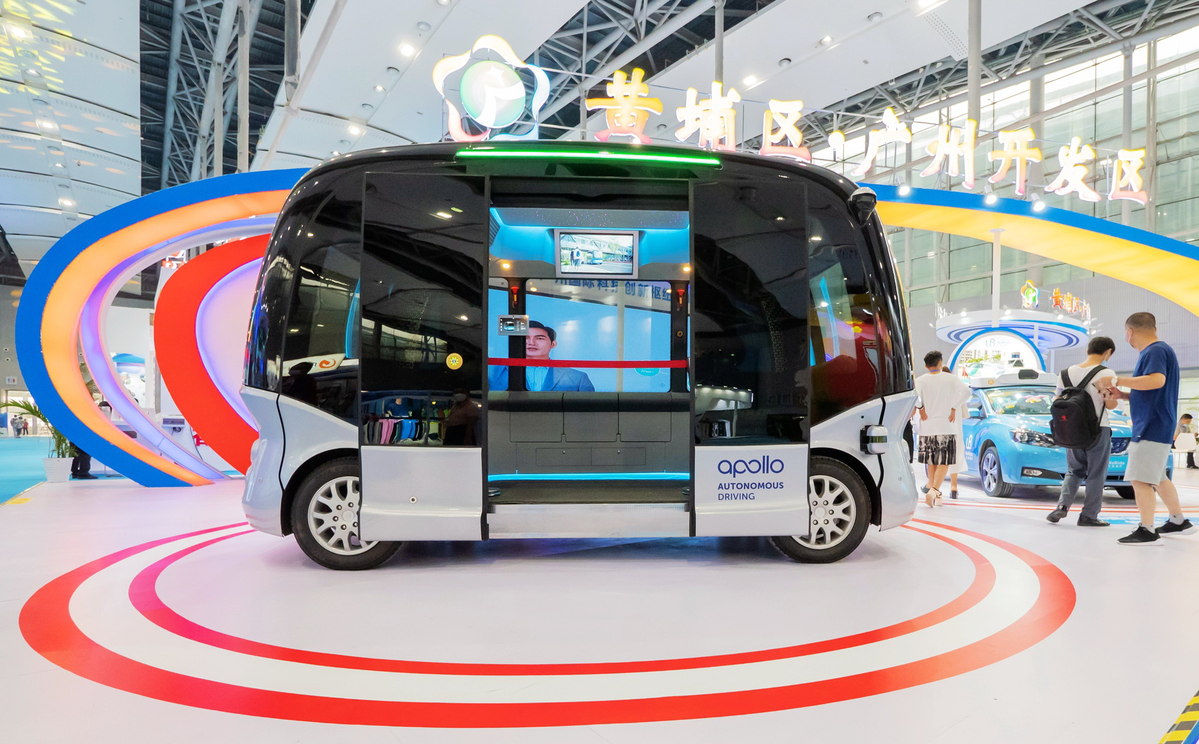
Competition in China's autonomous driving industry has intensified as several technology companies are ramping up efforts to launch self-driving taxi services in an attempt to bolster the large-scale commercial use of such cutting-edge technology.
Chinese internet search giant Baidu Inc is making autonomous driving technology more accessible and helpful to users by enabling its robotaxis to safely operate in busier areas of a city that have more variables for the autonomous driving system to process.
The company has announced it will open its self-driving taxi service to the public in Beijing soon, serving multiple areas that cover 700 kilometers of roads which include the Yizhuang, Haidian and Shunyi districts.
It was granted permission to start phase two of autonomous vehicle road tests in Beijing on Aug 24 with passengers on board, after conducting over 519,000 km of road tests in the capital.
Baidu secured 40 licenses to test self-driving vehicles carrying passengers on designated roads in Beijing on Dec 30, 2019. It now holds over 150 autonomous driving road test licenses and more than 1,800 intelligent driving patents globally.
The move came shortly after the Beijing-based tech giant opened the Apollo Go Robotaxi service in Cangzhou, Hebei province, in August, extending robotaxi coverage to the downtown area of a city for the first time in China.
The Apollo Go Robotaxi service in Cangzhou covers 55 pick-up and drop-off stations across the city. They include train stations, schools, hotels, museums, business and industrial areas, and other public spaces.
People in Cangzhou can easily hail a free robotaxi ride through one click on Baidu Maps.
Visitors to Cangzhou could hail a robotaxi after getting off the train to take them to their hotels. With safety a top priority, a human operator is assigned to each vehicle as a backup.
Cangzhou has invested heavily in the development of intelligent network technology to facilitate the roll out of autonomous driving in recent years. It was the first city in northern China to allow manned autonomous driving tests and built one of the largest road networks for testing autonomous vehicles.
Actually, Baidu fully opened its self-driving taxi service in Changsha, Hunan province in April. Robotaxi provides free rides to passengers across an area of 130 square kilometers.
The company signed multiple strategic cooperation agreements on Aug 28 with Guangzhou, the capital of Guangdong province, to build a smart transport system in the city.
Apollo Intelligent Travel Technology (Guangzhou) Co Ltd, a subsidiary of Baidu Apollo, won the bid of an intelligent transport project regarding self-driving and vehicle road coordination, which is valued at nearly 460 million yuan ($67 million), in the Huangpu district of Guangzhou.
Robin Li, chairman and CEO of Baidu, said the company will join hands with Guangzhou to strengthen cooperation in areas such as autonomous driving, intelligent connected vehicles and intelligent transport.
Jiang Zheng, a self-driving expert at China's GAC R&D Center, said the launch of self-driving taxi services in some designated areas might be the best application scenario for the technologies due to high operating costs of private vehicles.
China is planning to realize the scale production of vehicles capable of conditional autonomous driving and commercialization of highly autonomous vehicles in certain circumstances by 2025, according to a blueprint issued by the National Development and Reform Commission, the Ministry of Industry and Information Technology and nine other ministries.
Didi Chuxing, China's largest ride-hailing platform, announced in June the opening of its on-demand robotaxi service to passengers in parts of Shanghai.
Road tests for self-driving vehicles are available in more than 20 provinces and cities in China.
Companies such as SAIC Motor, BMW, Didi Chuxing and DeepBlue Technology have obtained authorization for passenger-carrying tests.
"More tests are still needed before such vehicles can reach mass production and enter large-scale commercial application because of widespread safety concerns," said Zeng Zhiling, managing director of LMC Automotive Consulting Co.











