


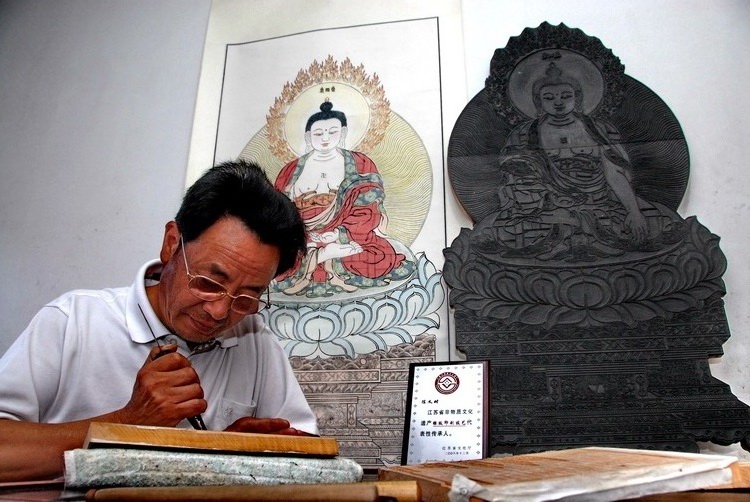
Father passes woodblock printing skills to his daughter, and together they work to popularize its unique character
Chen Yishi, 73, of Yangzhou, Jiangsu province, has devoted most of his life to woodblock printing, an ancient art that has embodied the charm of Chinese characters for hundreds of years.
In 2006, the traditional craft was listed among China's first items of national intangible cultural heritage, and Chen has been honored as a representative inheritor. In 2009, Chinese woodblock printing was included in UNESCO's Lists of Intangible Cultural Heritage.
The ancient craft, now largely replaced by modern printing techniques, is no longer widely used to communicate. It mainly appears as a traditional art form. It has a particular beauty that draws the admiration of many around the world. Great patience, diligence and skill are required to carve a single block of wood. To complete a book, craftsmen must carve dozens of blocks.
Known as the "living fossil" of printing, woodblock printing originated in China during the Tang Dynasty (618-907). Inheritors of the craft follow the ancient ways, using traditional tools to carve characters and patterns on a wooden block. Next, ink is applied to the carved face and blank pages of paper, silk or other material are pressed down on the ink, picking up the impression. Those pages are then bound into a book.
Together with movable type for printing, carved woodblocks occupy a place of honor in China as one of the "Four Great Inventions" of the past. The blocks continue to play an important role today in communicating the story of human history.
Not just any kind of wood can be used for woodblock printing. Chen always uses the wood of wild pear trees. He immerses the blocks in water for one or two summers, then allows them to dry in shade. In this process, resins and sugars are soaked out of the wood.
Afterward, the blocks are easier to carve. They're impervious to insects and good for preservation.
Once the wood is dry, a section is coated with a layer of thin paste. Then a page of manuscript written in Chinese characters is stuck to the block, backside up. When it's dry, a craftsman gently rubs the paper until the characters can be seen easily.
The characters become even more visible if a layer of oil is brushed onto the paper. The craftsman then follows those characters, using a series of knives to carve them out of the wood one by one.
After the blocks are carved, the craftsman uses a brush to apply ink to the blocks, and then covers the carved images with blank pages-traditional rice paper or other material-before wiping gently from left to right with another brush. The characters gradually appear, and the room is filled with the fragrance of the Chinese ink.
Carving characters on wooden blocks is anything but routine. A craftsmen must practice calligraphy for years while also mastering the skills of woodcarving.
"There are more than 100 skills at play when carving a character on the blocks," Chen said. "A craftsman may only be able to carve a dozen characters in a day."








