



Foldable screens all the rage









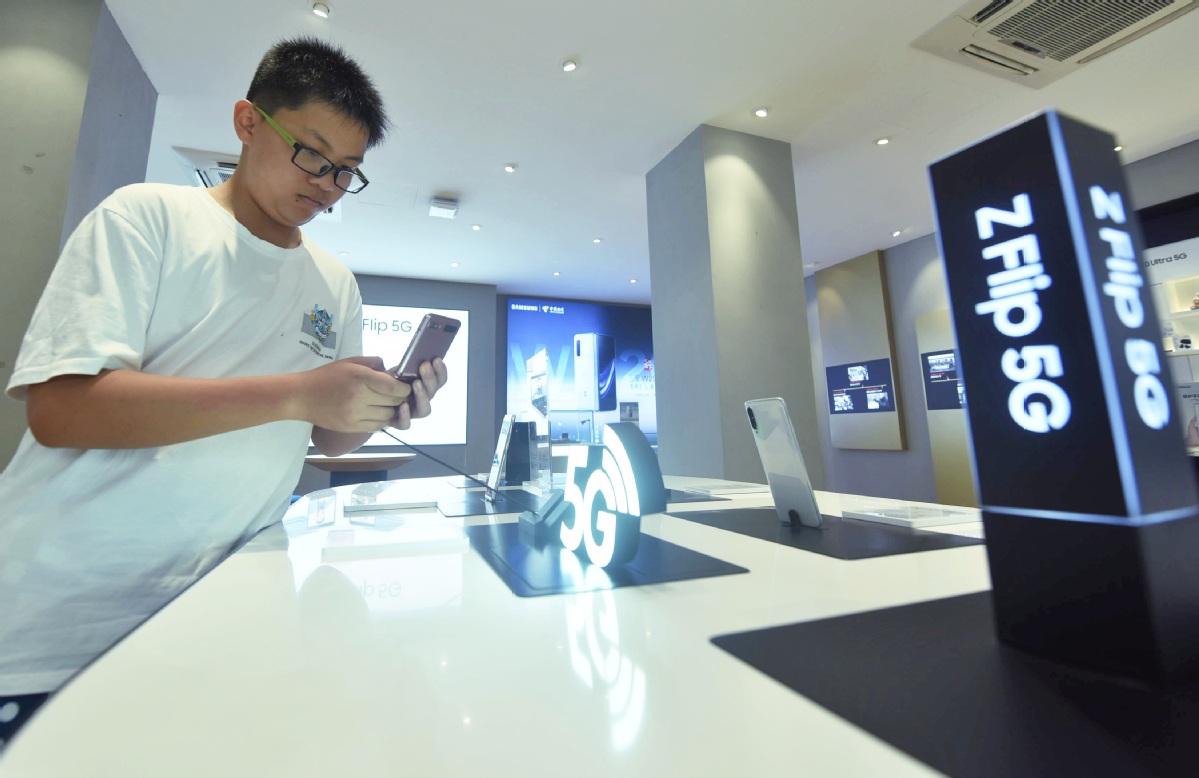
Wu Shuyuan, an analyst at Beijing-based market research firm Sigmaintell, said sales of foldable devices would be hampered by the supply chain, high costs and hinges-a mechanical design that allows the flexible panel to fold and unfold-thereby restricting them to a niche market position.
Wu added that manufacturers need to reduce production costs.
"Consumers need to spend more to buy foldable smartphones that have the same technical configurations compared with other handsets," said Jia Mo, an analyst at Canalys, a market research company. That is because foldables have low display yields and higher design costs as of now.
However, prices of foldables will likely fall in the future, and they will find broad application scenarios given their two-sized screens, Jia said.
Worldwide smartphone shipments decreased by 16 percent on a yearly basis in the second quarter, according to market consultancy IDC. Huawei became the biggest smartphone player in the world in the second quarter for the first time.
At present, the challenge of foldable mobile phones lies in the active-matrix organic light-emitting diode or AMOLED panels. And how to maintain similar sizes, especially thicknesses, with the current mainstream smartphone products is also a problem, said Qiu Yubin, vice-president of WitsView Research.
With the arrival of foldable smartphones, demand for displays that use AMOLED technology is also surging. AMOLED displays are more flexible with faster response times, higher contrast ratios and wider visual angles compared to traditional liquid crystal display panels.
Domestic display panel suppliers such as BOE Technology Group Co Ltd, Visionox Technology Inc and China Star Optoelectronics Technology Co Ltd are doubling down on flexible screens used in smartphones and scaling up their production capacities in this segment.
"AMOLED technology is the future trend for smartphone panels," said Zhang Yu, vice-president of BOE. "At the moment, technological upgrades of display panels on smartphones concentrate on appearance, function and image quality."
BOE has three sixth-generation AMOLED production lines. It started mass production of flexible panels from its facility in Chengdu, Sichuan province, in October 2017. The panels have already been used by more than 10 smartphone manufacturers.
The company's second line in Mianyang, Sichuan province, started mass production in July 2019, while work on a third facility commenced in Chongqing last year.
Xu Fengying, vice-president of Visionox, said the company has provided AMOLED technology for smartphone maker Xiaomi Corp's under-screen camera since June 2019. Xiaomi's prototype foldable phone also used an OLED display panel from Visionox.
The company's AMOLED display screen production line in Gu'an, Hebei province, began operations in May 2018. It can turn out 30,000 glass substrates (1,500 mm by 1,850 mm) every month, and meet highend, foldable screen demand for 90 million smartphones.
It also started building its second flexible AMOLED production line in Hefei, Anhui province, in December 2018.
CSOT announced its sixth-generation flexible AMOLED display panel production line in Wuhan, Hubei province, and achieved mass production on Jan 1. The company will make 48,000 modules each month.
According to research firm Omdia, the market for AMOLED smartphone displays is expected to expand by 9 percent this year despite the overall negative impact of COVID-19 on handset sales.
Global shipments of flexible AMOLED panels used in smartphones are set to soar to 513 million units this year, up from 471 million units last year, suggesting the product's penetration is deepening rapidly, Omdia said.
Chinese smartphone makers are expected to increase the number of high-end smartphones integrating AMOLED panels this year, said Brian Huh, principal analyst of small and medium-sized displays at Omdia.
Global information provider IHS Markit expects shipments of foldable AMOLED panels to reach 50 million in 2025.
Li Yaqin, president of Sigmaintell, said demand for flexible OLED panels used in foldable smartphones is expected to surge 140 percent this year, buoyed by the commercial application of superfast 5G technology.
"The penetration rate of OLED in global mobile market will reach 50 percent by 2024. By then, the overall shipment of global mobile panels will reach 1.6 billion units and half of them will be from OLED," Li said, adding that about 60 to 70 percent of sales revenue will be contributed by OLED.











