


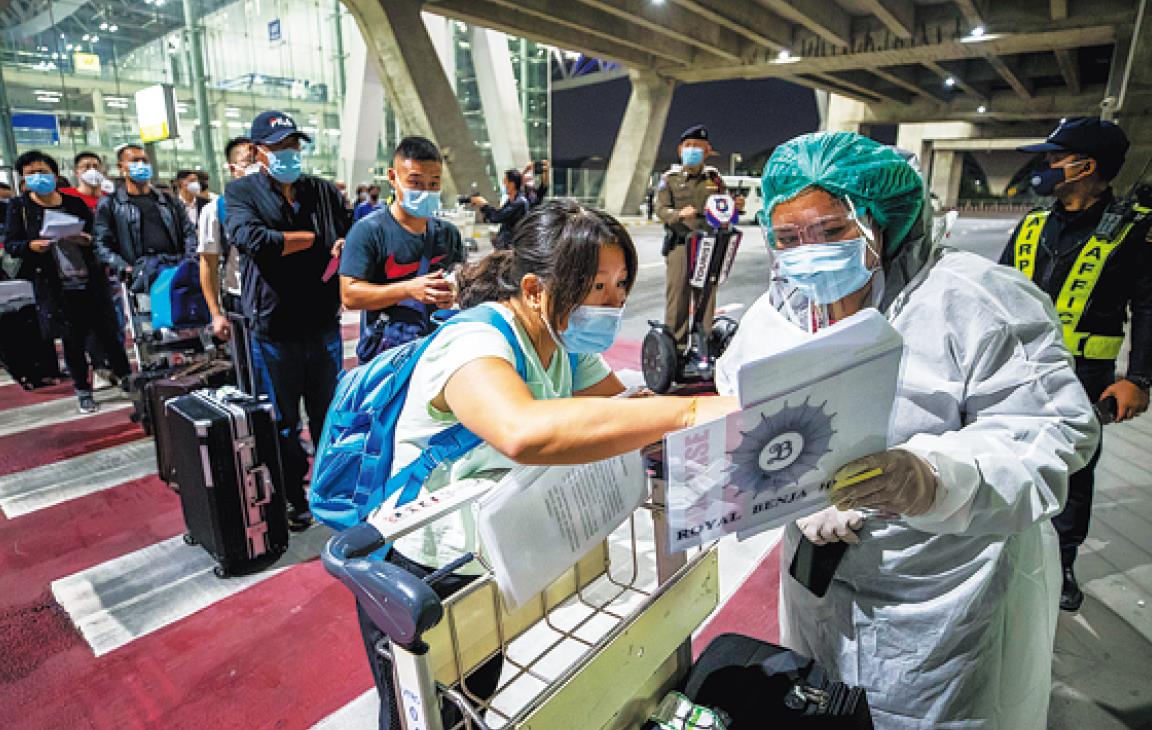
Arrival numbers fall
However, the tourism industry across the globe has been devastated by the pandemic, which has shattered economies, infected more than 62 million people and left close to 1.5 million dead.
International tourist arrivals dropped by 65 percent year-on-year during the first six months of this year, according to a report by the World Tourism Barometer, a UN agency.
Among regions, Asia-Pacific, the first to feel the impact of the pandemic on tourism, was the hardest hit, with a 72 percent fall in tourists for the six-month period.
Wu, the photographer, has witnessed evidence of declining tourist numbers in Bangkok. Many popular destinations that used to be buzzing with foreign visitors are now far less crowded, he said.
"Numerous restaurants that were popular among foreign tourists had to close due to the pandemic," he added.
Wu said the Thai government has implemented a series of preventive measures, including the compulsory wearing of face masks in public areas.
"In Thailand, people are very careful and have maintained good personal hygiene, such as wearing masks and observing social distancing. Hand sanitizers are also available in public places. I think life has almost returned to normal, as the infections now being reported are mostly imported cases," he said.
Wu added that despite the gloomy outlook for businesses driven by tourism, many popular local restaurants are welcoming more customers. With Christmas approaching, diners are lining up in front of these eateries.
"The government here is more focused on boosting domestic consumption and has introduced stimulus measures, including subsidies and tax incentives, for small businesses," he said.
While some 40 million overseas tourists arrived in Thailand last year, the country will struggle to attract 25 percent of that number this year, according to the Tourism Authority of Thailand. The pandemic is also expected to result in an 80 percent fall in tourism revenue for the country this year.
In Indonesia, the number of foreign visitors plunged by more than 70 percent year-on-year from January to September.
In the first half of this year, Cambodia also experienced a huge slump in overseas tourist arrivals. The country welcomed 1.18 million visitors during this period, a fall of 64 percent from the same time last year, according to Xinhua News Agency.
To rescue their pandemic-battered tourism industries and economies, Asia-Pacific countries have sought regional cooperation as, compared with other parts of the world such as Europe and the United States, the number of new COVID-19 infections remains low.
On Nov 12, leaders of the Association of Southeast Asian Nations member states adopted the ASEAN Declaration on an ASEAN Travel Corridor Arrangement Framework in a joint effort to restore tourism and facilitate regional cooperation during the pandemic. The declaration was adopted on the first day of the 37th ASEAN Summit.
Song Qingrun, an associate professor at Beijing Foreign Studies University, said the declaration demonstrates a shared vision among ASEAN countries to strengthen regional cooperation in the tourism industry, which attracts millions of visitors to the region each year.
"Tourism is a very important and large-scale industry in Southeast Asia. It's pivotal for local economies, not just because millions of people visit the region, attracted by its spectacular coastlines, but also due to the numerous benefits it brings to restaurants, hotels, airline companies and even taxi drivers," Song said.
If the tourism industry can recover, even gradually, it will help trigger a regional economic revival.
During the ASEAN summit, broader cooperation was highlighted as 15 countries signed the Regional Comprehensive Economic Partnership, or RCEP, which covers about 30 percent of the global population.
The partnership consolidates free trade agreements between the 10 ASEAN member states and China, Australia, Japan, New Zealand and South Korea.
Song said, "The RCEP is expected to bring East Asian countries to the debating table for new joint measures to better flatten the COVID-19 curve, which will also pave the way for non-essential travel in the region."
So-called travel corridors had emerged long before the November declaration.
The concept of "travel bubbles "was first proposed by Australia and New Zealand, before being quickly examined by other nations as a possible way to get international travelers on the move again. Countries who sign the RCEP agreement allow for non-essential journeys without quarantine.





