



'Artificial sun' may make fusion a reality









On the other hand, Chinese companies' cost control capabilities and technological advancements-especially in renewable energy-are also likely to continue providing companies with advantages, he said.
Nuclear fusion-when two atoms fuse to form a larger atom, such as hydrogen to helium-releases enormous amounts of energy. It is the energy source for stars, although keeping man-made imitations from exploding remains a big challenge, as gas formed by fused atoms is extremely hot.
Despite the challenges, the Chinese government is looking to proceed with building the China Fusion Engineering Test Reactor as soon as this year, and plans to use powerful magnetic fields to contain the hot gas and plasma.
The CFETR is aimed at ensuring keeping hot gas burning for months and building structures durable enough to contain it. These are similar engineering problems also facing construction of a commercial nuclear power plant.
Few new fusion research facilities have been added around the globe recently. The world's largest fusion experiment, the International Thermonuclear Experimental Reactor project in France, experienced long delays and the US government is also considering cutting financial support or withdrawing entirely from fusion power. China, however, is more ambitious and looking forward to achieving commercial production of fusion energy by 2050.
In China, the ambitious project still faces two major uncertainties-h(huán)ow to keep the reactor burning for as long as possible and how to make sure commercial fusion plants operate at a minimum of 10 times the temperature of the sun's core.
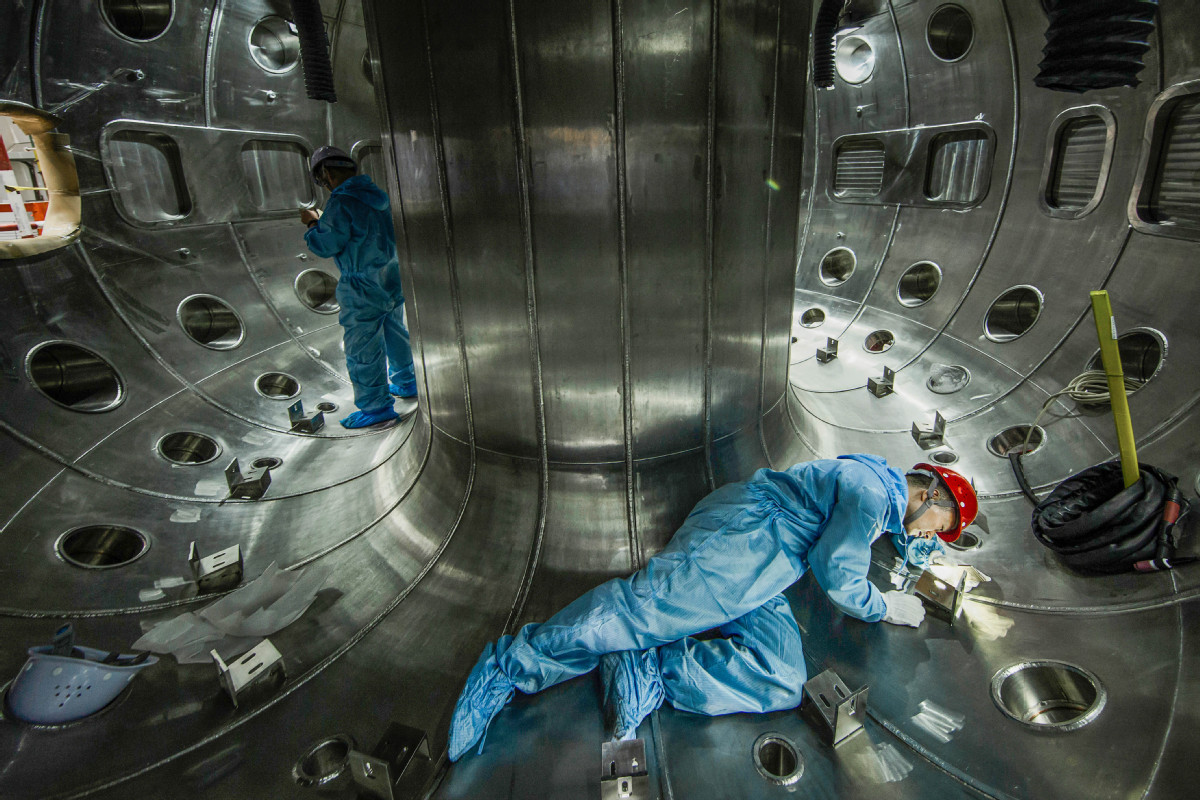
The HL-2M Tokamak is just the technology needed to achieve these targets.
Yang Qingwei, chief engineer of the HL-2M at the Southwestern Institute of Physics under the CNNC, said the artificial sun will provide key technical support for China's participation in the International Thermonuclear Experimental Reactor project and frontier research fields including flow instability and magnetic phenomena of ultrahigh temperature plasma.
Together with the artificial sun, China is also trying to find solutions at the Experimental Advanced Superconducting Tokamak in Hefei, Anhui province, which was built to make the fusion reaction last several minutes or longer.
Analysts said that with advances through research and development, China is likely to become a trailblazer in developing fusion energy.











