



G60 S&T valley powers Yangtze delta innovation









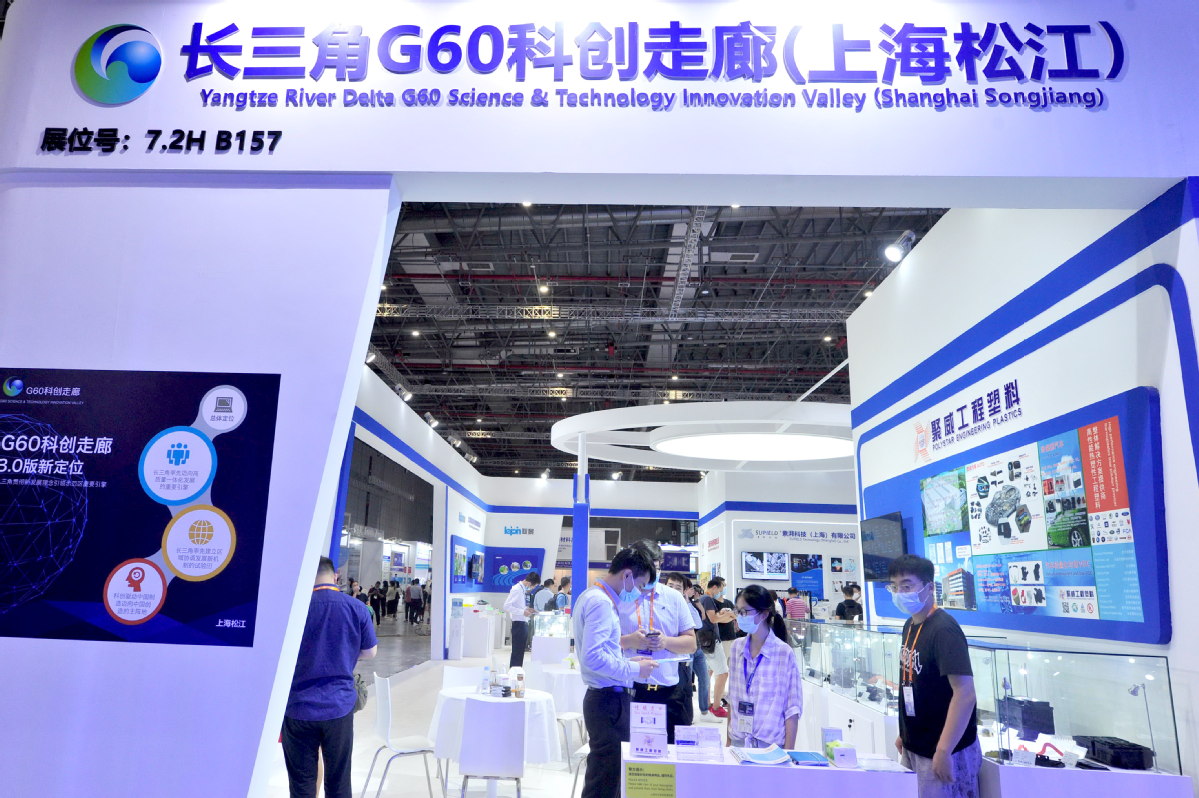
Burgeoning development in the Yangtze River Delta G60 Science & Technology Innovation Valley is helping research institutions and technological enterprises in the delta area to continue to find breakthrough solutions to key problems in innovation.
Last year, the G60 valley was expanded to involve the scientific and technological strengths of nine cities with Shanghai as the core.
These nine cities lead the nation in economic development and educational institutions, while boasting high-end talent.
A construction plan released at the end of last year noted that the G60 valley links the cities with the best potentials, making them competitive in high-end, smart manufacturing, and "it's the country's best location to cultivate frontier industrial clusters and emerging business formats and let them develop and grow".
The nine cities have evolved a strong consensus in the G60 construction, which has been included in all the cities' government work report and their next five-year plans.
Official data showed that by November, the nine cities' GDP had increased to 6.67 percent of the country's total from 6.25 percent when the valley was first established in 2018.
The number of market entities had risen from 2.86 million to 8.05 million, and their percentage in the country's total had doubled. Among them, around 21,000 were deemed high-tech entities.
The G60 construction plan required that by 2020, the research and development investment in the region needs to account for 3 percent of the local GDP.
High-tech enterprises were required to grow at an average of 3,000 entities per year, and no less than 200,000 high-end professionals and university graduates were to be hired every year.
The plan stipulated that by 2025, several world-class manufacturing clusters shall be formed with obvious enhancement of their status in the division of labor and value chains at home and abroad.
"G60 is targeted to become an important source of innovation for China," the plan said.
The Shanghai-based Center for Excellence in Molecular Cell Science, which is affiliated with the Chinese Academy of Sciences, teamed up with the Suzhou Industrial Park to set up an institute in Suzhou, Jiangsu province, to focus on transformation of biomedical technology and related achievements.
Backed by the Shanghai center's scientific research strengths and Suzhou's industrial advantages, the Suzhou institute targets at cell therapy and immunotherapy and will help establish the country's competitiveness and industrial development advantages in the field of cell medicine and stoke the growth of a number of large-scale enterprises.
Four projects from the Shanghai center have reached the stage of industrialization at the Suzhou institute. The goal of the Suzhou institute is to become one of the world's highlands in the emerging cell industry, the center said.
A program of sodium salt-based energy storage batteries, a low-cost, green and safe energy storage solution developed by the CAS' Shanghai Institute of Ceramics, was launched in Taicang, Jiangsu province, for industrialization in 2019. Its facility has a 100-megawatt-hour production line.
The Shanghai institute said this was also an attempt to boost the development and promotion of local new energy material technology and help the growth of the new energy industry of the entire Yangtze River Delta region and even the whole country.
It said the products will meet various energy storage application scenarios, such as peak shaving and valley filling, grid stability, and power supply in islands and remote areas, when power consumption in the region will continue to reach new highs with the advancement of industrialization.
The products already had stable clients overseas, according to the Shanghai institute.
Shanghai Kindly Medical Instruments is an enterprise specializing in the research and development as well as production and sales of interventional medical devices. It was established in the valley in 2006. Besides domestic sales, its products are also sold to more than 40 countries and regions.
Wang Cailiang, executive director and deputy general manager of the company, said that a policy unveiled in late 2019 to promote the unified development of the Yangtze River Delta region, allowed medical businesses to be registered in Shanghai while locating their production in other places within the delta region.
"Such measures further stimulated the vitality of product innovation. For our enterprise, we now do R&D, administration, marketing and medical-industrial collaboration in Shanghai, and have relocated other functions to other cities, which helps us to have a complete layout in the delta region and further open up the market," he said.











