



Rice growing boosts farm incomes in Inner Mongolia









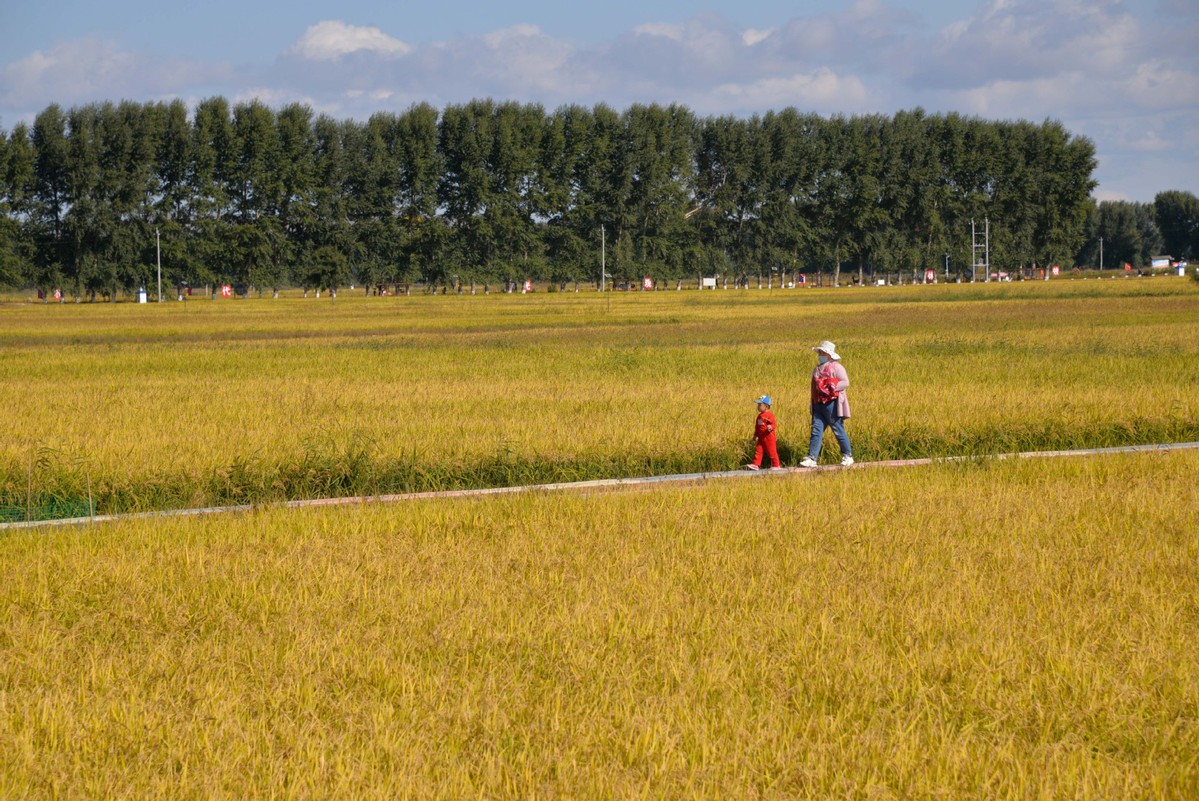
Inner Mongolian farmer Xu Lijun has seen his annual income triple to 24,000 yuan ($3,700) in the five years since he switched from growing corn to rice.
His farm, in Jalaid Banner, Hinggan League, is near the Nenjiang River, which offers plentiful water. Farmers in the banner have grown rice for decades, but it's a complicated and labor intensive process, and most prefer corn, which is far easier to grow but less lucrative.
In 2014, the banner government decided to push the expansion of the rice industry to boost farmers' incomes. This year, its paddies are expected to grow by 6,700 hectares to 73,000 hectares.
Before 2016, Xu, 28, grew corn on his 2 hectares of land and did chores for other farmers to earn extra money.
His sick father, who has since died, helped him with the farmwork, while his mother has impaired speech and hearing. His wife took care of their daughter and did the household chores in their family home in Hongxing village.
In 2015, the household was listed as impoverished because its combined income was less than 20,000 yuan.
Xu received only a primary school education and despite being physically able had never explored ways to earn a better living.
"I had no economic plan for the future because I didn't dare do so," he said. "My ailing parents were unable to do heavy labor. Also, we didn't have money to develop our farm."
In 2016, the village committee encouraged farmers to plant rice by providing them with a one-off 5,000 yuan subsidy. In addition to accepting the subsidy, Xu applied for a loan and rented another 2.7 hectares of land to begin growing rice.
Cultivating paddies requires more care than planting corn, and Xu said it was hard for him to learn techniques such as the use of the correct pesticides and modern methods for transplanting seedlings.
"Technical experts came to teach me every now and then, but I couldn't remember the steps by heart," he said. "My poor comprehension annoyed me."
He's made up for that by working harder. During the rice planting season, from June to September, he stays in the paddies from 5 am to 11 pm to ensure the correct water level is maintained. In the offseason, he raises cows and hogs and peddles sugarcoated haws on the streets.
"I now devote myself to the rice field and have little leisure time," he said.
"To be honest, I'm fatigued. But I must undertake the responsibility of being the household's breadwinner and plan for the future without my father, who used to steer the family."
His father seldom saw a doctor and died from an acute illness in 2019. Xu still doesn't know what he died from. In rural areas, people living in poverty tend to have less awareness of medical care and ignore what they consider niggling health issues to focus on making money.
Xu hopes that his mother's overall health will remain good and that his 6-year-old daughter can receive a higher education.
"I won't let my daughter repeat my life," he said.
Xiang Chunping, an official responsible for poverty alleviation work in the village, said that although Xu is feeling the pressure of taking care of his family, he has a bright future.
"He is active enough to take on various jobs," she said. "We will encourage him to take out a contract for more rice land and to raise more livestock.
"The government will continue offering favorable policies and technical guidance to prevent villagers from returning to poverty."
To modernize the growing of rice, Jalaid Banner authorities are running workshops on soaking seeds to accelerate germination. The technique can also assist in standardizing rice buds and increasing yields.
Through cooperation with local enterprises, the government ensures that farmers can sell their rice at reasonable prices. The government also gives policy and financial support to hundreds of new businesses involved in rice production and processing, social services, cooperatives and family farms.
To further increase farmers' incomes, the banner government has devised a private investment program that allows outsiders, mainly from big cities, to rent land and pay for farm services. Through cameras, the clients can monitor the rice as it grows. After the rice is harvested in fall, the farmers deliver the crops to the clients.
By September, clients from Beijing and Shandong, Hubei, Zhejiang and Guangdong provinces had rented about 733 hectares of paddies and farm services at annual rates of between 6,000 and 12,000 yuan per 667 square meters, the local government said.
"Although our rice quality is basically the equivalent of Heilongjiang rice, which is widely recognized, it has little influence on the market," Fu Hansheng, a Hinggan League poverty alleviation official, told Beijing Daily last year.
"Residents and high-end catering businesses in large cities have shown a strong interest in the quality, and the system that can trace the origin of our product. Letting them feel reassured by monitoring the whole growing process will become key to promoting Hinggan League rice."


- Increase in western Pacific military activities noted
- China, Pakistan pledge deeper military ties
- SPP to oversee handling of Shanxi mine explosion case
- Mine blast victims get mental health counseling
- China leads with ‘deep and real’ methane control efforts, expert says
- China calls for fair global ocean governance in Xiamen symposium





