



The Hope of China's War of Resistance Lies in the Northwest — James M. Bertram, the British Journalist Who Made the Slogan of "United Front" Known to the World









Editor's Note: To celebrate the 100th founding anniversary of the Communist Party of China, we are launching the "100 CPC Stories in 100 Days" series, featuring foreigners who witnessed and participated in the CPC's history and helped the world better understand the CPC. The following is the 6th story of the series.
Commending the CPC-led guerrilla war in enemy-occupied areas, the British journalist James M. Bertram said that when China, an armed nation and a powerful wakening force, rallies behind the right leader, no army in the world would be able to defeat it.
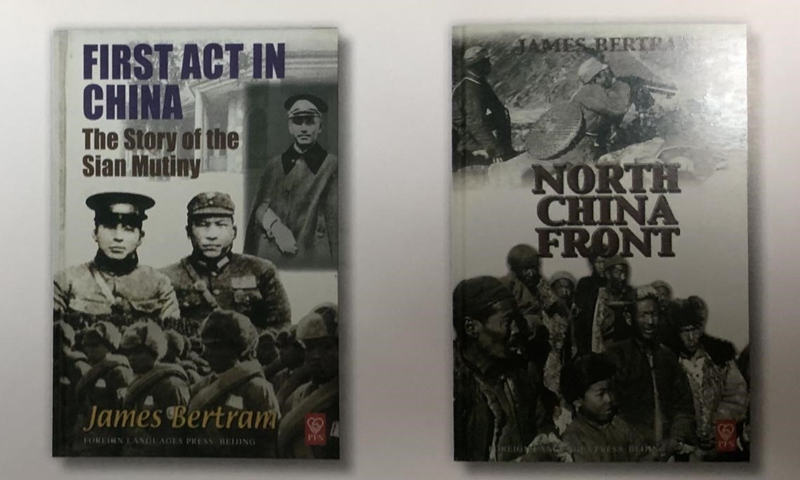
On December 12, 1936, when Bertram learned of the Xi'an Incident, he realized it was a rare news opportunity. As a journalist, he was eager to go to the front line and tell the world what was going on there. With the help of Edgar Snow, Bertram arrived in Xi'an and reported the Incident for 44 days, making him the only Western journalist who was on the ground during the whole incident. Shortly after that, his book, First Act in China: The Story of the Sian Mutiny, was published in 1937. This is the only book written by a foreigner on the Xi'an Incident. It gives an objective and impartial account of what really happened and the CPC's policy of peacefully settling the Xi'an Incident.
In the book, Bertram presented as they were what the main figures in the Xi'an Incident said and thought. In an interview, Yang Hucheng, a key figure in the incident, said with strong determination that, in face of such a serious national crisis, every political party should put its own interests aside and rally behind the anti-Japanese banner to form a national united front against Japanese imperialism. Yang did not see "united front" as merely a slogan, but something totally within reach in China at the time.
Bertram was thrilled about the slogan. He made speeches to tell the public about the Xi'an Incident. Together with Agnes Smedley, he hosted a broadcasting program for the Xi'an Radio Station, breaking the news blockade of the KMT. He believed that the Xi'an Incident was not personal conflicts between a few generals. It was a highlight of the great political struggle triggered by the insatiable aggression of the nation's enemy. It was the most acute manifestation of the anti-Japanese movement throughout China, especially among the Northwest Army. He saw the CPC, which pooled together all the forces that were willing to fight against the aggression and formed a national united front against Japanese aggression, as truly a force brave enough to shoulder responsibilities.
The July 7th Incident in 1937 (also known as the Marco Polo Bridge Incident) marked the beginning of an all-out War of Resistance Against Japanese Aggression. Only four days later, Bertram risked his life and returned to China from Japan for news coverage. He believed that the brutal aggression of the Japanese imperialism left the Chinese people with only two choices: surrender or war. The "middle way" did not exist. There was just something like delayed surrender. He pointed out with the unique vision of a good observer that the hope of China's war of resistance lied in the northwest. Then he went to Yan'an alone for interviews.
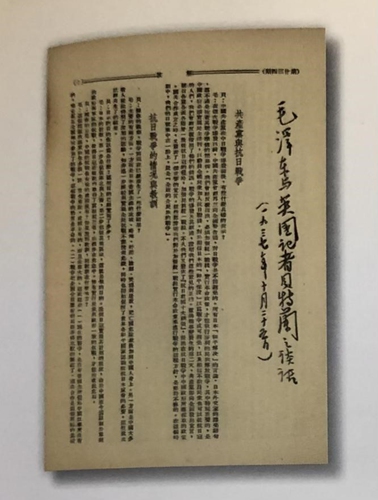
Yan'an impressed him as a progressive experimental zone during the War of Resistance. In his conversations with Bertram, Mao Zedong expounded on CPC's basic positions and propositions on the war. He said that the victory of the national liberation war hinged on a stronger united front and revolutionary policies. He told Bertram that the CPC issued a manifesto to the whole country the day after the July 7th Incident, calling on all parties, factions and strata to unite against the Japanese aggression and strengthen the national united front, which was a proof of CPC's unwavering position since the very beginning. As Bertram saw it, Mao Zedong paid little attention to etiquette, but had the power of knowledge and outstanding charisma. After visiting the frontline areas in northern China and interviewing Zhu De, Peng Dehuai, Zhou Enlai and others, Bertram developed sincere admiration for the leaders of the CPC and the Eighth Route Army and became even more convinced that the hope of China's war of resistance lied in the CPC and the Eighth Route Army. He once said proudly that he was the first British to visit Yan'an.
War time tends to foster a special revolutionary sentiment, which is a profound emotion transcending national borders. Bertram's career as a journalist was closely linked with China. During the trying times of the Chinese revolution, he stood with the Chinese people and communicate China's slogan of the national united front against Japanese aggression to the world. His deep love for China is touching.


- Tiny mobile barbershop brings free services, warmth to rural elderly
- Association on cross-Strait relations holds council meeting in Beijing
- China's second homegrown large cruise ship completes maiden sea trial
- Breathtaking views and smooth brews draw foreign fans to Yunnan coffee week
- Rain conjures ink-wash cloudscape over Hebei's Langya Mountain
- Robots transform Pudong airport expansion project





