Banking, insurance sector to aid clean energy transition









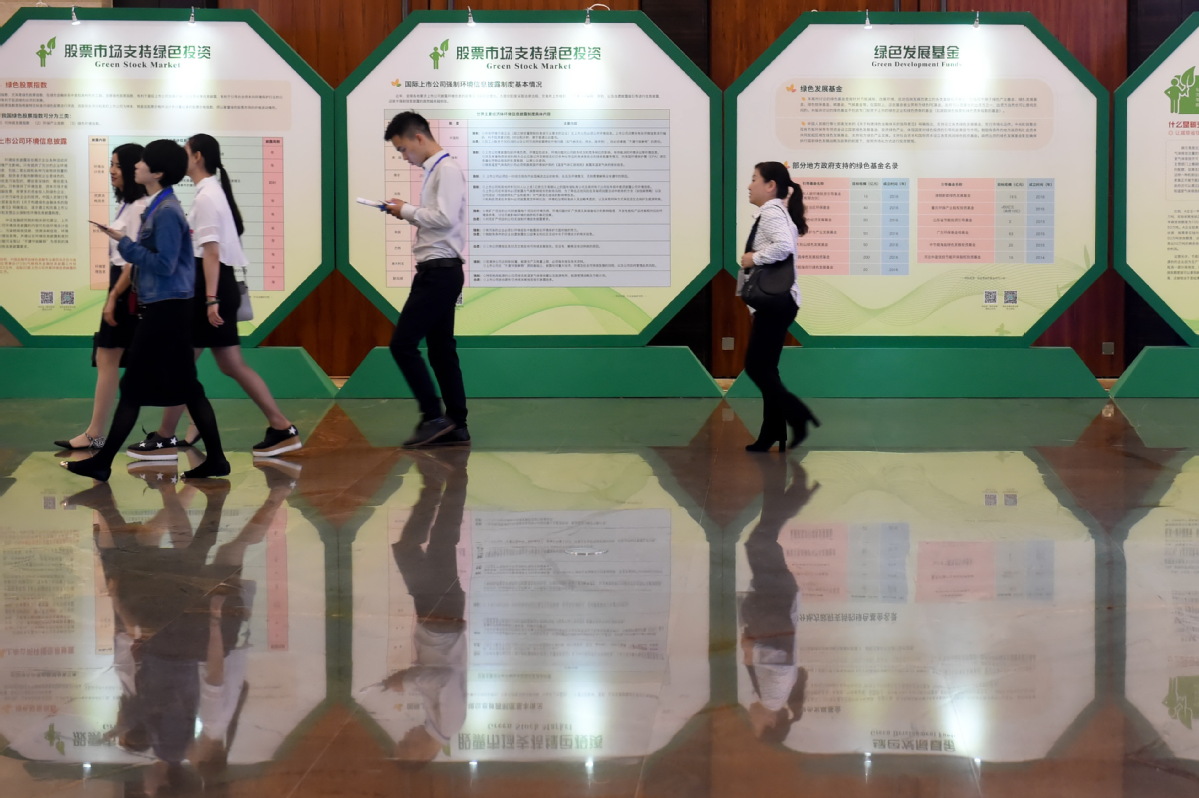
China's banking and insurance sector will accelerate the development of green finance and provide comprehensive financial services to assist in the country's transition toward a greener and low-carbon economy, regulatory officials said.
The world's second-largest economy should gradually improve regulatory framework for low-carbon development and green finance, establish green finance statistical monitoring and evaluation systems, and make standards for green finance information disclosure so that financial institutions will be able to comprehensively assess carbon footprints and strengthen environmental risk management, said Zhou Liang, vice-chairman of the China Banking and Insurance Regulatory Commission.
Financial institutions should innovate products and services, ramp up financial support for relevant sectors including renewable energy, green manufacturing and green transport, promote research, development and the application of green and low-carbon technologies, and explore various products such as climate bonds, green asset-backed securities and green insurance, Zhou said in Hangzhou, Zhejiang province, on Friday at a meeting for advancing the development of green finance.
"Green manufacturing and green consumption related investment and financing demands will be tremendous, which will create huge opportunities for business growth for China's banking and insurance sectors … During the process of achieving green and low-carbon development, the environmental and climate risk management capability of the financial sector will keep improving, and the financial system will become more resilient, safer and more sustainable," he said.
"On the other hand, the green transition will also bring risks to financial institutions. For example, as high-polluting, high-emitting companies and some high energy-consuming projects gradually exit the market, banks' asset quality may face the pressure of deterioration. Banking and insurance firms must handle well the relation between current and long-term interests, head in the right direction firmly while making sure to take steady steps, and include climate and environmental factors into their comprehensive risk management systems in a forward-looking manner," he said.
The regulator has also encouraged banks to strictly control carbon emission management for new projects, improve credit management, conduct scenario analysis and stress tests, assess the risk exposure of carbon emission reduction and environmental protection policies, and make contingency plans accordingly.
The work of promoting forced disclosure of environmental information could be first conducted by listed companies or in the country's green finance pilot zones, to provide financial institutions with the necessary information for making green financial product innovation and identifying climate-related risks, said Zhang Weiwu, senior executive vice-president of Industrial and Commercial Bank of China Ltd, the country's largest commercial lender by assets.
He urged regulators to unify the standards for green and low-carbon projects, and clearly define the investment and financing standards for green, low-carbon projects by clarifying their differences from non-green, high-carbon projects.
"Regulators should take into account the reality for China to realize its goal of hitting peak emissions by 2030 and achieving carbon neutrality by 2060, apart from taking the unification of domestic and international green standards into consideration. They should steadily promote China's transition toward a low-carbon economy in an orderly and prudent manner, according to the path and pace for the transition," Zhang said.
He also proposed that regulators step up incentives for financial institutions to make their transition toward green finance and consider granting permissions for innovation in green financial products, such as green asset-backed securities and green real estate investment trusts, in certain regions in an appropriate manner.