



Xinjiang meteorological workers strive for rainbow forecast accuracy









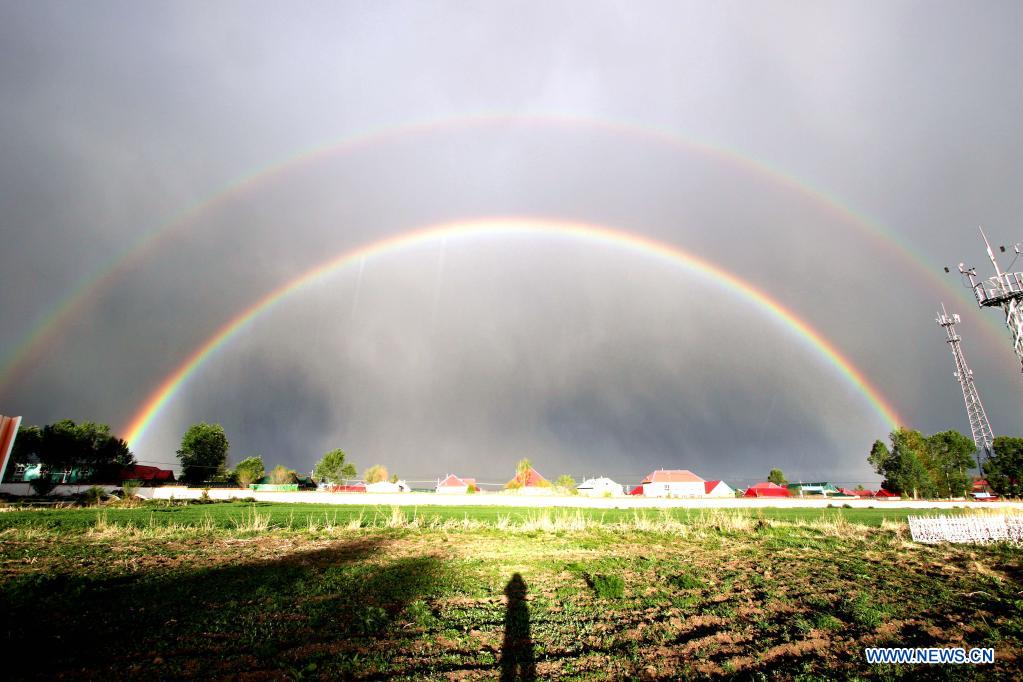
URUMQI - Wang Liping still remembers the first time she tracked a rainbow.
It was late in the afternoon on June 30, 2018, when she sat alone on a hilltop in Zhaosu county, Northwest China's Xinjiang Uygur autonomous region. She waited two hours until cloud clusters began to gather in the sky and raindrops began to fall.
Later, a partial rainbow appeared after the clouds cleared away.
"At that moment, I knew I had finally gotten what I really wanted. It was not just a rainbow, but a chance to prove the accuracy of my work," said the 33-year-old staffer at Zhaosu's meteorological bureau and a member of a rainbow forecast team of seven.
That day, she made a rainbow forecast report 10 hours in advance. It showed there was an 80 percent chance of rainbow occurrence and that they could be viewed from six locations across the county.
Every morning, either Wang or one of her colleagues spends 30 minutes making the day's rainbow forecast, including the possibility of rainbow occurrence and potential locations, after checking the weather forecast and cloud maps.
Their work is part of a broader effort by the bureau to develop the county's rainbow resources.
Zhaosu, located in a mountainous basin, sees frequent thundershowers during the summer. From June to August, convective clouds grow quickly into afternoon thundershowers, and there is always rain in the eastern sky while the sun sets in the west, creating the perfect conditions for rainbows.
According to Chen Chunyan, chief expert at the Xinjiang Meteorological Observatory, the requirements for rainbows include sufficient water vapor, clean air and a proper solar altitude. When sunlight encounters droplets, light is refracted, reflected and then refracted again before a rainbow appears.
Rainbows can be seen in Zhaosu almost 160 times from June to August, according to statistics provided by the bureau.
In 2017, photos capturing a double rainbow went viral on China's Twitter-like platform Sina Weibo, racking up views and comments. Some netizens said they hoped to see the rare event in person.
Such comments caught the attention of Wang Yuan, now head of the county's meteorological bureau, prompting her to take a new look at rainbows, which were nothing new to her. She wondered what the bureau could do to make full use of its resources.
"Rainbow forecasting could be an effective means of achieving our purpose -- contributing to the development of local tourism, and then to its economic development," she said.
Over the years, Wang Yuan and her colleagues have been promoting the improvement of the rainbow forecast weather service.
They established the rainbow forecast team in March 2017 to include the service in their daily work.
New to rainbow forecasting, the team worked out technicalities from scratch. Every time a rainbow appeared, they took videos and photos, kept notes on details such as when a rainbow began and ended, its location, and cloud and solar orientation, and analyzed data to figure out the laws of rainbows.
Four months later, the team successfully forecast a rainbow two hours in advance. In June 2018, it officially launched the rainbow weather service, providing forecast reports to local authorities like the bureau of tourism and culture.
Its efforts have yielded positive results. The county's natural conditions and the team's work won Zhaosu the title of "Rainbow Capital of China" from the China Meteorological Administration in late 2019.
The team has to date established a "rainbow gene bank" containing data on over 1,000 rainbows, including pictures and related meteorological information. It has made more than 370 rainbow forecast reports.
More organizations and locals have joined the efforts.
This year, the bureau has started collaborating with a subsidiary of the China Meteorological Administration to develop a model that is considered a time saver and a step toward intelligent forecasting.
In recent years, many specialized forecasts have been made in Xinjiang, including rainbow forecasts, according to Chen. "The rainbow forecast model itself is useful, but it will not be easy to improve its accuracy further in the future."
"We will continue to collect data and work with related organizations to improve the model in the hopes of gaining a higher forecasting accuracy rate and contributing to local tourism," said Wang Yuan.


- Increase in western Pacific military activities noted
- China, Pakistan pledge deeper military ties
- SPP to oversee handling of Shanxi mine explosion case
- Mine blast victims get mental health counseling
- China leads with ‘deep and real’ methane control efforts, expert says
- China calls for fair global ocean governance in Xiamen symposium





