



China-Europe trains have boosted investment and trade across Eurasia









Editor's Note: Better infrastructure connectivity including the Belt and Road Initiative, especially the China-Europe rail freight network, has played a big role in China becoming the top foreign direct investment destination as well as the top source of outward foreign direct investment in the world, writes a veteran journalist with China Daily in the fourth of a series of commentaries.
Most of the 44,000 Chinese-invested companies based in other countries and regions are subsidiaries of large and medium-sized Chinese enterprises, which means they have close links with the Chinese market.
Each day, hundreds of giant ships carrying oil, coal, timber and food products dock at busy Chinese ports. On their way back, they carry all kinds of equipment and daily necessities made in China. Urgent orders, of course, are delivered via airfreight.
This is how most of the cargo used to be transported from China to other countries, and the other way round, until 10 years ago when some Chinese people asked whether there was a better, faster and perhaps cheaper way to export goods to, as well as import goods from, other countries. Ship transport is usually cheaper than other modes of freight transport, but ships are vulnerable to pirate attacks in the Gulf waters and the Strait of Malacca and susceptible to accidents like the recent one in the Suez Canal. Airfreight is fast but very costly.
So a new transport route was proposed: a modern version of the ancient Silk Road that would connect China with Central Asia, the Middle East and Europe. The Silk Road was first used 2,000 years during the Han Dynasty (206 BC-AD 220) and reached its peak during the Tang Dynasty (618-907), when not only the Chinese but also other countries' merchants used it for trading tea, silk, porcelain and other goods.
But with ship transport graining ground, thanks to the development of navigation technologies, the Silk Road, which also brought Marco Polo to the Middle Kingdom, was eventually abandoned.
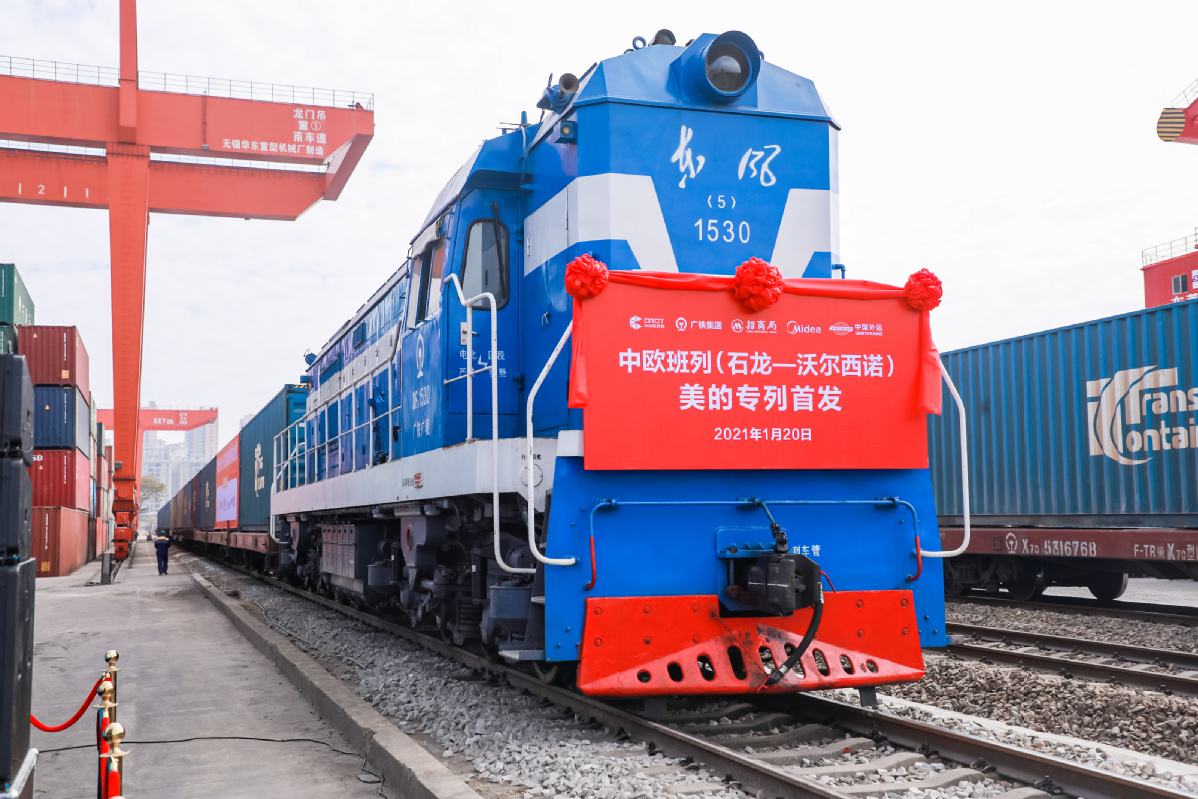
China's proposal of linking China with Europe with freight trains got enthusiastic response from more than 20 countries in Eurasia, although it took some time for the countries to work out rules and connect their railway networks, including laying new tracks.
Eventually, on March 19, 2011, the first China-Europe freight train left Chongqing in Southwest China for Europe. That whole year, however, only 17 freight trains departed from Chongqing for Europe. As Zhang Xin, who was involved in the project in Chongqing municipality, said: "At that time our goal was to ensure one train departed for Europe every day but we wondered whether we had set ourselves too ambitious a goal."
But soon Zhang's doubts were proved wrong. That China-Europe rail freight is far cheaper than airfreight and faster than sea transport-cargoes reach Europe in 10-12 days as compared with about 30-60 days by sea-h(huán)as made the sector a win-win proposition.
By the end of last year, more than 60 Chinese cities had been connected with 92 cities across 21 countries by the China-Europe railway network. Also, last year, the freight trains made 12,000 trips between China and Europe, up 50 percent from 2019. In the first two months of this year alone, more than 2,000 trips were completed, double the number in the same period of last year, and almost every other week there have been reports of a new city joining the network.
The China-Europe freight railway provides investors, both domestic and foreign, with a more profitable option. "By switching to the freight train service, we can save about 50 days of transport time and avoid potential breakdowns of the supply chain," said Zhuang Changbo, an official of Chinese automaker Changan.
The China-proposed Belt and Road Initiative has helped boost the progress of the China-Europe rail freight network, and vice-versa.
Last year, due to the impacts of the COVID-19 pandemic, China's outward foreign direct investment increased by only 3.3 percent year-on-year-albeit China was the only major economy to achieve positive growth in the field-while its foreign direct investment in the countries along the Belt and Road increased by 18.3 percent.
There are many reasons for the 18.3 percent increase in China's outward FDI, but a big part of them is the China-Europe freight railway, which incidentally helped improve the business environment in the Belt and Road countries through cheaper and faster transportation of goods.
The author is former deputy editor-in-chief of China Daily.
If you have a specific expertise, or would like to share your thought about our stories, then send us your writings at opinion@chinadaily.com.cn, and comment@chinadaily.com.cn.





