


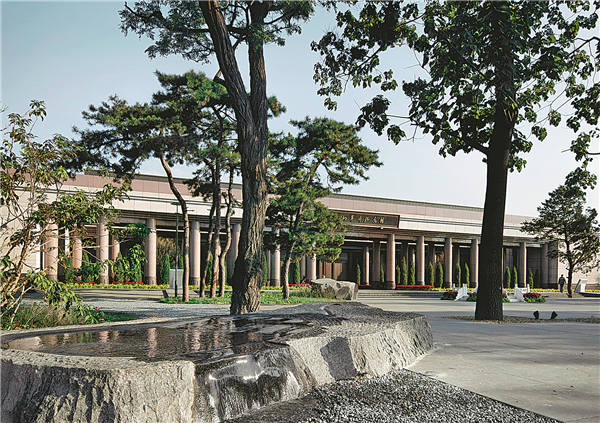
Xiangshan Mountain or Fragrant Hills, is famous for its landscape in the autumn when leaves turn red. And the attraction of the place is not only in the views it offers, but also its revolutionary history as a temporary headquarters of the Central Committee of the Communist Party of China in 1949, where Chairman Mao Zedong lived in Shuangqing Villa. It was here he directed the military campaign that led to the collapse of the Kuomintang regime.
On March 23, 1949, the CPC leadership left Xibaipo village in Hebei province for Beijing. They reviewed troops at Xiyuan Airport in Beijing, then settled down in Xiangshang in the western suburb of the city.
"Xiangshan is far from the city, so air attacks against it were difficult. Moreover, there was an urgent need for housing in the city after its liberation, so moving to the suburb did not disturb ordinary people's lives," says a tour guide at the Xiangshan revolutionary museum.
In April that year, the CPC and the Kuomintang held peace talks but failed to reach an agreement.
The CPC Central Military Commission sent soldiers to launch the campaign to cross the Yangtze River, and liberated Nanjing where the Kuomintang government was located.
Then, PLA troops marched ahead, engaged in battles in the north, northwest, east, and southwest parts of China, liberating the entire country.
When the final victory drew near, CPC leadership decided to hold the Chinese People's Political Consultative Conference in Beijing. In preparation, Mao and other leaders invited heads of non-Communist parties and public figures without party affiliation to Xiangshan to discuss plans for New China.
Mao moved from Xiangshan to the Zhongnanhai leadership compound in September 1949, followed by the whole of the CPC leadership. On Oct 1, the founding ceremony of New China was held at Tian'anmen Square.
To better reflect the history of the CPC Central Committee's stay in Xiangshan, a project was launched in 2018 to renovate the revolutionary sites in the area.
In 2019, the Xiangshan revolutionary museum was opened to the public. Revolutionary sites in the area include Shuangqing Villa, where Mao lived and worked, and the Laiqing Pavilion, where Party leaders Zhu De, Liu Shaoqi, Zhou Enlai and Ren Bishi resided. The sites have attracted more than 1 million visitors as of Jun 10 this year, according to the museum.
The exhibition, according to Zhang Aijun, the museum's director, shows the history of the CPC leadership in Xiangshan in a comprehensive way through the display of around 800 photos, maps, newspaper clippings, literature and 1,200 cultural relics. Highlights of the exhibition include the same model of jeep as the one Mao took from Xibaipo to Beijing, and the red lanterns used to decorate the Tian'anmen Rostrum at the 1949 founding ceremony.
Modern technology is also used in the exhibition. For example, an interactive multimedia exhibit features a map showing the liberation of the country, upon which visitors can follow the path the PLA took in liberating China. Since 2020, and the COVID-19 outbreak, people have also been able to view the exhibition online.
In the future, the museum plans to work as an education base for people, especially young people and Party members, to better understand the history while combining it with the venue's naturally stunning setting.





