



China vows to continue support for UN nuclear test ban treaty









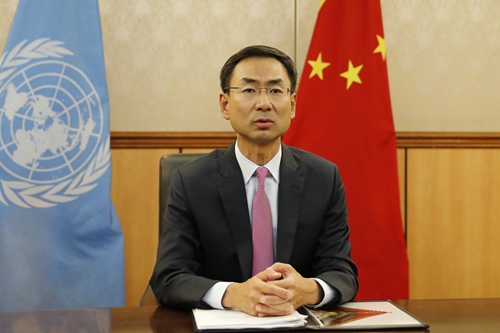
China will never be an obstacle to a multilateral treaty that bans all nuclear tests, and will continue to make contribution to facilitate its entry into force, a Chinese envoy reiterated Friday to a high-level United Nations conference.
"Since the very first day when it came into possession of nuclear weapons, the Chinese government has advocated the complete prohibition and thorough destruction of nuclear weapons," Geng Shuang, China's deputy permanent representative to the UN, told senior officials at the 2021 Conference on Facilitating the Entry into Force of the Comprehensive Nuclear Test Ban Treaty.
"China has solemnly declared that it would not be the first to use nuclear weapons at any time and under any circumstance, and unconditionally committed itself not to use or threaten to use nuclear weapons against Non-Nuclear-Weapon States or Nuclear-Weapon-Free Zones. China has always kept its nuclear forces at the minimum level required for national security," he added.
The Comprehensive Nuclear Test Ban Treaty, or the CTBT, which bans nuclear explosions by everyone, everywhere, was adopted by the UN General Assembly in 1996 as part of the international effort to ensure the absence of nuclear tests.
Since its adoption, the landmark treaty has been signed by 185 countries and ratified by 170 nations. To become an international law, it still needs signature and ratification from eight nations that possessed nuclear power reactors or research reactors from 1994-1996, the time the treaty was negotiated.
These countries included: China, Egypt, India, Iran, Israel, North Korea, Pakistan, and the US. Of the eight, China, Egypt, Israel, Iran, and the US, have all signed but have not ratified the pact. India, North Korea and Pakistan have yet to sign and ratify the accord.
"As one of the first signatories of the CTBT, China has always firmly upheld the purposes and objectives of the treaty. The Chinese government has all along strictly honored its commitment of moratorium on nuclear testing," Geng said.
He noted that China has always been an active supporter and participant of the CTBT's International Monitoring System, which keeps track of nuclear explosions across the globe. China is also the second largest financial contributor to the CTBT organization and cooperated with it on voluntary donation and research.
The CTBT has played a significant role in curbing nuclear arms race, Geng said. But with the changing international security situation, it's particularly important to bring the accord into force, something that requires the "collective, unremitting efforts of the international community," the envoy stressed.
He made five proposals on behalf of China. First up is the need to "practice true multilateralism."
"We should resolve disputes and differences through dialogues and consultations, and eradicate the root causes for the existence and proliferation of nuclear weapons, so as to create favorable political environment for the entry into force of the treaty," the envoy said.
Second, the international community should reject "the Cold War mentality" and oppose "the pursuit of absolute military superiority", Geng said. Instead, it should focus on maintaining "global strategic stability", so as to create necessary security environment for the CTBT to come into force, he said.
Third, China voices opposition to the "willful withdrawals from treaties or agreements", the envoy said.
"We should firmly defend the integrity, authority and effectiveness of the existing international arms control regime, so as to provide firm institutional guarantee for the entry into force of the treaty," Geng said.
Fourth, countries need to strengthen international consensus by continuing to advocate for the complete prohibition and destruction of nuclear weapons, so as to "inject strong political impetus" for the treaty, Geng said.
Finally, the envoy emphasized the importance of continuing to make progress on the preparatory work.
China supports the development of the mechanisms by the CTBT organization, such as the International Data Center, to scan the globe for nuclear tests in a "comprehensive and balanced manner", so as to lay a solid technical foundation for the treaty's entry into force, he said.
The CTBT conference took place from Sept 23 to 24 during the 76th session of the UN General Assembly's high-level week. It marks the 25th anniversary of the treaty's opening for signature and aimed to rally international support for its formal entry into force.










