



Painted pottery
No matter the number of discoveries during archaeological research in recent years, painted pottery remains a typical symbol of Yangshao Culture.
This pottery, with hand-drawn patterns of smooth lines and various forms, is often hailed by scholars as "the first artistic wave in the prehistoric period of China". The Miaodigou site and the area under its influence are generally considered to represent the highest-level achievements of Yangshao painted pottery, which was found as far as the middle reaches of the Yangtze River.
Li Shuicheng, an archaeology professor at Peking University, said, "During the boom time in Miaodigou, Yangshao Culture entered an era of unity with vast influence, which can be seen from painted pottery unearthed elsewhere."
Decorations on Yangshao painted pottery also include petals and patterns of an arc triangle and circular dots. Other designs such as birds, fish, human faces and flames are commonly seen.
In researchers' eyes, these designs are more than mere decorations.
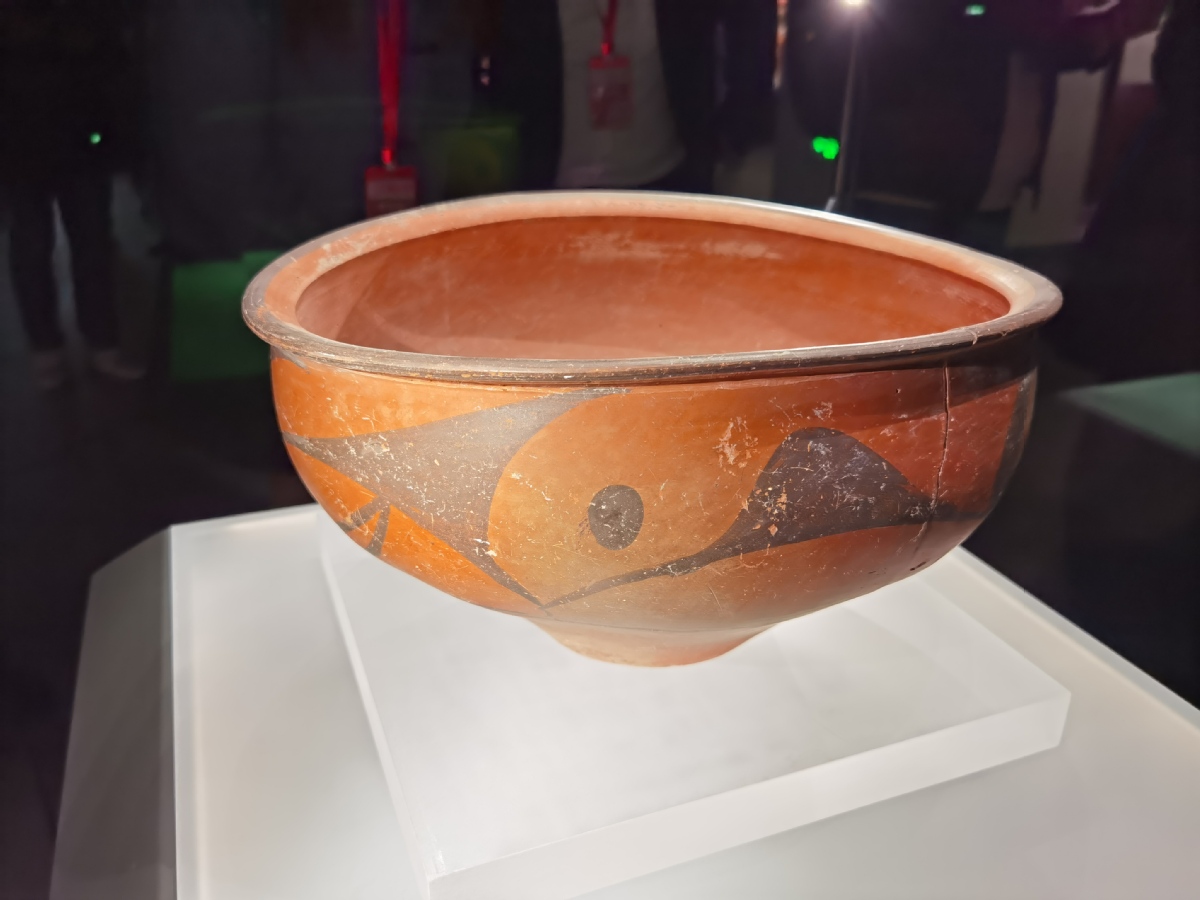
Ma Mingzhi, an associate researcher at the Shaanxi Academy of Archaeology, said that the designs may provide clues to a belief system, while the human face design is a symbol of witchcraft and priests.
"Birds and fish may have acted as ambassadors between the people and heaven," he said. "These patterns were not casually drawn on pottery to look good, and their use followed rigid rules involving the gods. Many variants await further clarification.
"Such a system could have influenced the worshipping of jade in China, and later inscriptions on bronzeware," he added.
Zhang Hai, deputy dean of the School of Archaeology and Museology at Peking University, said painted pottery only comprises about 10 percent of excavated Yangshao Culture ceramics.
"These items might not have been for daily use, but were probably set aside for special occasions," Zhang said. "Scholars' explanations of the designs still vary, but most of us tend to agree that they represent some shared ideologies."
Zhang said the expansion of Yangshao painted pottery accompanied the planting of millet, a fundamental and indigenous crop in North China.
"Due to such economic reasons, it was easier for people elsewhere to accept the ideology of Yangshao Culture and thus form an early-stage Chinese cultural circle," he said.
However, after Andersson's findings a century ago, this exquisite colored pottery triggered heated debate among scholars on the origins of Chinese culture.
In modern-day Romania, Moldova and Ukraine, an archaeological culture, Cucuteni-Trypillia, is known for its decorated pottery. It had designs similar to those of its Yangshao counterparts, so Andersson argued that Chinese culture came from the West.
However, discoveries in West China in the following decades put an end to such thoughts. Sites unearthed much later than those containing examples of Yangshao Culture were found in Gansu province and Xinjiang Uygur autonomous region.
The pottery discovered at these sites was apparently influenced by Yangshao Culture, indicating that the culture spread from Central China.
Li, the Peking University professor, said: "Subsequent cultures were incubated by Yangshao. That trend kept rolling westward, while the central plains of China absorbed cultural elements from the west, such as the use of jade, turquoise and bronze, providing a cornerstone for the Silk Road later," he said.
Still, an explanation was needed for the highly similar pottery of Cucuteni-Trypillia and Yangshao cultures, which existed around the same period, but at locations 7,000 km apart.
As a first step, in 2019, a group of experts from the Institute of Archaeology at the Chinese Academy of Social Sciences joined excavations in Dobrovat, a village in northeastern Romania where Cucuteni culture was discovered.
Li Xinwei, a researcher at the institute, said many clues are still missing, and other objects unearthed from the two cultures vary.
"However, archaeological findings clearly show that many ancient agrarian cultures across the Eurasian grasslands had a tradition of making painted pottery," Li Xinwei said. "Chinese culture continued and thrived, but some others didn't."
For example, he said that after Cucuteni-Trypillia Culture died out, there was no noticeable social development in the region until the rise of the Roman Empire.
"Even if we cannot prove there was a prehistoric, intercultural communication route spanning such a long distance, the studies had high value," he said. "We can better understand the characteristics of our own culture as it developed."





