


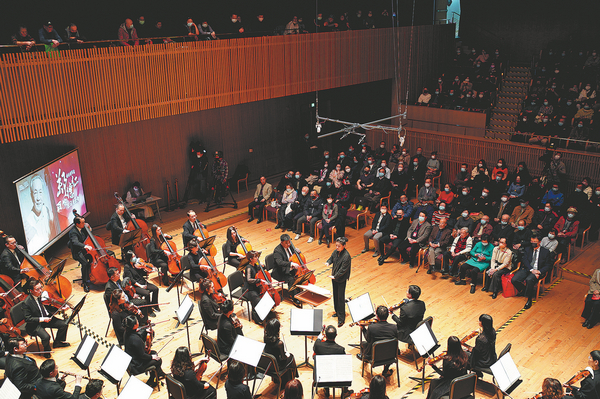
Born in Shanghai in 1923, Zheng grew up playing the trumpet in a boyscout band before learning how to play the violin and subsequently the double bass during the tumultuous Pacific War period. One of the major turning points in his life took place in 1941 when several leading universities in China moved to southwestern China to start the National Southwest Associated University. Zheng enrolled in Jinan University, one of the institutions involved.
However, as he was getting ready to travel to Kunming, Yunnan province, to study economy at the new university, he suddenly lost contact with his seafaring father because of the war. The family only heard from the father, who had been stranded in Australia, five years later.
As the eldest child in the family, Zheng was left with no choice but to abandon his plan of going to university and shoulder the responsibility of providing for his mother, two younger brothers and two younger sisters. To make ends meet, he took up a job as a librarian in Shanghai. Realizing that the salary was insufficient to provide for his large family, Zheng thought about supplementing his income by moonlighting as a performer. With a few music-loving friends, Zheng set up a band that auditioned for performance slots at night clubs and dance halls.
The make-up of the band proved to be fortunate. At a time when most Chinese musicians only knew how to play traditional Chinese instruments, Zheng's band easily stood out from the competition due to their proficiency in Western instruments such as the violin, mandolin and piano. Before long, the band signed a lucrative three-year contract with Cosmos Club, which offered Zheng a salary five times that of his day job. With musicians from the Philippines and Russia, Zheng and his band entertained audiences while getting to hone their skills.
When the Shanghai National School of Music (known today as the Shanghai Conservatory of Music) announced its first public student recruitment in 1943, Zheng decided to make the leap of faith and focus on carving out a career in music. He aced the entrance exam, becoming one of only 30 people out of 600 applicants to make the cut.
Fascinated by the deep sounds produced by the cello, Zheng set his mind on majoring in the instrument. But Russian teacher, J. Shevtzoff, who was the principal cellist in the Shanghai Municipal Orchestra, suggested that Zheng take up the double bass instead because he had already recruited eight cello students. Zheng then turned to learning the double bass.
Zhu Shunhua, the principal bassist with the Shanghai Symphony Orchestra who had been one of Zheng's students, says the nature of the instrument benefitted his teacher's role as he would go on to guide future generations of bassists in China.
"The double bass in an orchestra is like a foundation in architecture. If the bass section fails to uphold the structure, the entire performance will collapse," says Zhu. "Although it is primarily a supporting instrument, the double bass produces such beautiful and striking sounds as a solo instrument that a slight pluck of the string is enough to touch your heart."





