



Driverless vehicles park themselves in rapidly expanding market









Mercedes-Benz said it is planning to introduce its Level 3 technology in China and the US from Germany, where the technology has been certified by local authorities.
Last month, the carmaker opened a research and development center in Shanghai, which will work in fields such as connectivity, automated driving and big data.
Consulting company IHS Markit said smart driving is gaining traction, especially in China, adding that new cars with functions at or above Level 2 will comprise at least 45 percent of the nation's market in 2025, and more than 80 percent in 2030.
These promising prospects are encouraging automakers to invest heavily in the sector. SAIC Motor, the Chinese partner of Volkswagen and General Motors, said it is allocating 300 billion yuan ($47 billion) to develop smart vehicle features, including functions at Level 2 and above.
Great Wall Motors, China's largest SUV maker, has spun off Haomo, an arm dedicated to autonomous driving.
Gu Weihao, CEO of the two-year-old startup, said its ADAS system will be available in 34 models this year, up from five Great Wall Motors models last year. He added that more than 1 million passenger vehicles will feature this system in the next three years.
Haomo also produces driverless Level 4 logistics vehicles, some of which are delivering groceries to residents in Beijing and also e-commerce parcels to university campuses in Wuhan, Hubei province, and Hangzhou, Zhejiang province.
Like Haomo, Baidu is betting big on Level 4 technology, which means that under most circumstances vehicles can navigate themselves.
The internet giant, which is based in Beijing, is targeting the robotaxi market. Apollo Go, Baidu's autonomous ride-hailing service, provided some 213,000 rides free of charge in the fourth quarter of last year, more than double the number in the third quarter.
The service is now available in eight cities, including Beijing and Shanghai, where users can hail a robotaxi via a smartphone app. Baidu CEO Robin Li told the media last month that the service will be available in 65 cities by 2025 and 100 cities by 2030.
Meanwhile, the authorities are rolling out policies to explore opportunities in the sector.
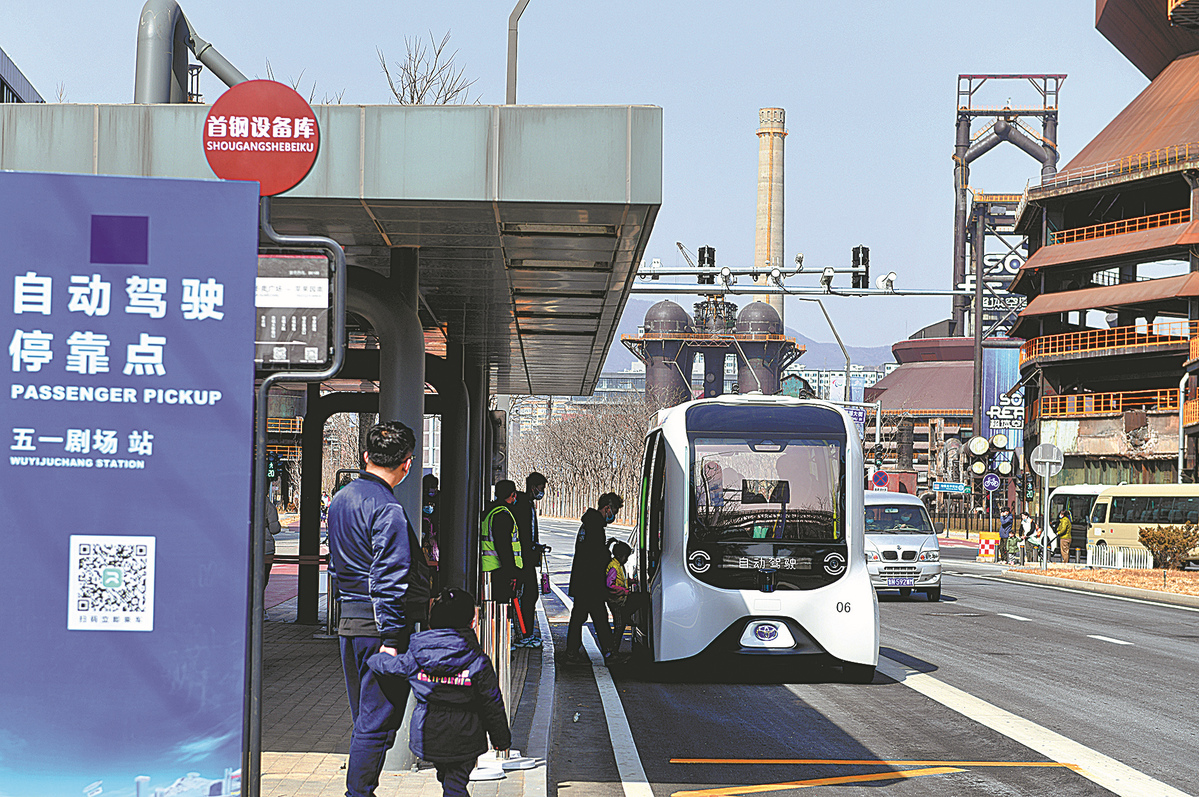
In November, China's first pilot area for commercial robotaxi fleets was launched in Beijing, with paid services authorized in an area of 60 square kilometers in the suburbs.
Baidu and the Toyota-backed startup Pony.ai were among the first to receive permits to offer such services in the pilot area.
Lou Tiancheng, Pony.ai co-founder and chief technology officer, said its virtual driver is "now equal or superior to a human driver" in most circumstances.
"We're confident about our autonomous vehicle technology readiness as we rapidly move toward robotaxi and robotruck commercialization and mass production," he said.











