


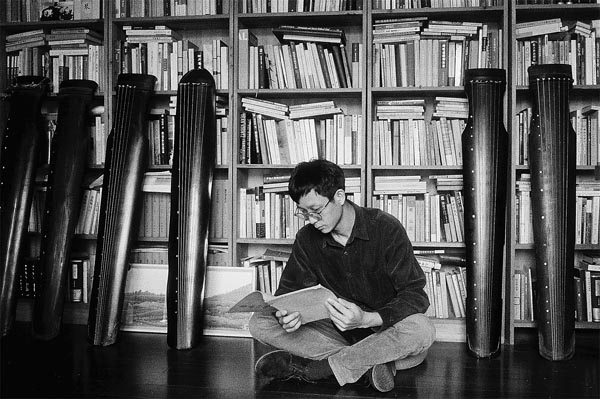
"You don't consider the consequences of your decisions at 16. I was simply attracted by something and drawn to start a journey to find it," says Yang.
After nearly 20 years, Yang, now 35, says he does not regret his choice as he's satisfied with his current life, but, sometimes, he feels curious about how his life would have turned out if he had taken another path.
"He is very independent, a little rebellious, and has his own understanding of the world," says Le Shenme, a friend of Yang.
He bought a guqin in Shijiazhuang, Hebei province, and then went to Shaolin Temple where he was introduced to martial arts by a Buddhist surnamed Wu. Life there was so different from what he had imagined, that, several times, he expressed a wish to leave, but Wu persuaded him otherwise.
In his spare time, he explored the instrument he bought. He got in touch with a man who made guqin in Luoyang, Henan, and decided to visit him. The following summer, he left Shaolin Temple for Luoyang, and spent half a year there learning how to make guqin.
At the end of 2004, he went back home and tried to make guqin by himself, but didn't manage to complete one. In 2005, his father died in a traffic accident, and Yang plunged himself into a sea of books to dispel his grief. He records in his book how, since his mother had nearly no demands beyond him being happy, he became more free.
"That seems to be a keystone for my later life, which, ever since, has all been about freedom," says Yang.
In 2009, when he was invited by a friend to go to Ningbo, Zhejiang province, he agreed and took on the journey, carrying tools to make guqin and some books he liked.
He made a concerted effort to learn playing and making guqin by himself. He first learned to read guqin score, then he found audio of the pieces of music he wanted to play, trying to perfect them by reading scores and imitating the audio.
This way of learning guqin is quite different from the traditional method. In the old days, guqin was taught face-to-face-literally. The teacher and student sat opposite each other. They created a part of melody together, without going ahead to the next part until the student could play as well as the teacher.
According to a book written by guqin master Yang Zongji (1863-1932), he learned a piece of music by playing it nearly 1,000 times with his teacher Huang Mianzhi.
Later, Yang Lan found that he met difficulties. Different from the scores for some Western instruments, which record the melody and rhythm of the music, the score for guqin only records the fingering.
"You can see a guqin score as an exposition, full of descriptions about where to put your fingers and which string you should pluck, but it doesn't tell you the result of the fingering, no melody or rhythm. No one knows how the music actually sounded in ancient times.
"So the score offers the player a lot of freedom. Mature players can create music according to their unique understanding based on experience, and don't need to follow a composer. But for a beginner, there's a big obstacle," says Yang Lan.





