


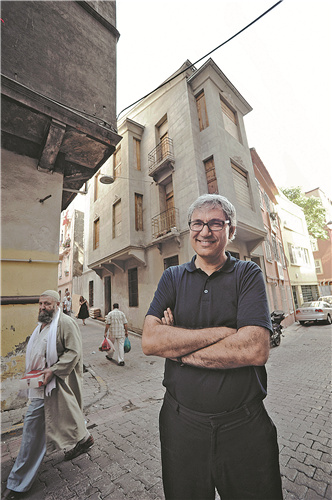
"I want to tell everyone, please take your children to museums. Maybe they will be bored in their childhood, but in the end that may make them museum lovers." Turkish Nobel laureate Orhan Pamuk encouraged more museum visits on May 18, International Museum Day, when guiding an online tour of the Museum of Innocence in Cukurcuma, a historical neighborhood in Istanbul, for Chinese readers.
He introduced how he created the homonymous novel and the museum, the exhibits, and his philosophy of museum and art during the tour, launched in cooperation with the Chinese publisher of 14 of his works, Beijing-based Horizon Books. The video was recorded in advance and released on International Museum Day.
"We hope readers can get to know more about Pamuk's museum philosophy, his unique style and ideas that have been clearly expressed in the video, from his interpretation on literature and museology, to his modest manifesto for museums," says Wang Ling, deputy general manager of Horizon Books. She was one of the editors of The Museum of Innocence when the novel was first published in Chinese in 2010.
This year marks the 10th anniversary of the museum. More than a quarter of a million people have visited in the past decade and although there was a drop due to the COVID-19 pandemic, visitor numbers will hit a record this year, according to Pamuk. Some readers come with the novel in hand, as there's a free ticket in each copy.
The Museum of Innocence was published in 2008, the first full-length novel after Pamuk won the Nobel Prize in Literature in 2006. He's the first Turkish author to get the award.
The novel tells a love story, set through the 1970s to the beginning of the 21st century, between 30-year-old rich man Kemal, who was engaged to Sibel from a noble family but fell in love with a poor, remote relative of his, Fusun, who was 18 years old.
They were together shortly. But when Kemal finally broke off the engagement, Fusun disappeared. When they met again around one year later, Fusun was married.
Kemal then stopped by at Fusun's home frequently over the next eight years, staying until late at night, and collected objects Fusun liked or even just touched, including 4,213 cigarette butts, and displayed them in a small museum he created called the Museum of Innocence.
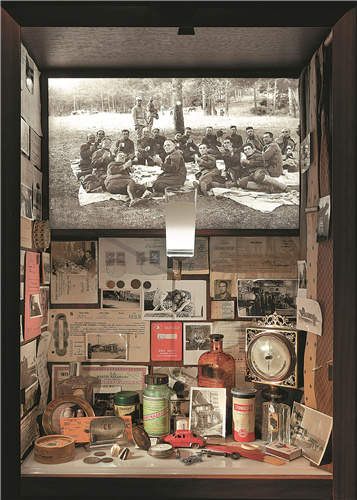
The novel touches the obsessiveness of intimacy and human nature, social and political issues of Turkey in a transition period, and, intended or unintended, the social pressure on women squeezed in the overlap of tradition and modernity. Despite that, the novel was written in two men's narrations.
"I conceived it in my mind together, the museum and the novel. It's not that I created a successful novel and decided to make the museum," Pamuk says, adding that the novel, together with another derived book called The Innocence of Objects, operates as a catalogue of the museum.
"The museum is not an illustration of the novel, neither the novel an explanation of the museum."
He concludes that the museum and the novel intertwine, shadow and complement each other while having different logics: the museum would not help visitors understand the novel, but present the visual world of the characters.





