



Trade agreement to aid economic growth









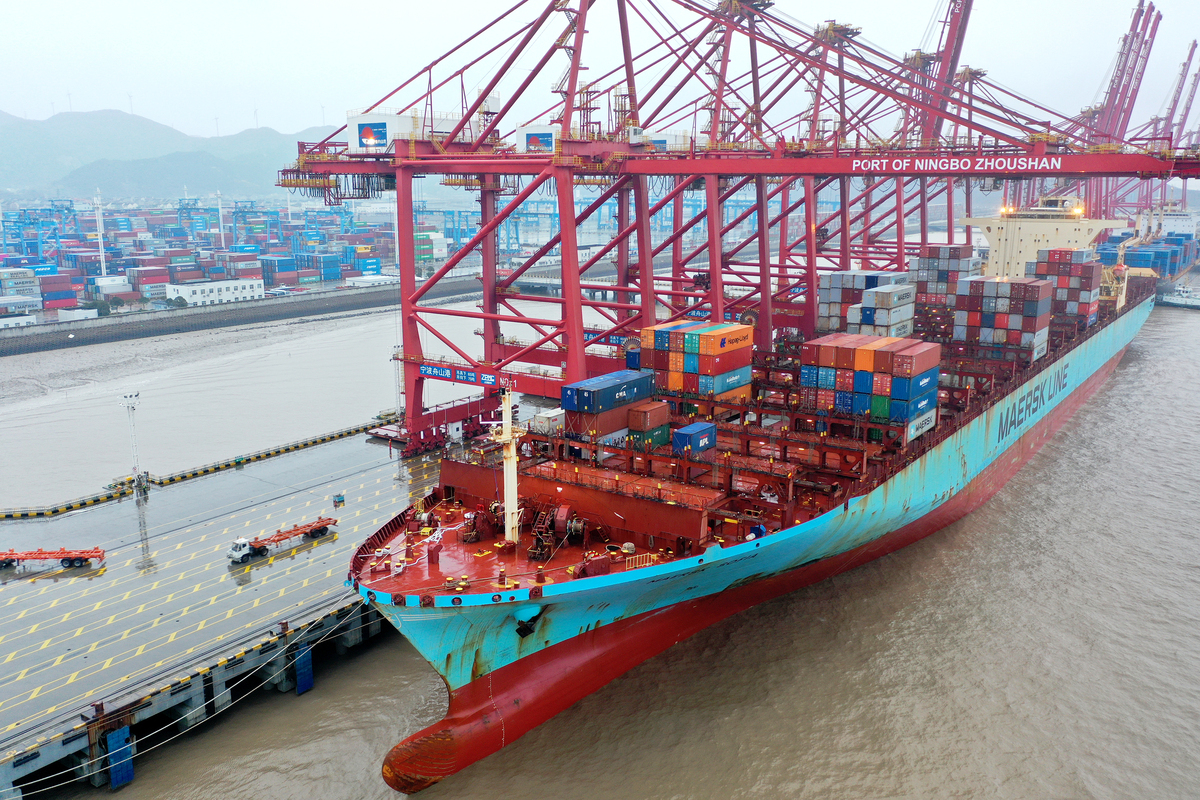
Experts say RCEP will help countries better meet digital transformation goals
The digital trade, regional connectivity and efficient industrial chain sectors will help member countries of the Regional Comprehensive Economic Partnership boost economic growth in the post-pandemic era, experts and global business leaders said on Sunday.
Addressing a sub-session of the RCEP Media & Think Tank Forum in South China's Hainan province, held both online and offline, they said these are practical business areas that can promote the restructuring of the industrial supply chain and bolster the drive for common prosperity in the Asia-Pacific region, amid global uncertainties.
Shen Yuliang, director of the international trade office of the Institute of World Economics, Shanghai Academy of Social Sciences, said that under the RCEP framework, multilaterally unified comprehensive e-commerce rules will accelerate the digital transformation and upgrading of the regional supply chain.
Apart from facilitating the institutional environment for the growth of the digital economy, the rules in this field will help build a solid foundation for RCEP countries to expand their trade volume via digital trade in the coming years, said Zhang Jianping, deputy director of the academic committee of the Ministry of Commerce's Research Institute.
Digital trade comprises both digitally ordered trade in goods and services, including cross-border e-commerce, and digitally delivered trade such as services delivered internationally through the internet or other networks, according to the United Nations Conference on Trade and Development.
Li Jie, vice-president of the Chinese People's Institute of Foreign Affairs, said the megapact will support universal and equal participation in the growth of the digital economy, narrowing the technology gap and gradually realizing the digital transformation of the economy in the years to come.
The RCEP has adopted many creative ways in the design of specific rules, so that member countries can easily find a position in the regional industrial chain that suits their advantages, said Yose Rizal Damuri, executive director of the Jakarta-based Center for Strategic and International Studies.
Together with enhanced regional connectivity projects, Shada Islam, founder of the China-EU Forum, said the free trade deal also plays a positive role in expanding market access for investment, harmonizing rules and regulations, streamlining customs procedures and setting standards and rules concerning the development of e-commerce and small and medium-sized enterprises.
The New International Land-Sea Trade Corridor, a trade and logistics passage jointly built by western Chinese provincial regions and Singapore, has promoted close ties between western China and RCEP members in Southeast Asia, and has bolstered the smooth flow of economic and trade exchanges between the two sides.
Freight trains from the corridor delivered 170,000 twenty-foot equivalent units in the first quarter of this year, soaring 56.5 percent year-on-year, according to national railway operator China State Railway Group.
The RCEP will encourage more cross-border trade, investment and flows of people across the Asia-Pacific region, thus expediting economic and trade integration in the region. It will create substantial new trade and investment opportunities, said Harley Seyedin, president of the American Chamber of Commerce in South China.
Arthur Xu, president for China of Danfoss Group, a Danish engineering company, said the pact will not only boost trade activities in the Asia-Pacific region but also innovation. The reinforced protection of intellectual property rights further boosts the confidence of global companies to lift up China from a manufacturing base to an innovation base, he said.
In addition to shipping more products manufactured in its plants in China to other RCEP member countries in the future, he said the company will invest 300 million yuan ($44.79 million) to build new manufacturing facilities in Tianjin to support its growth in the Asia-Pacific region in the second half of this year.











