


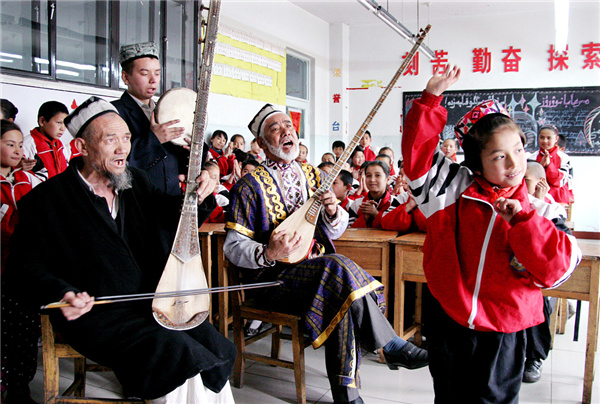
Art center director Rehman Ablimit enjoys his daily routine of leading actors through rehearsals.
The 53-year-old is from Yarkant county in Northwest China's Xinjiang Uygur autonomous region. The county is known as the hometown of the "12 Muqam". It is an art form known as the "mother of Uygur music", which combines classical Uygur songs, dances and music.
It was almost lost before the founding of the People's Republic of China in 1949.
Thanks to the efforts of the government and local folk artists, the art form lives on.
The government arranges for folk artists to participate in training in the art form for 15 to 30 days every year, according to Rehman.
"Each artist receives a subsidy of 50 yuan (about $7.5) a day. They learn a Muqam piece every year while practicing dance and participating in various programs," he says.
To promote inheritance of the art form, the local government has invested 5 million yuan in the construction of the Muqam art center, which Rehman works with. The performance hall can accommodate hundreds of performers, and any visitor is welcome to learn the art form there.
In 2005, the Xinjiang Uygur Muqam of China was approved by UNESCO as an intangible heritage of humanity.
Awut Yuwup, an inheritor of the art form, has taught more than 60 apprentices. He has led his troupe to many provinces in eastern China to perform and introduce the art form.
"I'm proud to be a practitioner, as we can perform outside Xinjiang and spread our intangible cultural heritage," he says.
The art form has also attracted cultural enthusiasts from other parts of China.
Wang Jiangjiang, 37, from North China's Hebei province, studied opera performance and composition in Italy. He came to Xinjiang in 2010, devoting himself to establishing a "music database" of Muqam artists. He has interviewed and recorded videos of more than 3,000 Muqam artists to date.
"Muqam songs are full of ups and downs, and the drumbeats are changeable, and this can only be passed down by practitioners. At the same time, the art form's system is huge, its words are profound, and its songs are long. It is difficult to recite them completely," Wang says.
"Today, few people can sing all the pieces, and I think that is one of the reasons why they need to be recorded," he says.





