


Voice of sage of the ages echoes down the centuries









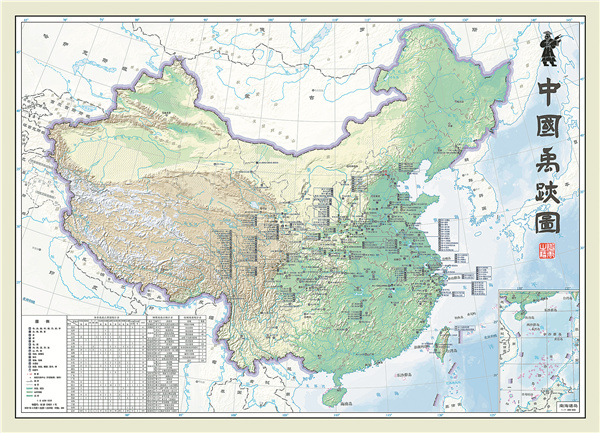
For a long time, Yu had been regarded by some as mythical, but more recent archaeological and historical findings have led to a revaluation of the historicity of him and his flood control. In the 1960s archaeological excavations at Erlitou in Yanshi, Henan province, an early Bronze Age site, turned up remains of palaces and ancestral temples that predated the Shang Dynasty (c. 16th century-11th century BC). The ruins of Wangchenggang, in Dengfeng, Henan province, excavated in the 1970s, are believed to be the capital established by Yu in about 2070 BC and recorded in pre-Qin (221-206 BC) literature.
Archaeological excavations have also confirmed that several regional civilizations existed along the Yellow River, the Huaihe River, as well as the middle and lower reaches of the Yangtze River and the Taihu Plain between 10,000 and 4,000 years ago.
In fact, in the Song Dynasty (960-1279), an effort had already been made to draw the Yuji Tu (Map of Traces of Yu). The one that had been engraved on a stele in 1136, and that now resides in the Forest of Stone Steles Museum in Xi'an, Shaanxi province, is one of the earliest extant national maps and among the most famous.
The first attempts to make the current Zhongguo Yuji Tu were in 2017, when Qiu and his collaborators set out to compile the Shaoxing Yuji Tu (Map of Traces of Yu in the city of Shaoxing in Zhejiang province), which was published in 2018 and the following year was expanded to become the Zhejiang Yuji Tu (Map of Traces of Yu in Zhejiang province). It is no coincidence that Shaoxing was the focal point, for it was to this place that Qin Shihuang (259-210 BC), China's first emperor, traveled and performed sacrificial rituals for Yu the Great.
Shaoxing is also where Yu's mausoleum lies today and where the most widely heard story of his is said to have taken place.
It is said that when Yu the Great went about taming the floods, he met a member of a local clan and they married. However, a few days later Yu had to leave home to continue fighting the scourge of floods. For the next 13 years he did not set foot in his home again, even though he went by it three times.