


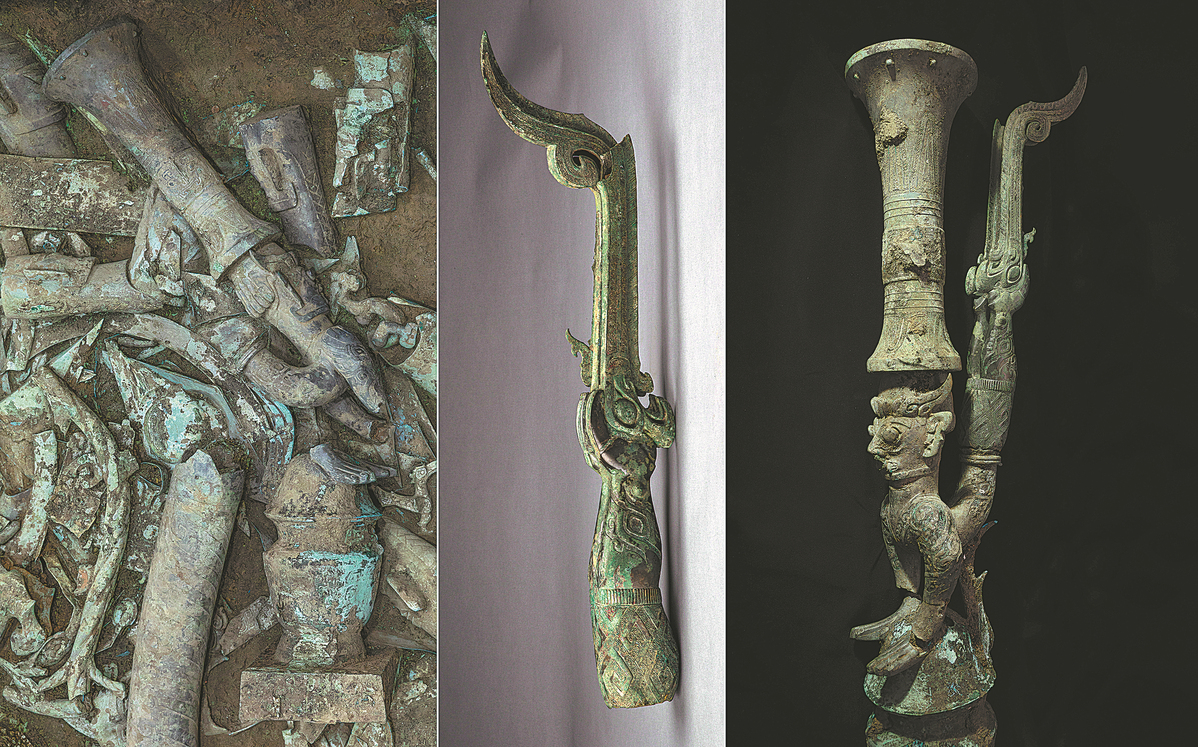
An exquisite and exotic-looking bronze statue recently excavated from the Sanxingdui site in Guanghan, Sichuan province, may offer tantalizing clues to decoding the mysterious religious rituals surrounding the famous 3,000-year-old archaeological site, scientific experts said.
A human figure with a serpent-like body and a ritual vessel known as a zun on its head, was unearthed from the No 8 "sacrificial pit" from Sanxingdui. Archaeologists working on the site confirmed on Thursday that another artifact found several decades ago is a broken part of this newly unearthed one.
In 1986, one part of this statue, a man's curving lower body joined with a pair of bird's feet, was found in the No 2 pit a few meters away. The third part of the statue, a pair of hands holding a vessel known as a lei, was also recently found in the No 8 pit.
After being separated for 3 millennia, the parts were finally reunited in the conservation laboratory to form a whole body, which has an appearance similar to an acrobat.
Two pits full of bronze artifacts with a bizarre appearance, generally thought by archaeologists to have been used for sacrificial ceremonies, were accidentally found in Sanxingdui in 1986, making it one of biggest archaeological finds in China in the 20th century.
Six more pits were found in Sanxingdui in 2019. Over 13,000 relics, including 3,000 artifacts in complete structure, were unearthed in the excavation which started in 2020.
Some scholars speculate the artifacts were deliberately smashed before being put underground in sacrifices by the ancient Shu people, who dominated the region then. Matching the same artifacts recovered from different pits tends to lend credence to that theory, the scientists said.
"The parts were separated before being buried in the pits," explained Ran Honglin, a leading archaeologist working on the Sanxingdui site. "They also showed that the two pits were dug within the same period. The finding is thus of high value because it helped us better know the relations of the pits and the social background of communities then."
Ran, from the Sichuan Provincial Cultural Relics and Archaeology Research Institute, said many broken parts may also be "puzzles" waiting to be put together by the scientists.
"Many more relics may be of the same body," he said. "We have many surprises to expect."
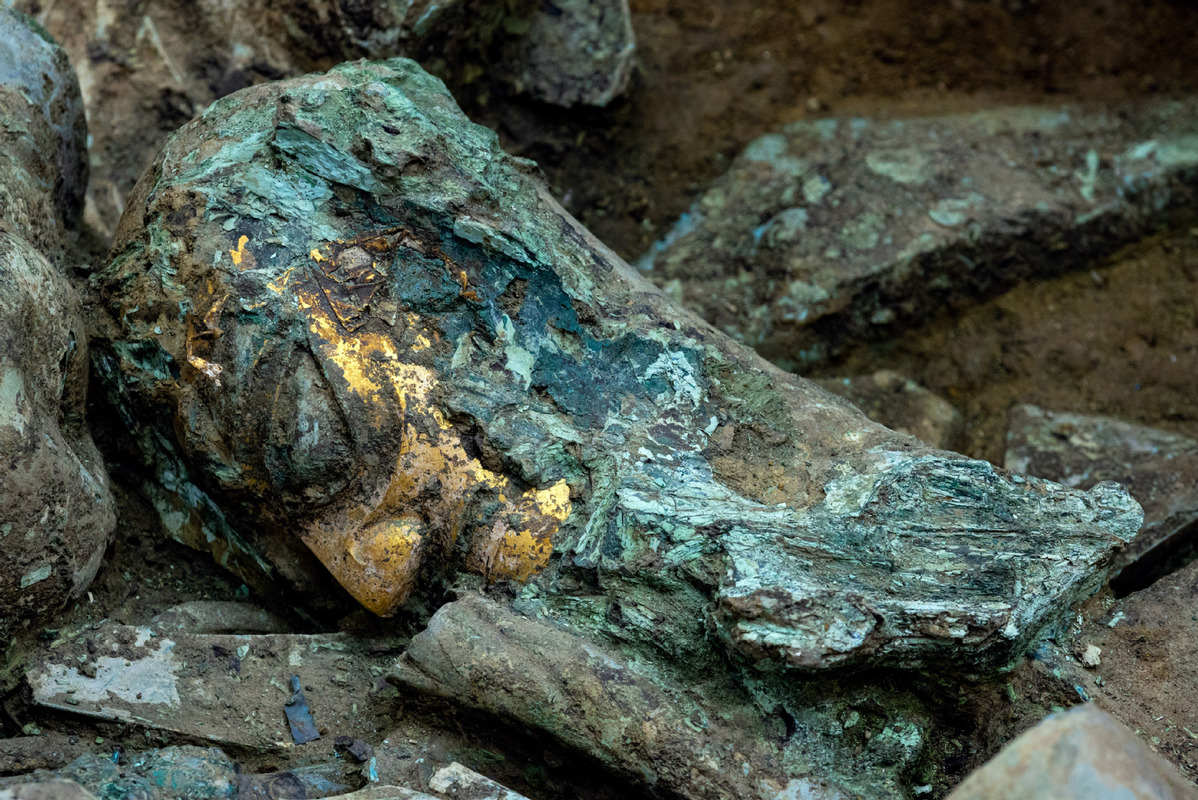
Figurines in Sanxingdui were thought to reflect people in two major social classes, differentiated from each other through their hairstyles. Since the newly found artifact with the serpent-like body has a third type of hairstyle, it possibly indicated another group of people with a special status, the researchers said.
Bronze wares in previously unknown and stunning shapes continued to be found in the pits in the ongoing round of excavations, which is expected to last until early next year, with more time needed for conservation and study, Ran said.
Wang Wei, director and researcher at the Chinese Academy of Social Sciences' Academic Division of History, said studies of Sanxingdui were still at an early stage. "The next step is to look for ruins of large-scale architecture, which may indicate a shrine," he said.
A construction foundation, covering 80 square meters, was recently found near the "sacrificial pits" but it is too early to determine and recognize what they are used for or their nature. "Possible discovery of high-level mausoleums in the future will also breed more crucial clues," Wang said.





