



Xinjiang condemns US' 'Uyghur Forced Labor Prevention Act'









The Xinjiang Uygur autonomous region strongly condemns and firmly opposes the United States' "Uyghur Forced Labor Prevention Act", said a spokesman for the region's government, noting that the act seriously undermines the stability of the international supply chain.
"So-called forced labor in Xinjiang is totally the lie of the century," said spokesman Xu Guixiang at a recent online news conference. "It's an upgrade of the US' crackdown on China under the pretext of human rights."
Under the act, which was passed at the end of 2021 and took effect on Tuesday, US Customs and Border Protection will block all imports made wholly or partly in Xinjiang, citing "forced labor" as the reason. Importers must prove to authorities with "clear and convincing evidence" that the goods are not produced by "forced labor" should they want to resume the imports, according to the USCBP.
The move would seriously harm enterprises and consumers in both China and the US, said the spokesman, stressing that the interests of Chinese and foreign companies intersect quite closely and cannot be divided, as the world has already become a shared community with deepening globalization.
He also warned sanctions that violate international law and trade rules would severely threaten the security of global industrial and supply chains and seriously damage the fair international business environment.
"The US has asked all companies relevant to Xinjiang to prove their own innocence, which would definitely force companies to spend plenty of human resources, materials and finances on useless work and place an increasingly unreasonable burden on them," Xu said.
Published in mid-June, just before the US act banning Xinjiang-related imports took effect in the country, a Sheffield Hallam University report accused four major photovoltaic cell manufacturers in the region, including Xinjiang Zhongtai Chemical, of using "forced" or "transferred" workers.
"Irrespective of how employees join the company, we sign labor contracts with them on the basis of equity and free will and inform them of their rights and duties," said Shang Xiaoke, trade union director at Xinjiang Zhongtai Chemical.
The company employs workers via recruitment through websites, on campuses and the open market, as well as through internal recommendations, he said.
The trade union leader said the company strictly implements labor laws, including the laws on work safety and the prevention and treatment of occupational diseases, and constantly improves the working environment.
"We strictly follow the system of the eight-hour shift day as required by law," he said, stressing that extra work is compensated with overtime pay and holidays.
In response to the US act, Shang said the company's recruitment is a market action and involves two-way selection.
"If workers are satisfied with the salary and benefits provided by the company, they will stay. Otherwise, they will go. Also, companies will pay more for the more talented workers," he said.
Chen Zhongkuan, vice-president for the regional federation of trade unions, said trade unions at various levels in Xinjiang spend around half their time interviewing workers to learn about their unique situations, including the implementation of labor rights laws, signing labor contracts, collective salary negotiation and the special rights of female workers.
"We, together with the Xinjiang bar association, have established a group of nearly 1,000 volunteer rights-protecting lawyers to offer workers free legal consulting and services," he said.
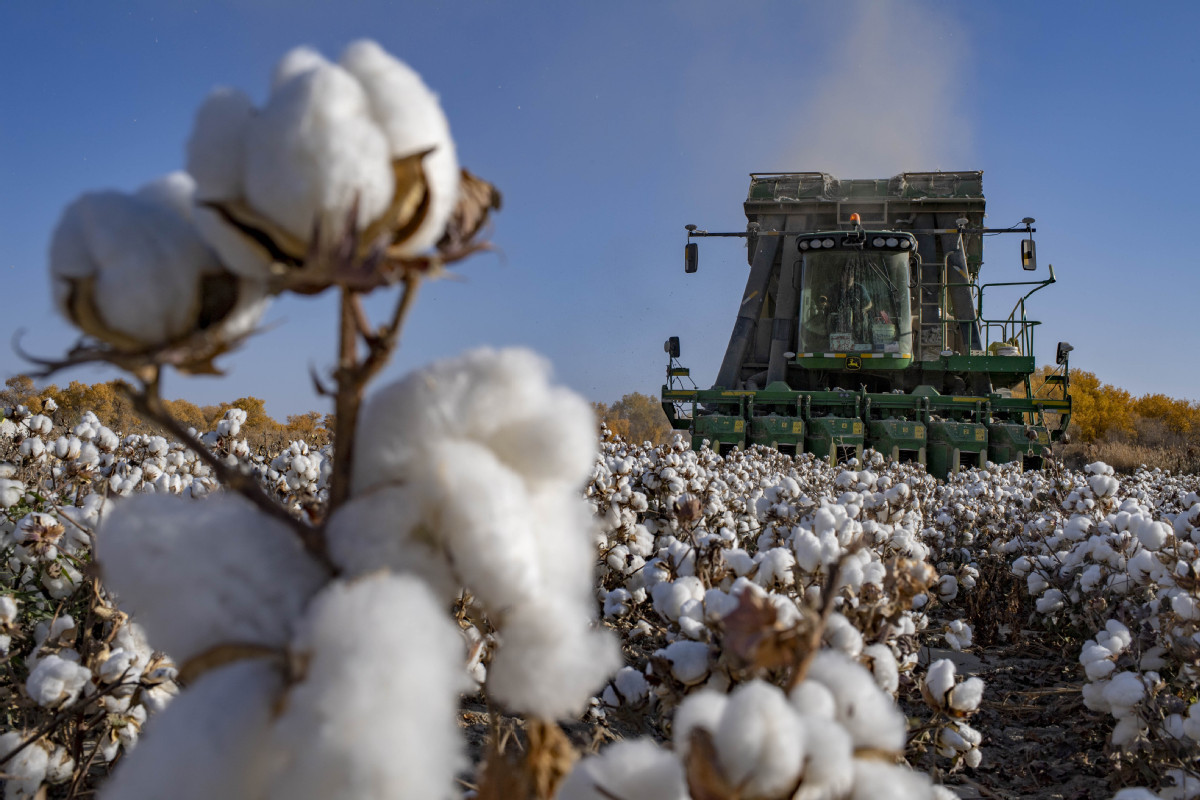
Wu Sheng, director of the regional cotton association, said the mechanization rate of cotton production in northern Xinjiang is above 95 percent, and the rate in the southern region exceeds 80 percent. This is due to the popularization of cotton-picking mechanization over the years.
"That has raised the cotton-planting efficiency in Xinjiang and significantly lowered the planting and labor cost."


- Increase in western Pacific military activities noted
- China, Pakistan pledge deeper military ties
- SPP to oversee handling of Shanxi mine explosion case
- Mine blast victims get mental health counseling
- China leads with ‘deep and real’ methane control efforts, expert says
- China calls for fair global ocean governance in Xiamen symposium





