



The BRICS collectivity: Its moment of reckoning in COVID-wake schema









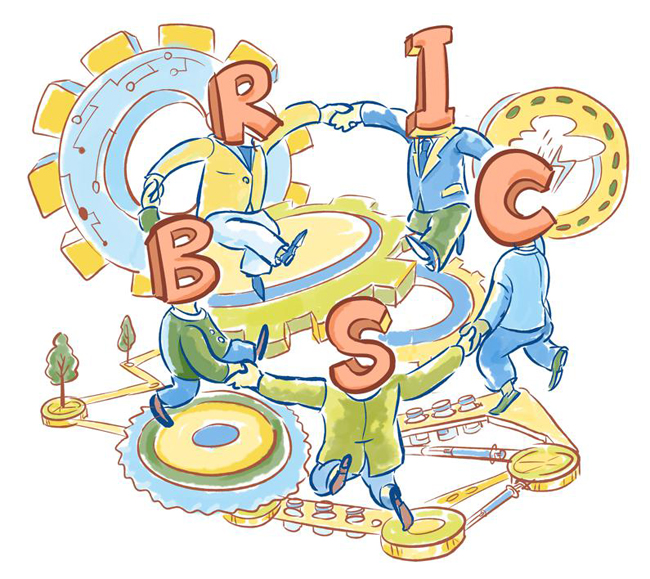
In a COVID-wake world of black-swan uncertainties, fluid complexities in power transitions and shifts, and definitive repurposing of global governance compacts, around strategic development portfolios steeped in sustainable and resilient socio-economics, the BRICS, grouping Brazil, Russia, India, China and South Africa, beholds possibilities to condition and showcase alternative trajectories of stakeholder-centric growth models and development paradigms despite its innate limitations.
The pandemic-era supply-chain disruptions and volatile commodity markets induced cascading recession in the West. Structural stagflation, green-shoots precipitating debt and poverty alleviation stresses upon macro-economic stability, and unprecedented bare-knuckled Russia-Ukraine conflict, have challenged BRICS to transcend its summitry, and emerge as a veritable participative, actionable-actor, systemic-influencer, and institution-builder.
The salutary nature of the constellation presents it as a platform for cooperative dialogue and information-sharing deliberation, it being home to the world's second largest economy in China, the premier developing economy in India, a major military power and commodities behemoth in Russia, and continental powerhouses in the form of Brazil and South Africa, respectively.
Upon conclusion of the 14th summit meetings under Chinese stewardship on June 22-24, there is much that BRICS could potentially accomplish, in consonance with China's enjoined vision of a high growth compact to usher in a new epoch for global development.
As the three biggies Russia, India and China produce their vaccines, all eyes would be on the nascent BRICS Vaccine R&D Centre launched in 2021, with South Africa voicing contingency for equitable vaccine access for the continents.
In times of spiking commodity prices, commodity verdant BRICS nations ought to be fostering intra-grouping price stabilisation measures, both for within and aimed at ameliorating the distress of fragile low income economies, in the extant.
Similarly, as the phenomenon of vengeance travel has caught-on amongst middle-class swathes across BRICS countries, a tourism realm agreement, intended at revivalism of a sector that's both employment procreator and revenue generator, is in order.
India with its qualitative juxtaposition to China is pivotal for forging and underwriting consensus and fostering tangible consolidation across focus area initiatives, from multilateral developmental lending through the BRICS Development Bank (NDB), the liquidity disbursement mechanism of the Contingency Reserve Arrangement (CRA), or in the epochal consideration of expansion of the BRICS fold or purported BRICS-Plus framework.
As the BRICS's NDB gears up for both green-financing and transition-financing models in project-lending, the focus on fiscal-resource injection during an erratic macroeconomic milieu, must atone for a COVID no-show.
For BRICS to enable itself in proclaiming as an iconic actor on the global stage, it has to transcend its identity crisis, whether as a loose-skein emerging economies forum subject to cyclical vagaries in their fortunes; or merely an assemblage of nations, litigating individual grievances in anti-thesis to the Western neo-liberal geo-economic institutional order; or a vanguard developing countries collective, articulating existential issues of the 'Global South".
To lift their operative threshold above a low common denominator in the new era, BRICS economies can harmonize and integrate national systems, nurture best practices in collaboration, and build trust through tangible action in materially significant domains of bridging the digital divide and technological innovation, energy security leading to energy independence, water-stress dynamics, robust food-systems, securitization over critical health and wellness ecosystems, and the ilk.
The author is assistant professor at School of International and Area Studies of Goa University, India.





