



Scientist sees great advances in sci-tech









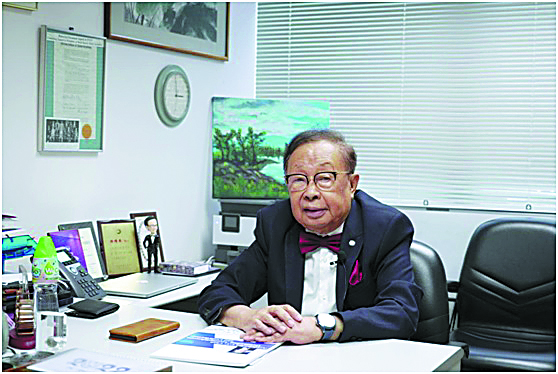
When I turned 80, I did something I had in mind for a long time. I wrote a letter to President Xi Jinping. It wasn't on a whim. I had my reasons and it has been my mission and responsibility to call for action to address the lack of attention to Hong Kong's sci-tech development.
As a scientist, I don't consider myself old enough to retire. Science is a never-ending quest for me, to continue exploring the laws of nature in the hope of benefiting humankind. That's why I wrote to Xi to draw his attention to Hong Kong's scientific development.
I was born in Indonesia and returned to China in 1953. As a Chinese person living in Indonesia, I felt constant insecurity without a strong motherland. China, once a powerful country but weak in sci-tech development, was being bullied.
Technology is what's needed if Hong Kong is to punch above its weight, transforming itself into a brand-new "Pearl of the Orient "and an international metropolis that's attractive to all.
As a Chinese person, I was thrilled when President Xi vowed in 2016 to make the nation a tech powerhouse. I knew then that the time was ripe for Hong Kong to seek greater sci-tech advancement to help with the country's lofty goal.
Technology has been given great attention by generations of State leaders. Be that as it may, national tech funding was still beyond the reach of Hong Kong scientists. I first talked about this when I was a member of the National Committee of the Chinese People's Political Consultative Conference. But the matter remained unresolved as I was told it would involve many departments.
The letter I wrote to Xi was a game-changer. It was a milestone in Hong Kong's sci-tech development, both psychologically and materially. It outlined a road map for Hong Kong's scientific-technology development-the SAR must participate fully in national projects and make itself a global innovation and technology hub.
Whether Hong Kong should develop a technological focus has been debated since the handover. When Hong Kong was ruled by the British, there was no need for it to develop technology. But, following the handover, it became a special administrative region-a fundamental transformation. Trade has long been the main component of Hong Kong's economy. The city has deep-water ports, its residents are business experts and it's a major trading, shipping and financial center. It seemed to have no space for technology.
Whenever the city's chief executives planned to develop the technological sector, there were always different voices raised, but when Xi suggested that Hong Kong should become an international hub of innovation and technology, he affirmed the city's critical role in national scientific-technological development. The president's instructions enriched the "one country, two systems" principle and the Basic Law in terms of science and technology.
On top of that, his instructions have helped Hong Kong resolve many of its deep-rooted problems. In line with his instructions, central government departments issued a series of policies that enabled scientists to apply for funding for national scientific projects, and offered tariff cuts for Hong Kong university branches on the mainland for purchasing scientific necessities from overseas.
As far as I know, at least HK$620 million ($79 million) in national scientific funding has been allocated to Hong Kong scientists to support 310 projects.
At the national level, Hong Kong has gained growing attention for its sci-tech ambitions, as shown in the 14th Five-Year Plan (2021-25) which explicitly laid out eight lofty goals for the SAR to become an international center in various sectors, including innovation and technology.
Although I'm now 85, I'm not at the end of my career. I don't want to waste a moment on developing science, like my inspiration Yuan Longping, the "father of hybrid rice", who returned to work on an experimental farm in Hunan province after receiving a national award at the Great Hall of the People.
If I had the chance to write to Xi again, I would tell him that "one country, two systems" is being steadily implemented in Hong Kong and, under his instructions, Hong Kong scientists will fulfill their responsibilities and work to make the SAR a better place.
Chan Ching-chuen spoke with Oasis Hu.


- Diplomats, experts highlight role of skills training ahead of WorldSkills event
- Top court reiterates zero tolerance for child abuse
- Liaocheng hosts 160 athletes at Asian university dragon boat contest
- China to launch activities marking National Science and Technology Workers’ Day
- Study finds once-weekly HIIT burns fat as effectively as three sessions
- Han-Tibetan couple embodies ethnic unity through public service





