



Hungry deer help trim overgrown reeds in park









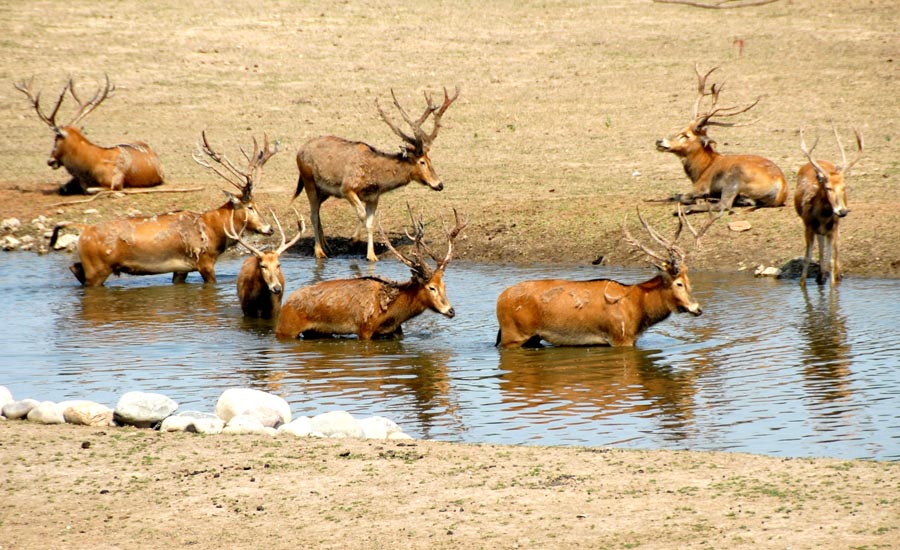
As a city, Beijing's environment and biodiversity have improved in recent years, and now, it has learned to protect its wetlands by bringing in milu, a rare deer native to China, for a feast.
At the 14th Meeting of the Conference of the Contracting Parties (COP14) to the Ramsar Convention on Wetlands, which was held earlier this month, wetland protection came to the attention of the public.
After years of effort, Beijing's wetlands cover 62,100 hectares and provide habitats for up to half its plants and 76 percent of its wild animals, according to data from the Beijing Municipal Forestry and Parks Bureau.
On June 5 last year, World Environment Day, four milu deer from the Nanhaizi Park in the capital's Daxing district were taken to the Yeyahu National Wetland Park in Yanqing district to deal with problems created by some of the plants growing a bit too well.
The deer were important participants in an experimental project of wetland biodiversity conservation.
Since then, they have helped reduce the excess of reeds and other aquatic plants, making space for more animals and plants to thrive.
Meanwhile, eutrophication — a process in which surplus nutrients in a water source cause the dense growth of plant life, often killing other animal species in the process — has been controlled, and a new way to protect wetland biodiversity has been found.
Yeyahu is the biggest wetland in Beijing. The animals and plants in the reserve have been protected well for many years. However, its ecosystem lacked the species capable of controlling the growth of reeds, resulting in their proliferation.
Zhong Zhenyu, a researcher at the ecological experiment center at Nanhaizi Park in Daxing, said that the reeds need to be harvested every year, which encourages growth the following year.
"However, this requires manpower and resources. The autumn and winter harvest can also disrupt the habitats of wintering birds," he said. "If they are not harvested in time, they rot, affecting the water quality and resulting in eutrophication. That leads to a reduction in wetland function."
"Deer are suited to life in wetlands, where they can multiply, helping to improve biodiversity," said Xu Lin, who works at the nature reserve management department in Yanqing district's greening bureau.
"In the past, reeds could grow to a height of 3 to 4 meters, but now they are flattened or eaten by deer," Xu said. "Some lucky visitors might even spot them from a distance."
This summer, Beijing's forestry and parks bureau brought experts from animal institutions and nature reserves to conduct an on-site check. They believe that the introduction of the deer has achieved the expected results in the conservation and improvement of wetland biodiversity and suggested that their numbers can be increased and the trial area expanded.
Yao Yuxin contributed to this story.


- China's State Council sets up team to investigate Shanxi coal mine explosion
- Desert fighter, US friend to reunite soon
- Serbian president meets HBIS chief, backs green steel push in Belgrade
- Chinese-built cruise ship passes sea trials
- Senior Jiangxi official Li Wei investigated for discipline violations
- Guangzhou launches latest affordable housing scheme





