



Insomniacs awaken to new ways to find sleep









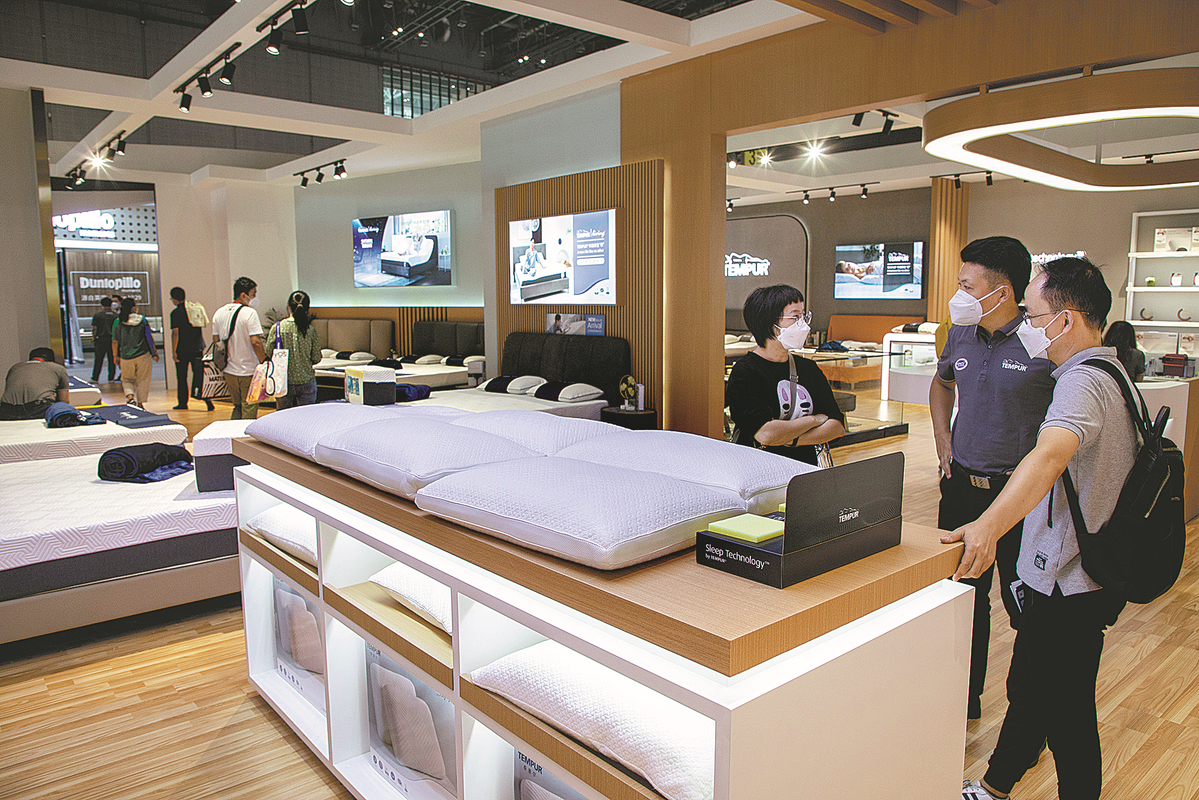
Digital therapy is creating new treatment options for health issues such as insomnia, a malady that is on the rise. With that, businesses are opening their eyes to new opportunities.
Digital therapy, including cognitive behavioral therapy and sound and light stimulation, is designed to help people get better sleep. Cognitive behavioral therapy challenges negative thought patterns to alter unwanted behavioral patterns.
Data from the Chinese Clinical Trial Registry showed that between January and August, 17 clinical tests related to digital therapy for sleep disorders were registered. The number exceeded 14 registered for all of 2021 and 15 registered in 2020.
"Thanks to the surging sleep demand in China, a growing number of digital therapy enterprises have started to step into the sleep disorder sector, and use their products in clinical settings," said Chen Peng, an analyst at VBData.cn, a Chongqing-based healthcare service platform.
Nearly 75 percent of survey respondents indicated they have sleep problems once or twice a week, according to the 2022 White Paper on Healthy Sleep among Chinese, released by the Chinese Sleep Research Society. "Finding it difficult to fall asleep" was the most common issue cited, with 30 percent of the respondents citing the problem.
Last year, a report from market consultancy iMedia Research showed that between 2016 and 2020, China's sleep economy rose from 261.6 billion yuan ($36.8 billion) to 377.9 billion yuan. It is forecast that the market will surpass 1 trillion yuan by 2030.
Business opportunities have become more plentiful for sleep-related enterprises. In June, DeRucci Healthy Sleep Co, which makes products including the T10 AI mattress and is based in Dongguan, Guangdong province, became listed on the Shenzhen Stock Exchange. In August, 8HSleep, based in Chengdu, Sichuan province, a company that markets sleep-related products, was also listed on the exchange.
The stock prices of both companies soared on the first day of their listing. DeRucci rose 44 percent within an hour and hit its daily limit; 8HSleep surged 217 percent on the day of its listing, triggering two temporary stops, and closed up 171 percent at day's end.
Lin Junchao, co-founder of sleep-related digital therapy provider Sumian — a company based in Shenzhen, Guangdong province — said: "With the country's economic development, people are increasingly aware of the importance of sleep, and they are willing to spend more money and time to improve their sleep."
"Specifically, people have learned that some sleeping disorders cannot be resolved by simply changing their bedding or improving the environment. This is when they turn to digital therapy," he said.
Another digital therapy provider Slanhealth in Hangzhou, Zhejiang province, developed a mini program named Softsleep. The mini program is available only on Huawei's smart wristwatch.
The wristwatch collects and analyzes user sleep data, and uploads the data to the mini program. With user permission, the mini program works out personalized, digital and scientific ways for users to improve their sleep.
Sumian joined the Shenzhen Institute of Advanced Technology of the Chinese Academy of Sciences to set up a lab on digital therapy and brain science. The lab worked out a magnetic pulse therapy system in which a pulse field generates, amplifies and modulates electrical signals.
Through energy conversion devices, the system can generate a magnetic pulse of a specific pattern that is designed to stimulate the release of sleep-related hormones, producing sedative and soothing effects, the company said.
Lin said the fast growth of sleep-related products is expected to greatly increase competition. Plus, with consumers becoming more discerning, products based on medical research will sell better and start to dominate the market.
"This will quickly earn the trust of patients, widen the products' distance from other nonmedical products, and help patients make purchasing decisions," he said.
Li Wenyu, CEO of Shanghai-based digital therapy company Sdodt, said: "Products that target sleeping disorders should be based on medical science, as the solutions to sleeping disorders are scientific and precise. We should not encourage products with false and exaggerated claims but instead boost the healthy development of the industry."
Chen from VBData.cn said: "With the introduction of digital therapy, sleeping disorder treatment has changed from a time of trial and error to an era that is personalized, digitalized and refined. Vast business opportunities lie ahead."











