


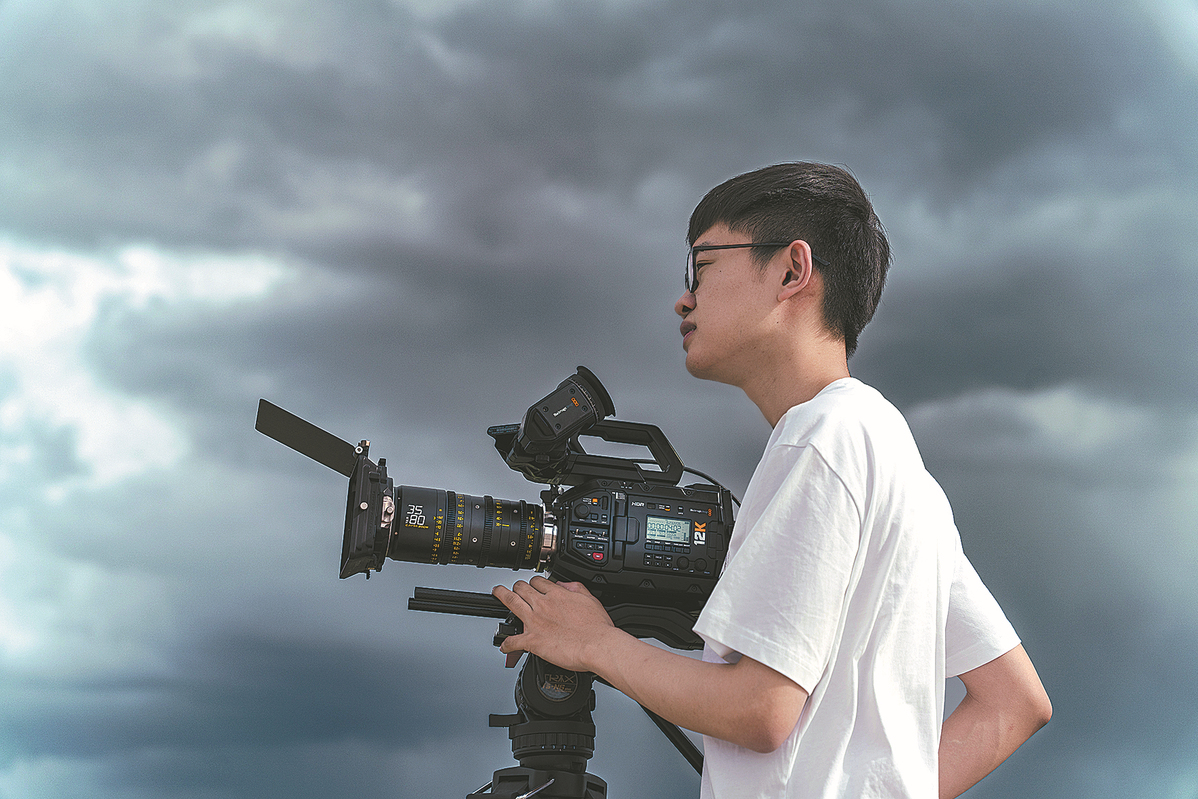
Su usually drives and his partner — more often than not 21-year-old Wang Lucheng, a senior student at the University of Shanghai for Science and Technology — sits next to him navigating.
Wang not only needs to monitor the navigation route, but also check the direction in which the storm is heading at the same time via radar software on his laptop.
Unlike self-driving tourists, who navigate to the parking lot of a scenic spot, Su and his partner pick a random spot in the storm's predicted path, which requires constant adjustment in their navigation and destination while on the road.
"It's like throwing a dart on the map. Sometimes we drive into a field because we don't know what the spot looks like," Su says.
For them, each chase is intense, as the deadline for a certain spot is set, and if they miss it, that's it.
Wang says, "We need to find the best position to ensure that we can measure good data and also capture the storm from a good angle."
Danger is an inevitable element of storms, yet the chasers are far more aware of how to stay safe than normal people.
Wang recalls that, during his first storm chase with Su on Oct 1, 2019, when Typhoon Mitag made its landfall in China, "The rain was so heavy that we decided to stay behind the car to record the rain, but Su's glasses were blown away by the strong wind."
When searching for a position to observe and record the storm, Wang says they avoid mountains, as the heavy rainfall can cause mudslides. Nor will they choose unpaved roads which might result in the car getting stuck easily.
"It can't be too close to the storm, as the core location with heavy rain or hail will be life-threatening, but it can't be too far away either. The best distance is between 5 and 10 kilometers from the storm," he says.
Su says a storm is fast, it usually takes 10 to 20 minutes to pass overhead, but for that, they need to chase one for the whole day before the "encounter".
"I don't think about what time it is or where I am, I just focus on where we are in relation to the storm and calculate how much time we have before it arrives," Su says.
Missing a storm is a regular occurrence, sometimes because their projection is not accurate and sometimes the storm does something that is completely outside the range of forecast.
"Sometimes after a day's chasing, when we are about to reach the area, the storm suddenly disappears, which is frustrating," Su says.
He adds that it's a unique experience. "Each storm has its own temper, so the feeling is fresh. Once you 'catch' it, there's a sense of accomplishment, and you want to chase more."
The data collected during a chase can help with multidisciplinary studies, Su says, which is another reason for him to continue his trips. Some research institutions have contacted him about his data, Su says.
This year, Su took a signal communication device, made at the College of Surveying and Geo-Informatics, Tongji University, to collect data on a typhoon.
"They are studying the impact of extreme weather on positioning accuracy, which can serve information for future autonomous driving and other artificial intelligence applications," Su says, adding that he plans to carry the device on future trips.





