



China to retain pull for MNCs in 2023









China will remain a key go-to destination for multinational corporations in 2023 as the country's massive and lucrative domestic market and its opening-up measures boost business confidence amid subdued global investment sentiment, said business executives on Thursday.
They also said foreign companies operating in China, especially manufacturers, will continue to set up new digitally enabled plants, establish innovation centers and seek to grab more market share in their respective industries, including automotive, consumer goods, green development and high-end manufacturing.
US-based 3M Co has been heading in that direction. It will set up a $2.5 million thermal runaway barrier — TRB — converting production line at its Hefei plant in Anhui province in the first quarter of 2023, aiming to supply more products for new energy vehicle producers in China.
Typically, TRB material is applied in the battery systems of electric vehicles or EVs. It can effectively enhance battery thermal management performance and reduce risk of thermal runaway caused by battery overheating, 3M said.
Mass production in China will enable 3M to respond more quickly to the growing demand in the local EV market, said Tony Shen, global segment leader for ePowertrain of 3M Automotive and Aerospace Solutions, a subsidiary of 3M.
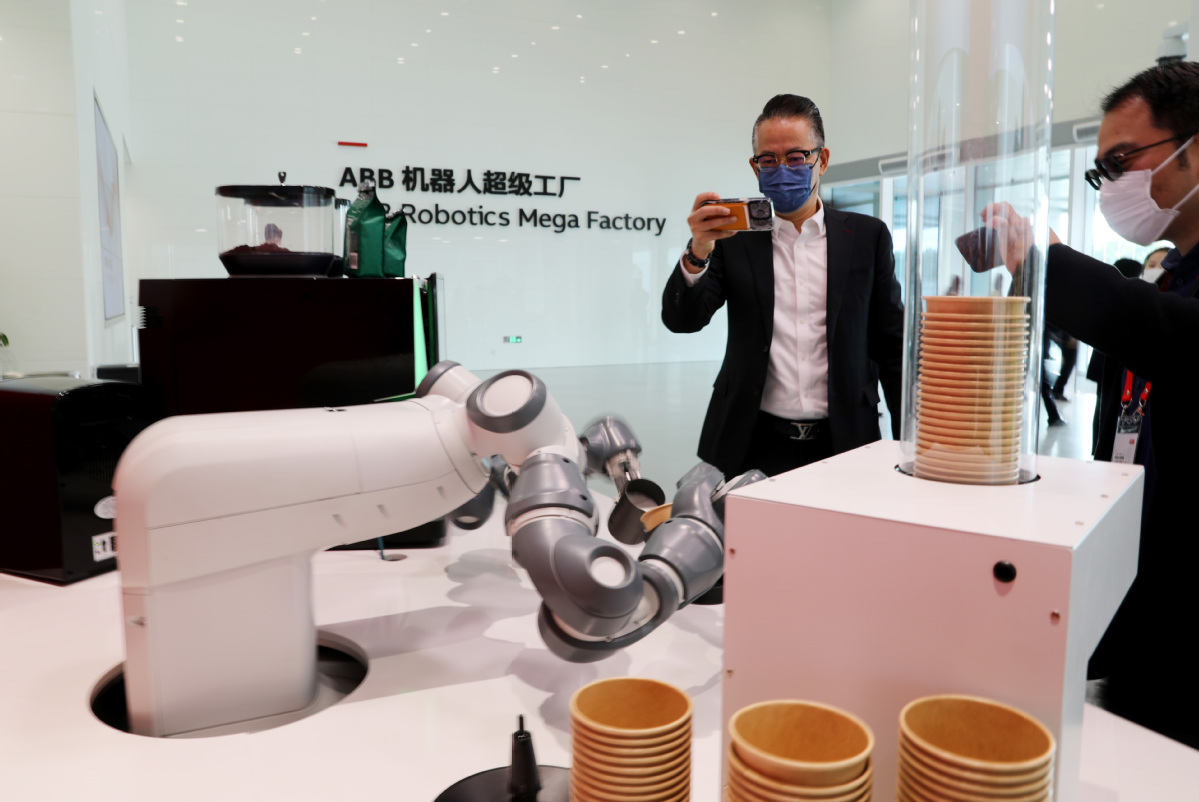
In early December, ABB Group, the Swiss technology company, opened its $150 million mega robotics factory with production and research facilities in Shanghai. It will deploy the company's digital and automation technologies to manufacture next-generation robots, which will be supplied to markets in both China and the Asia-Pacific region, said Marc Segura, president of ABB Robotics, a business unit of ABB Group.
"Apart from providing products and solutions to automakers across China, we see more market opportunities from other emerging sectors, such as electronics, e-commerce logistics, healthcare, pharmaceutical and service robots," he said.
Supported by China's industrial and supply chains, foreign manufacturing companies that use high-tech or low-tech are willing to further expand their market presence in the country, with an eye on long-term prospects. They see strong demand emerging in China and the Asia-Pacific region. Such companies include Germany's Siemens AG and Japan's Panasonic Holdings Corp as well as low-tech businesses from home appliance, garment and toy production sectors, said Gao Lingyun, a researcher at the Institute of World Economics and Politics, which is part of the Chinese Academy of Social Sciences in Beijing.
Although the production costs of foreign companies in China are rising, the country has established an efficient and well-established manufacturing ecosystem to ensure high productivity. The ecosystem also includes well-developed logistics infrastructure such as ports and roads as well as well-trained workers, said Gao.
Concurred Jason Peng, global vice-president and executive president for China unit of Danaher Corp, a US-based conglomerate that designs, manufactures and markets professional, medical, industrial and commercial products and services, mainly in the fields of water, product identification, diagnostics and life sciences. "In addition to enhancing our capabilities for production, sales and innovation, we will invest more to consolidate our industrial chain in China," said Peng.
For instance, Pall Corp, Danaher's microelectronics business unit based in New York, has been accelerating its localization pace in China by setting up innovation and technical support facilities, and expanding its manufacturing capacity of microelectronic filtration products, as well as delivering China-based manufacturing, research and development, and applications.
A plan whose implementation started in 2022 and will continue till 2025 will see Pall harnessing the power of China's supply chain, employing local talent and investing 70 million yuan ($10.05 million) to further expand its semiconductor product portfolio and the capacity of its plant in Beijing. This will help better serve its customers in both China and the Asia-Pacific region.
The actual use of foreign direct investment in China expanded 9.9 percent year-on-year to 1.16 trillion yuan during the January-November period, data from the Ministry of Commerce showed.
zhongnan@chinadailly.com.cn











