


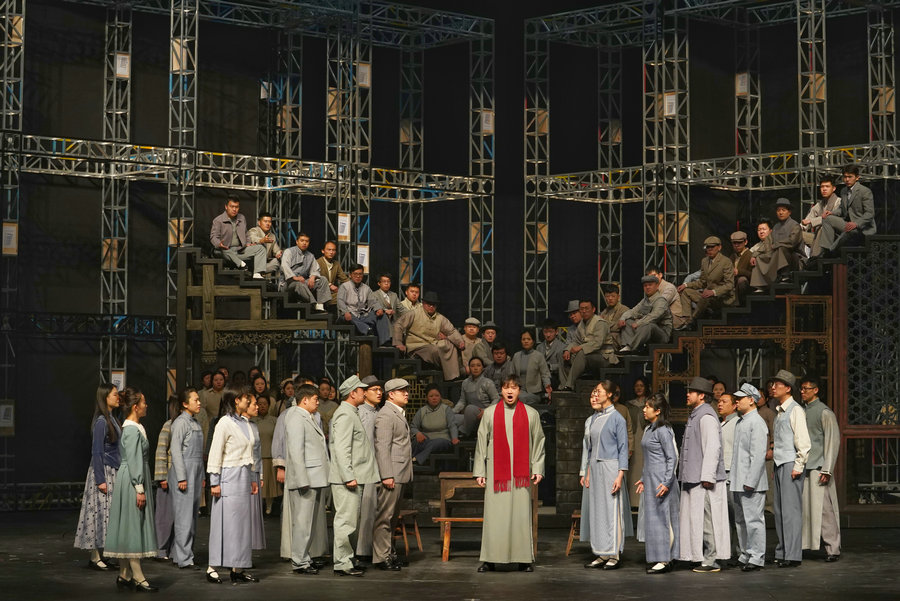
It was 65 years ago that Yang Mo (1914-95) wrote the novel The Song of Youth, which has become a widely acclaimed "red classic" in the annals of contemporary Chinese literature.
Red classics, a genre of plays, ballets and other artistic productions that showcase revolutionary culture and heroes, constitutes an important part of Chinese art in the 20th century.
The Song of Youth is one of the representatives of the genre, telling the story of a group of Chinese university students whose lives are forever changed by the Japanese invasion of their homeland, chronicling their transformation from idealistic student protesters to battle-hardened revolutionaries.
The work, based on the author's own life experience and the biographical details of many of her comrades, echoes the lives of a generation that suffered great tragedy and displayed remarkable heroism, and along with others like it, has achieved lasting success.
From Thursday to May 1, the National Centre for the Performing Arts will bring an opera adaptation of the work to the live stage.
The work will premiere at the 2023 National Centre for the Performing Arts Opera Festival. According to Zhao Tiechun, vice-president of the NCPA, the production is their 100th, and once again gathers together the theater's strong production team, which has prepared for years for the launch.
The novel portrays the historical turmoil of the 1930s through the intellectual and political metamorphosis of a young woman named Lin Daojing.
Despite coming from a wealthy landlord family, Lin refuses to accept her destiny as a tool of her family's interests, escaping a forced marriage to a high government official. As she struggles to control her own fate, she faces a series of setbacks, including expulsion from her teaching position and difficulty finding a career.
The story is, at its core, a romance. Lin's life course is profoundly influenced by the men she meets, including Yu Yongze, who saves her from suicide after her life hits rock bottom; Lu Jiachuan, a dashing student revolutionary who introduces her to socialist struggles; and Jiang Hua, a member of the Communist Party of China who urges her to devote her life to the revolutionary cause.
Throughout, the author weaves the beauty of love with the imperative of solving the enormous challenges faced by the country in the'30s, placing heartfelt moments against a grand backdrop.
In 1959, The Song of Youth was adapted to a film, introducing Lin to the silver screen and making the actress who played her, Xie Fang, a household name.
"From literature to film, The Song of Youth depicts the complex journey of intellectuals who embrace the revolutionary path and become proletarian soldiers. This is a true reflection of the awakening of countless young people throughout the Party's century-long history," Zhao says.
The opera was completed by composer Zhang Qianyi, scriptwriter Zhao Daming, and director Wang Xiaoying. The first round of performances will be conducted by Lyu Jia, the musical and artistic director of the NCPA.
"The composer created distinct musical images around the theme of youth, expressing the passion and fighting spirit of educated youth in the revolutionary tide, and brought new explorations to the creation of Chinese lyric opera," Zhao Tiechun says, adding that both the composer and the writer of the opera preserved the essence of the original work while leveraging the charm and advantages of the opera form.
Zhang explains that the overall musical style of the opera is influenced by late romanticism, and since the story takes place in the 1930s, the audience can feel the cultural atmosphere of that era when listening to the music.
"Youth is the core theme of the opera, which covers all major characters," Zhang says. "The most important characteristic of the music in this opera is their youthful portrayal."
In Zhao Daming's opinion, the most touching part of the opera is that "it was a unique moment in history when the country and the Chinese nation were undergoing turbulent changes and facing life and death struggles."
He says that, when the original novel was adapted to film in 1959, it embodied many of the key ideas and historical principles of that era. In his adaptation, he has tried to add to the understanding of this episode of history from the present-day perspective.
Wang, the director, will reunite with his dance and stage design partner Liu Kedong, as well as lighting designer Xing Xin, multimedia designer Hu Tianji, and other team members to produce a luxurious product.
The stage presentation adheres to a romantic style in its music, while using a modern, open and flexible stage space to showcase the characters' ideological conflicts, emotional entanglements and life choices.
According to Wang, The Song of Youth portrays the ways in which young people think, make decisions and grow, and he is designing a modern, youthful stage to bring this story to life.
Lin's life decisions were rooted not only in emotional shifts, but a reevaluation of her values, Wang says. Her first partner, Yu, helped her break away from a constricting marriage and family life, while Lu, by contrast, was animated by a sense of national duty.
"This story not only exemplifies varying levels of magnanimity, mindset and perspective, but also reflects different interpretations of meaning, choices of values and sense of responsibility," Wang says.

Singers Song Yuanming and Zhao Lili have both been entrusted with the pivotal role of Lin, the heroine of this inspiring opera. As they take to the stage, they are joined by the talented opera performers, chorus and orchestra of the NCPA, all of whom come together to infuse the performance with a youthful vigor and a spirit of awakening.
In rehearsals, Song has faced the challenge of bringing Lin's thought transformation to life. She recalls that when growing up, her mother often talked about Lin's story with her, which has helped her understand the role she is now playing.
"We aim to fully embody this character and perform with genuine emotion, bringing the scenes from that time period to life through singing and opera," Song says.





