



Toward lifelong skills development for decent work









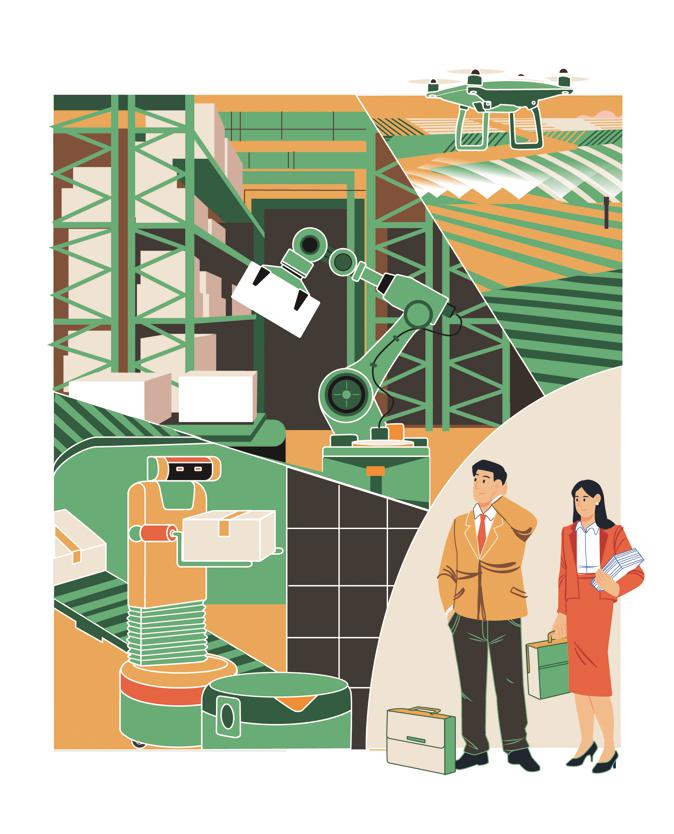
Jobs are central to our lives. They enable us to make a living. Productive jobs create wealth and drive development. Full employment ensures not only economic prosperity but also social cohesion and stability. That is why the International Labour Organization, as one of the UN agencies specialized in employment, promotes decent work as a key to sustainable development and social justice.
Globally, the world of work is undergoing profound changes unseen in a century, impacted by climate change, rapid technological transformation and demographic changes. We often hear that many people can't find jobs, while employers can't find qualified employees. Even those who have jobs are worried about the future of their jobs.
Such anxiety is not misplaced. The ILO's World Employment and Social Outlook 2020 report shows that all regions are facing major job-skills gaps and mismatches. According to a study, a generation ago the skills you learned in school were sufficient for you to survive in the job market for a while. Now half of the skills you acquired through education and training may start to depreciate within 5 years! (Boston Consulting Group, 2023) Skills become obsolete much quicker, as technological transformation and the green transition are accelerating.
ChatGPT is a case in point. Artificial intelligence has the potential to replace many professional and even creative jobs. The potential threat is no longer limited to replacing unskilled repetitive jobs by automation. Technologies are fundamentally reshaping workplaces and jobs.
The green transition is another driver for growing skill-job mismatch. The automobile industry may continue to thrive, but electronic cars require a different set of human skills from fossil fuel-driven cars. Jobs in high carbon emission sectors will gradually disappear, while alternative jobs are greened or created in green sectors. According to an ILO analysis, because of the green transition, there could be around 78 million job losses globally by 2030. However, over 103 million jobs can be created — but only if workers can be systematically reskilled and upskilled. (ILO, 2019)
China is at the forefront of technological transformation and green transition. It makes labour market adjustments urgent and critical. According to a study by McKinsey Global Institute (2020), by 2030 up to 30 percent of the workforce in China might have to change jobs due to technological changes if they are to remain in productive employment.
Unfortunately, according to the 9th Survey of Chinese Workers in 2022, 29.3 percent of industrial workers hold technical professional qualifications. It is worrying. But there is hope. According to the same survey, 95.3 percent of workers show willingness to skill and upskill themselves. (All-China Federation of Trade Unions, 2023).
And the government is taking initiatives. Since 2018, building a lifelong vocational training system has been a national policy priority. Last year, the revised National Vocational Education Law took effect, providing a sound legal foundation to encourage and support lifelong skills development for all. The 14th National Five-Year Plan of Vocational Training aims to help workers in all walks of life to upskill themselves.
It is the right policy for a better future. A universal entitlement to lifelong learning will enable people to skill, upskill and reskill themselves, as all workers may have to go through frequent job changes in their lifetime.
And China has a great scheme in this respect, the Credit Banks, which is being piloted in cities and industries. Workers and citizens can open accounts at these banks that are linked to various training resources. If you complete a training course, scores will be deposited in your account to be used to apply for skills qualifications. Employers linked to this system can easily identify future employees with the right set of skills. This is a very innovative system for lifelong skills development. Collaborations among the government, employers, technical and vocational education and training providers will ensure in-time delivery of tailored training.
So, which core skills would workers need to be able to constantly adapt to the ever-changing world of work? Whatever specific occupation you may have, there are four core skills which would enable workers to adapt to the changing requirements. According to the ILO, social and emotional skills, cognitive and metacognitive skills, digital skills and skills for green jobs are four categories of core skills for life and work in the 21st century. They should be integrated into all vocational training curricula with national policy support.
The ILO promotes, together with the Chinese government, lifelong skills development for workers' employability and quality employment. The ILO has worked with the Chinese government for the modernization of the skills development system, including quality apprenticeship and core skills. China is at the forefront of technological transformation and green transition. I am sure China will be at the forefront of lifelong skill development and decent work.
The author is country director of International Labour Organization in China and Mongolia.
The views don't necessarily represent those of China Daily.
If you have a specific expertise, or would like to share your thought about our stories, then send us your writings at opinion@chinadaily.com.cn, and comment@chinadaily.com.cn.





