



Shenzhen's economic miracle fueled by innovation, talent









Former fishing village's GDP ranks third in nation backed by biz environment
SHENZHEN — Once a small fishing village, Shenzhen, in South China's Guangdong province, is now a mega city, having spent more than four decades growing at full speed.
As the first special economic zone and tech hub of the world's second-largest economy, Shenzhen's GDP totaled 3.2 trillion yuan ($446 billion) in 2022, the third highest in China after Shanghai and Beijing.
How was this metropolitan miracle created? The answer lies in ceaseless innovation and highly competent talent.
Innovation-based success
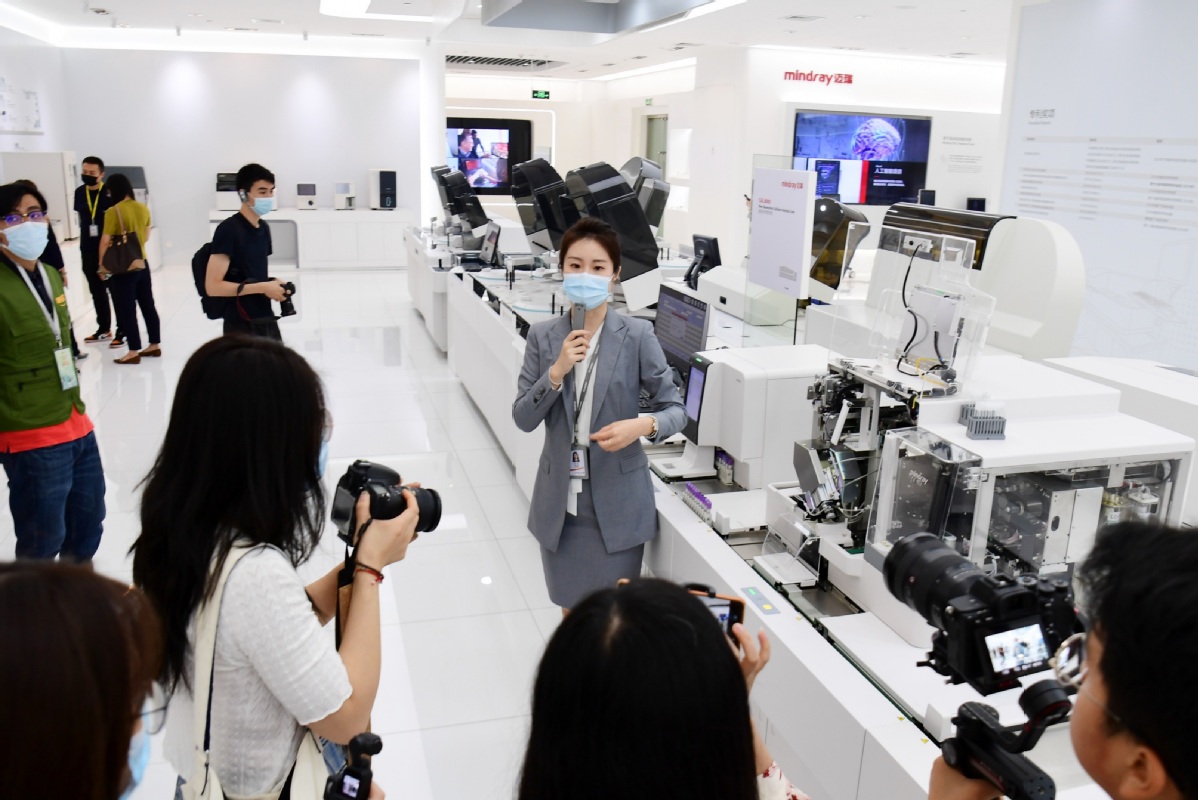
Over three decades, Mindray Bio-medical Electronics Co Ltd grew from an agent for imported medical devices into China's biggest medical solutions provider. During this period, it developed cutting-edge technologies while boosting its core competitiveness and developing its brand.
Mindray takes up a considerable share of the international market with its self-developed products, such as monitors, anesthesia machines and ventilators. The company's direct-sales products have entered a large number of hospitals in the United States.
With an annual revenue of over 30 billion yuan, Mindray puts over 10 percent of its revenue into innovation and research, which takes the company's business performance to a higher level. In the first quarter of 2023, Mindray saw both revenue and net profit increase by more than 20 percent year-on-year.
"A great market nurtures good enterprises," Mindray's founder Li Xiting said, attributing the company's success to the solid innovation-based research and development of products and services to meet the ever-changing market demand.
The local government also plays an indispensable role, Li added, noting the policy and capital support Mindray received in the early stages, as well as the current favorable innovation atmosphere, industrial ecology and business environment in Shenzhen.
Improving the business environment is one of the priorities of Shenzhen's government work. In recent years, it has strengthened legislation to tackle dishonest business practices and unfair competition, while utilizing AI to reduce administrative intervention and establishing pilot projects to better protect intellectual property.
During a recent visit to Guangzhou and Shenzhen, Vice-Premier Zhang Guoqing stressed that independent innovation is an inherent requirement for building a powerful manufacturing nation and achieving high-quality development, adding that enterprises should take more responsibility for attaining dominance in innovation.
Zhang said that enterprises should focus on the primary strategic needs of the country and build a modern industrial system, keep an eye on industrial development and technological changes, strengthen basic research and continuously optimize the environment for independent innovation.
Young, competitive talent
Shenzhen has continued to ramp up efforts to foster innovation to advance technological development, including setting up research alliances encompassing leading universities and research institutes.
The Shenzhen Institute of Advanced Technology was co-founded by the Chinese Academy of Sciences, the Shenzhen government and the Chinese University of Hong Kong. It specializes in research in health care, robots, new energy and materials, big data and smart cities.
The average age of SIAT's 3,219 personnel is 33, while the annual turnover rate stands at 15 percent, ensuring high-level competence and a competitive mechanism.
As a result, SIAT has jointly established 230 laboratories with enterprises, while 1,582 businesses have been incubated. Altogether 27.5 percent of scientific and technological achievements have been converted into practical use.
Huang Shuqiang, SIAT's human resources director, said that the institute adopts a system of competition for funding. Meanwhile, the institute's coordination with enterprises boosts healthy market-driven competition.
The relatively high conversion rate is supported by SIAT's innovation and the government's industrial policies, said Fu Xiongfei, SIAT's deputy director.
He explained that Shenzhen has mapped out a new model for startup businesses, namely "upstairs-downstairs", which means accommodating industrial research and incubation inside one complex, making for more efficient innovation and talent integration.
Xinhua











