


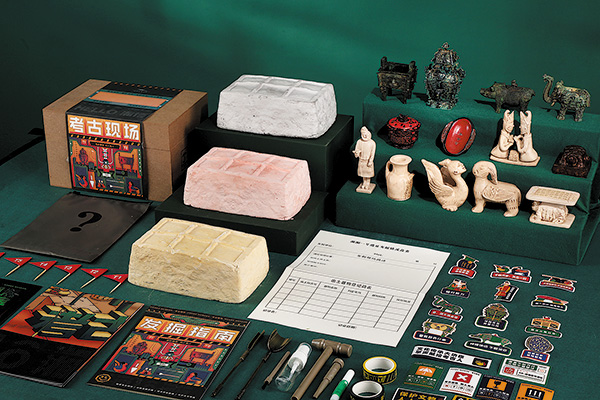
Items inside the boxes designed by Hunan Museum allow people to experience the thrill of excavation.[Photo provided to China Daily]
"We find that they are in pursuit of beautiful products. People's appreciation for aesthetics has greatly improved," says Wan.
Last year, they produced a doll wearing clothes in the Tang Dynasty style and posing like a flying apsaras from the Mogao Grottoes, which house one of the finest Buddhist art collections in China. The exquisite clothes are made using a traditional Chinese technique called qiasi, or wire inlaying, which uses metal wire to weave pattern on clothes or the surface of porcelain.
When they showed the doll at the China Culture Center in Amiens, it received a warm welcome and hundreds of them were sold within a day.
Yang says that more and more museums have mixed intangible cultural heritage with their products to offer added value for consumers.
"I think they are a perfect match. Techniques of intangible cultural heritage demonstrate China's craftsmanship spirit and museum products show history and culture," Yang says, explaining why so many cities currently are adding museum products onto their gift lists. Some have even been listed as national gifts for foreign celebrities.
"Such exquisite products can be seen as a demonstration of our country's culture and image. From this point, cultural relics shoulder the mission to spread Chinese culture," she adds.
Suzhou Museum in Suzhou, Jiangsu province, has long been known for its exquisite products. They have begun applying traditional techniques such as Suzhou embroidery, brocade from the Song Dynasty (960-1279) and kesi, a type of Chinese silk tapestry weaving that used to be enjoyed by royalty, into their products, such as bags, wallets and scarfs.
"These products are often priced at hundreds or thousands of yuan, a little bit expensive because we have to hire craftsmen to make them. But the price never influences their popularity among young people," says Jiang Han, head of the cultural products department of Suzhou Museum.
The sales of cultural products at Suzhou Museum are doing well in the industry in China, ranking third after the Palace Museum and the British Museum, says Jiang.





