Zhejiang practice shows goal of treating rural sewage achievable









Editor's note: Many rural water utilities have inadequate water and wastewater treatment facilities, and therefore are exploring ways to overcome the challenges of sewage treatment. Fortunately, a number of innovative solutions are available for the purpose, writes a veteran journalist with China Daily.
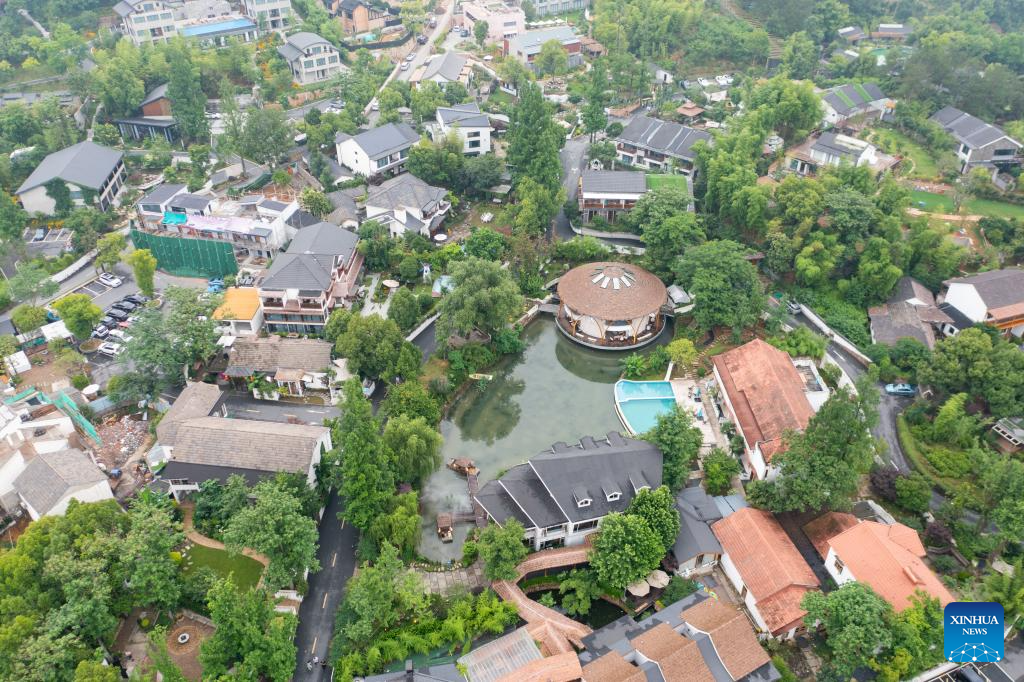
Having lifted millions of farmers out of absolute poverty by the end of 2020, the central authorities have set a new rural development goal: improving living conditions in villages and making them more beautiful.
There are half a dozen criteria to assess whether a village has met the new standards including overall planning, development level, range of public services, and the environmental and ecological condition.
However, many village heads soon realized that it's the improvement of the environment which demands most of their time, energy and funds.
For thousands of years, villagers have been dumping excreta in open-air cesspits to turn it into natural fertilizer used in farming. As for household wastewater, villagers either pour it into sewers or pits, or just allow it to flow into streams nearby. And in terms of garbage, they dispose of it anywhere outside their yard.
Such habits are not conducive to improving the living conditions or making villages beautiful. That's why village heads are trying to persuade the villagers to abandon them.
In better-off provinces on the eastern coast, garbages from villages are collected and separated before being transported to waste treatment plants or landfills built with funds from governments at different levels. And villagers are being encouraged to build or install biogas digesters to turn both human and animal excreta into biogas.
Biogas digesters not only seal off the stink from the excreta but also produce biogas which can be used for cooking and heating. And to encourage households to build or install such digesters, local governments provide each household with subsidy ranging from 800 yuan ($110.46) to 2,000 yuan which more or less covers the cost of a digester.
The treatment of wastewater, however, has proved to be the most challenging task that rural officials face. After decades of hard work, the authorities announced last year that China had realized its target of providing safe and clean drinking water for all its 600 million rural people. In fact, 85 percent of China's rural residents are now using tap water.
The availability of tap water, while making life more convenient for villagers, has also increased water consumption in rural areas. As a result, the volume of wastewater has also increased.
The fact that villages usually have few households and are scattered across large areas makes it less economical to collect wastewater in rural areas compared with urban areas. And although the authorities see to it that at least one sewage treatment plant is in operation in each town, more often than not, such plants treat sewage produced only in the town or from nearby villages.
Despite the fact that there are about 14,000 sewage treatment plants in rural areas, only about 45 percent of rural sewage is treated compared with nearly 98 percent in cities. To connect all the villages with sewer networks is not economical, and even if the local governments are ready to pay the bill, it would take a long time.
Realizing the huge market potential, research institutions and enterprises are providing alternative solutions. Enter terms such as "rural sewage treatment" in Baidu search and you'll see endless entries advocating sewage treatment equipment and solutions.
And not surprisingly, most of the solution providers are from Zhejiang province, which is a pioneer of the beautiful countryside campaign. According to reports, by the end of last year, the province was treating nearly 85 percent of rural sewage — which is close to the national target of treating at least 90 percent of the country's rural sewage by the end of 2045. More important, Zhejiang's experience has convinced us that the seemingly impossible mission of treating rural sewage is actually achievable.
China's target is to treat at least 55 percent of rural sewage by the end of 2025, 60 percent by the end of 2027 and 90 percent by 2045.
While we are confident that better-developed provinces such as Zhejiang will realize the national-level target, special attention should be paid to and sufficient support provided for the less-developed western regions.
For a project like rural sewage treatment, money really matters.

The author is former deputy editor-in-chief of China Daily.
kangbing@chinadaily.com.cn