


The Palace Museum, also known as the Forbidden City, spreads across 720,000 square meters in the heart of Beijing.
Many visitors are stunned by its architectural splendor and numerous collections of former royal artworks, which light up its centuries-old galleries.
However, most people who pass through its portals probably don't realize that the former imperial palace is also home to a trove of written treasures.
Housed behind closed doors, covered in dust, they have been closely scrutinized by researchers, but time has also taken its toll on these historical tomes.
According to statistics of the Palace Museum, about 600,000 ancient books, documents and related printing woodblocks are in its inventory, accounting for nearly a third of the total number of cultural relics in the museum's collection.
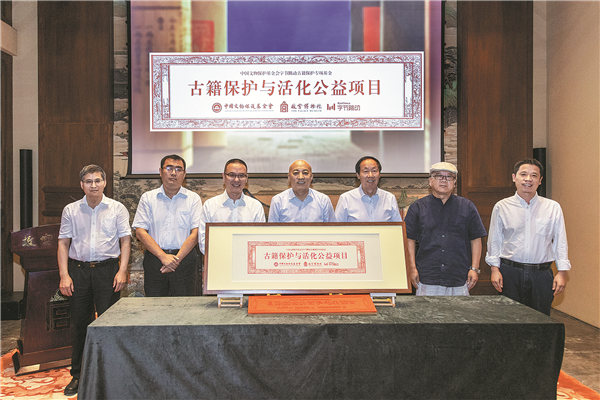
A new charity program was announced on Friday to further revitalize these literary treasures by introducing new technology and encouraging wider participation by the public.
The museum, the China Foundation for Cultural Heritage Conservation and ByteDance, the parent company of short-video platform TikTok, jointly established a fund to better restore, digitalize and exhibit the documents.
"The myriad ancient documents are a unique psychological touchstone of our nation," Wang Xudong, director of the Palace Museum, said at the program's launch ceremony, held at the museum on Friday. "They compose a root of Chinese culture.
"Generations of conservators have been devoted to safeguarding them. We want to explore more creative ways to better protect and inherit such fine Chinese culture and bring the ancient books to life."
According to Ren Wanping, deputy director of the museum, the pillar collection of ancient books and documents held at the museum includes manuscripts and volumes of printed records from the imperial household departments during the Ming (1368-1644) and Qing (1644-1911) dynasties, Buddhist sutras, including those copied by emperors and high officials, scripts for traditional opera performances, and key historical files.
"They're indispensable references for the study of Chinese textual and imperial history," Ren explains.
In 1729, a royal printing house was established in Wuying Dian, or the Hall of Martial Valor, within the Forbidden City, which yielded a rich reservoir of ancient books.
"We've collected these royal books, whole sets of the original printing woodblocks and historical files recording the printing process," Quan Lu, deputy director of the Palace Museum Library, says. "It's rare for an institution to have them all. As such, we are able to study, compare and verify various editions."
Thanks to the new cooperative program, which will last three years, a joint laboratory will be set up in the Palace Museum introducing a high-tech approach to the conservation of ancient books.
In the first year of the cooperation, the digitalized projects will also benefit Qinding Gongzhong Xianxing Zeli ("the current imperial regulations in the palace") and the Buddhist classic Tripitaka.
Qinding Gongzhong Xianxing Zeli refers to dozens of editions listing the regulations for the royal palace throughout the Qing Dynasty, including manuscripts and printed versions. Ji Zhangwei, a researcher at the Palace Museum Library, explains that they offer key clues to the law and imperial politics of the time, as well as offering a history of printing.
A thematic exhibition will also be organized to showcase relevant documents and their printing blocks to the public.
"Only when more enterprises, organizations and individuals participate in ancient book protection, can the culture they hold be better understood and more widely utilized," says Liu Yuzhu, head of the China Foundation for Cultural Heritage Conservation.
In the past few years, the foundation has cooperated with ByteDance in sponsoring restoration, revitalization and raising the public profile of ancient books alongside Peking University and the National Library of China. Since 2021, 107 restorers of ancient texts have attended training sessions within the framework of the joint fund.





