


Nation sets impressive pace on AI applications










Market opportunity
A report released by the Institute of Scientific and Technical Information of China said that as of May, the nation had developed at least 79 AI LLMs.
Other Chinese tech giants such as Baidu, Tencent Holdings, SenseTime and JD have been busy rolling out their own AI models in recent months.
Robin Li, co-founder and CEO of Baidu, said: "Generative AI and large language models hold immense transformative power in numerous industries, presenting a significant market opportunity for us. To stay ahead of the game, we keep upgrading our models to generate more creative responses while improving training throughput and lowering inference costs."
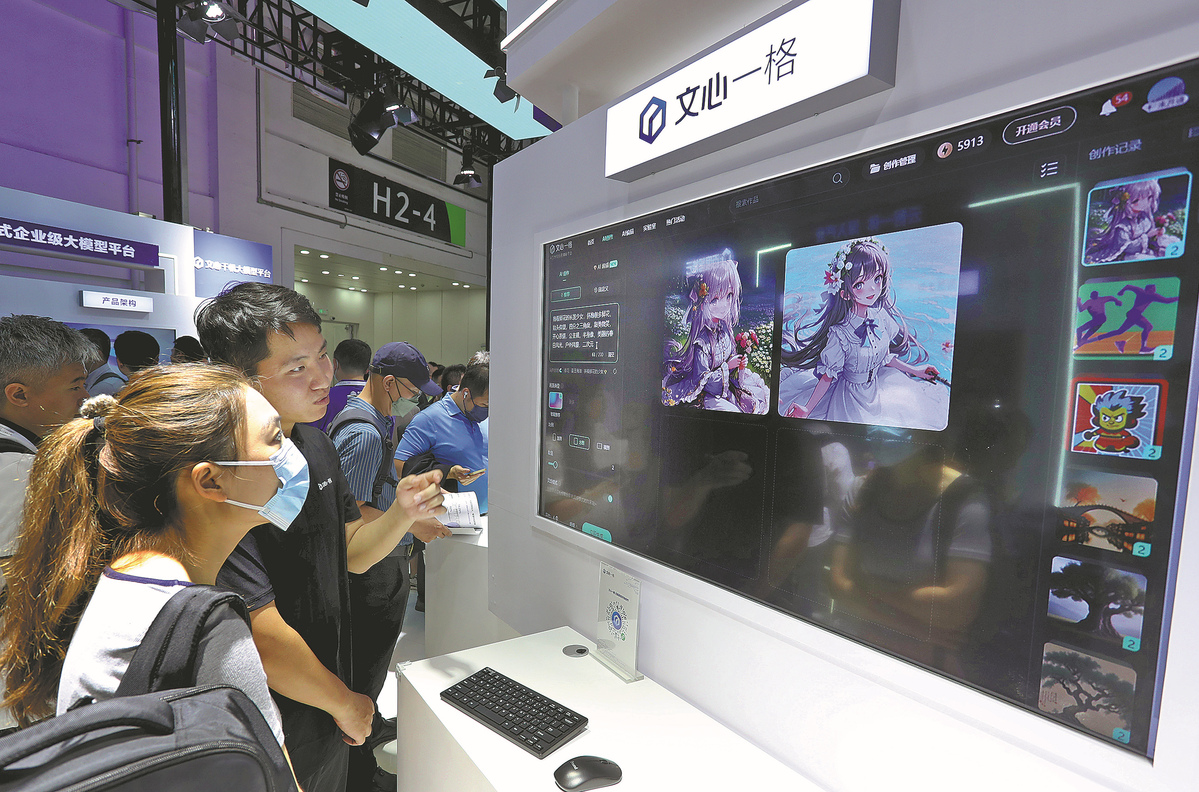
Li said Baidu will further intensify its generative AI efforts, and plans to roll out the latest version of its LLM, Ernie 4.0, by the end of this year. The company, which unveiled its Ernie 3.5 LLM in the second quarter of the year, has been embedding the Ernie AI model into its products, including search engines, Baidu Maps, and online marketing business.
Baidu is committed to building new growth momentum for generative AI and LLMs to drive sustainable long-term development, Li said. He emphasized that the company is working hard to build Ernie-powered applications and solutions for different industries and scenarios, and empower more enterprises to create industry-specific AI models and applications.
Last month, Chinese authorities issued a 24-point guideline for managing generative AI services. The nation encourages the innovative development of generative AI, and supervises the technology using methods compatible with innovation and development.
Interim measures support use of the technology in various fields to produce positive and high-quality content, and encourage the independent innovation of basic technologies, including generative AI algorithms, frameworks, chips and software platforms.
Li said, "The Chinese government has been increasingly supportive of the development of generative AI and LLMs," adding he is quite optimistic about the future of the regulatory environment in China, as the latest AI rules are "more pro-innovation than regulation".
Zhang Yaqin, dean of Tsinghua University's Institute for AI Industry Research, said although ChatGPT was not developed in China, about 100 Chinese companies have entered the generative AI field over the past six months. Some have rolled out LLMs, while others are developing industry-specific models covering fields such as biological computing and education, Zhang said.
"China has been doing some terrific work in basic research, algorithms and industrial application of AI models, and generative AI has brought about disruptive changes to the entire industry," Zhang added.
Pan Helin, co-director of the Digital Economy and Financial Innovation Research Center at Zhejiang University's International Business School, said, "China has gained an upper hand in bolstering the industrial application of AI compared with its foreign counterparts, given that the country boasts relatively complete industrial categories, an ultra-large consumer market and a strong development foundation."
Although LLMs have significant potential in fields such as culture, retail, finance, healthcare and education, their real value comes from the consumer market, and the ultimate goal of LLMs in industrial application is to benefit the people, Pan said.
He added that Chinese AI companies should devote more resources to improving computing power, algorithms and data quality, and step up investment in basic scientific research to gain a competitive edge in the global AI chatbot race.
Market consultancy Gartner predicts that by 2025, generative AI will account for 10 percent of all data created, compared with less than 1 percent last year, and it could be used for activities such as creating software code, facilitating drug development, and targeted marketing.
Yu Yi, technology lead for global consultancy Accenture China, said, "As generative AI will have a far-reaching impact, business leaders must act immediately and scale up investments in data, talent and customized AI models to meet enterprises' unique needs."
Most Chinese executives agree that generative AI will trigger significant creativity and innovation, and usher in a new era of enterprise intelligence, Yu added.
China has officially launched the formulation of a national standard for testing LLMs, and the nation's first standardization task force for LLMs was formed during the sixth World Artificial Intelligence Conference, which ended in Shanghai on July 8.
The task force, headed by the Shanghai Artificial Intelligence Innovation Center, consists of six joint team leaders - Baidu, Alibaba Cloud, iFlytek Co, 360 Security Technology, Huawei Cloud and the China Mobile Research Institute.
It will be responsible for drafting LLM standards to promote the combination of LLM technology and standardization practice, and boosting the healthy development of the overall AI industry.





