



Archaeologists uncover rare sheep-drawn carriage in Xi'an









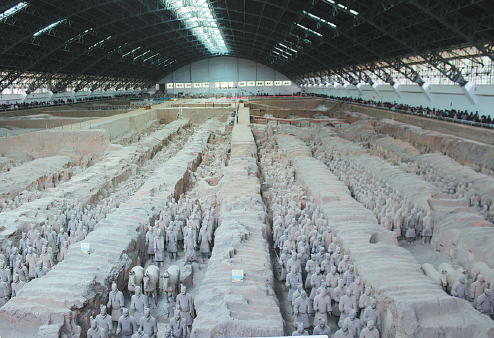
A rare sheep-drawn chariot was excavated at the western tomb of Emperor Qinshihuang's Mausoleum site recently in Xi'an, Shaanxi province, which helps further research on ancient Chinese vehicles.
At the burial pit, six sheep were lined up in a row. Although the body of the chariot has ceased to exist, the accessories used for pulling the chariot were still preserved on the sheep's bones, so archaeologists inferred that it was a sheep-drawn chariot, according to Jiang Wenxiao, who is in charge of the western tomb's archaeological excavations, at the fourth China Archaeological Congress held in the city from Monday to Wednesday.
In ancient China, people often traveled by horse-drawn and ox-drawn carts, so a large number of such relics have been unearthed. The discovery of a sheep-drawn chariot is extremely rare.
Emperor Sima Yan of the Western Jin Dynasty (265-316) rode a sheep-drawn cart every night, and when the cart stopped at a palace he would sleep there, according to a Chinese idiom. It was the first historical record of sheep-drawn chariot.


- China's State Council sets up team to investigate Shanxi coal mine explosion
- Desert fighter, US friend to reunite soon
- Serbian president meets HBIS chief, backs green steel push in Belgrade
- Chinese-built cruise ship passes sea trials
- Senior Jiangxi official Li Wei investigated for discipline violations
- Guangzhou launches latest affordable housing scheme





