



Stabilization fund talk spurs investor sentiment
Volatility in stock market noticed by regulators; more moves in pipeline









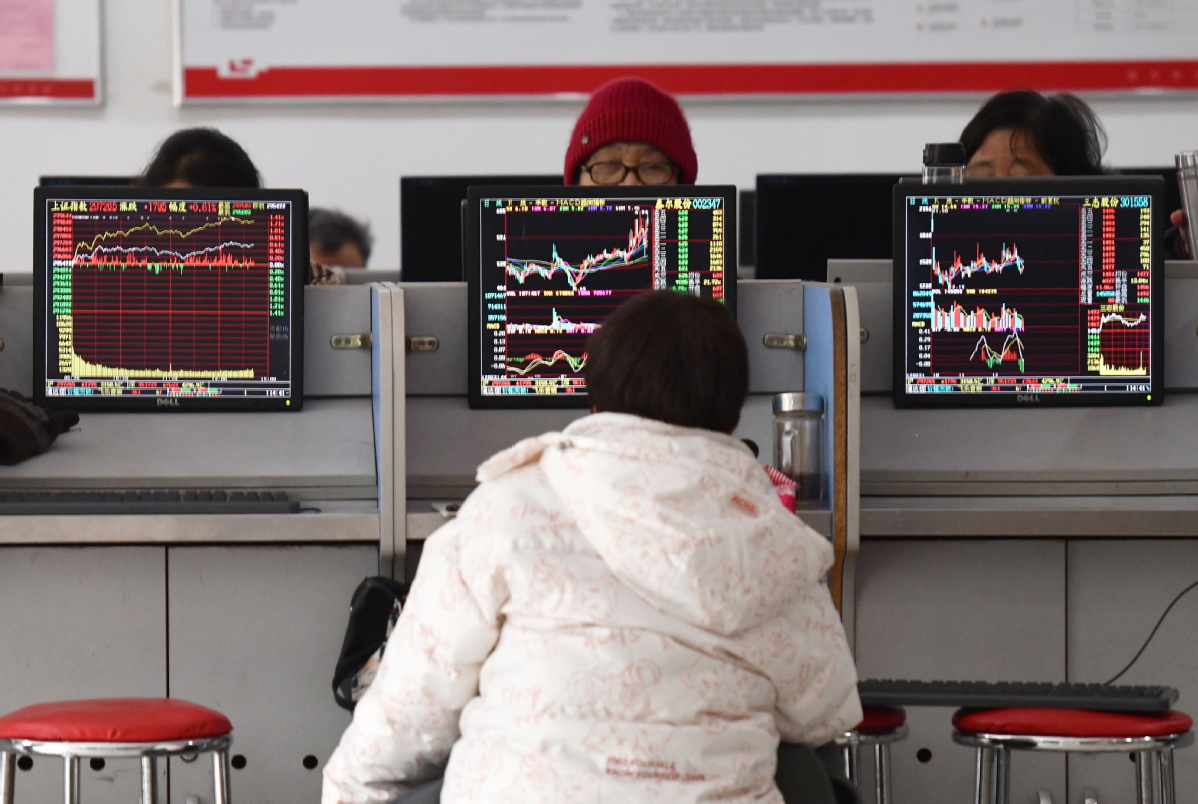
Any market support measures, such as a stabilization fund, on which many investors are pinning hopes, would not only inject liquidity into currently struggling A shares, but also boost overall sentiment, which is crucial for the time being, said industry insiders and experts.
Chinese authorities are seeking to mobilize about 2 trillion yuan ($278 billion), mainly from the offshore accounts of Chinese State-owned enterprises, as part of a stabilization fund to buy A shares via stock connect programs linking the Shanghai, Shenzhen and Hong Kong bourses, Bloomberg reported on Tuesday, citing sources familiar with the matter.
The Bloomberg report came a day after Premier Li Qiang announced during a State Council executive meeting on Monday that the country will roll out more measures to stabilize its stock markets and introduce more long-term capital.
While policymakers have not yet commented on the widely anticipated buffer fund, the benchmark Shanghai Composite Index closed up 1.8 percent on Wednesday to regain its 2,800-point psychological level. Meanwhile, the Shenzhen Component Index rose 1 percent and the tech-heavy ChiNext in Shenzhen closed 0.51 percent higher.
Yang Delong, chief economist at First Seafront Fund, said that powerful policies and large-scale capital inflows are needed for the A-share market at present, as a downtrend has already been established. If the indexes head much lower, some leverage-based capital would be forced to close their positions, further exacerbating the slump.
"Therefore, real money is crucial now to reverse the trend and restore investor confidence," Yang said.
Yang Haiping, a researcher at the Central University of Finance and Economics' Institute of Securities and Futures, agreed that it is necessary to introduce the stabilization fund at present in the market, which is currently overly pessimistic in terms of sentiment.
While the US Federal Reserve will likely maintain high interest rates for a longer-than-expected period, there may be continued capital outflow pressure in China as the country makes more efforts to stabilize economic growth, further lower financing costs and prepare for any possible external financial stress. The stabilization fund will help address these issues, said Yang.
Meanwhile, the ongoing deeper reforms in the Chinese capital market will include strengthened crackdowns on violations of rules and regulations and protecting retail investors' rights. The stabilization fund will serve to safeguard such reforms, he added.
James Wang, head of China strategy at UBS Investment Bank Research, said that A-share investor sentiment is downbeat, with some worrying that market liquidity, rather than China's economic fundamentals, will be the main factor affecting market performance. The anticipated stabilization fund may provide a burst of confidence that is sorely needed at present.
But it should be noted that share price improvements may not take place immediately upon the introduction of the stabilization fund, going by the example of government support provided to the A-share market in 2015, Wang said.
Analysts from Soochow Securities explained that stabilization funds had been used in mature markets such as the United States and Japan when their equity markets had faltered. But certain standards, conditions and appropriate timing are needed for such funds to be effective, including drastic share price declines, irrational capital outflows, less satisfactory results from other stimulative policies and stagnant trading volume levels, they said.
The benchmark SCI has shed nearly 5 percent since the beginning of the year.
But Soochow Securities also stressed that stabilization funds can only serve as a transitional tool. If used for too long, results will be less than optimal, they said.
Bloomberg also reported on Tuesday that State-owned China Securities Finance Corp or Central Huijin Investment — an arm of China's sovereign investment fund — may purchase no less than 300 billion yuan of A shares directly.
Wang Jianjun, vice-chairman of the China Securities Regulatory Commission, said in a news report released on Wednesday that regulators have noticed the higher volatility of the A-share market of late. More efforts will be made to complete the market mechanism, improve public companies' quality, and balance investment and financing to better protect investors' rights and interests.











